
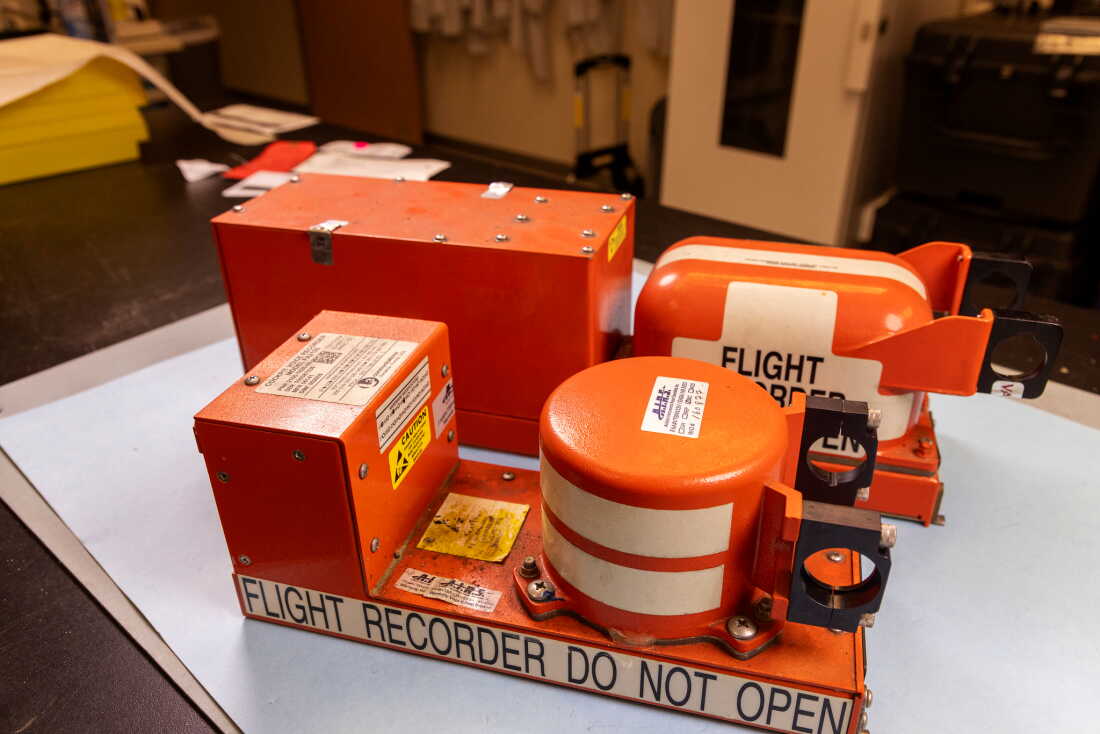
An Amazon cargo jet crashed at Miami International Airport, killing five individuals in a van as the aircraft barreled off a runway on Sunday afternoon. On Tuesday, September 8, 2026, the National Transportation Safety Board (NTSB) released a photo of the flight data recorder, marking a significant step in the ongoing investigation.
Pilot Warnings Ignored
For nearly two minutes, one pilot repeatedly warned about excessive speed during the plane’s approach and after touchdown. The NTSB summary of cockpit voice recordings noted the fellow pilot didn’t respond consistently to these warnings. The plane attempted to take off again briefly before crashing into a van, causing fatalities.
The aircraft skidded roughly 1,300 feet beyond the runway’s end, striking the van transporting employees from a plane cleaning company. It then collided with a compact SUV, crossed a public road, and caught fire. Five victims inside the van died, and five others suffered injuries. As of Tuesday, two individuals remained critically injured.
Opportunity for Corrective Action Missed
Former FAA official Mike O’Donnell emphasized that the pilots had multiple options to slow the airplane during its fast descent. By extending the spoilers, cutting throttles, or lowering the landing gear, they could have mitigated the situation. Additionally, the pilots had sufficient time to abort the landing and circle to attempt a safer approach.
O’Donnell noted the pilots had ample opportunity to initiate a go-around two minutes before touchdown. Several experts across the field supported this view, suggesting the landing should have been aborted while the aircraft was in the air.
Flight Data Analysis Reveals Instability
Data from the flight recorder highlighted the aircraft’s instability amid strong winds as it approached for landing. The landing gear touched down late, severely reducing the available stopping distance on the 9,360-foot runway. Flight-tracking site Flightradar24 estimated the plane was nearly halfway down the runway upon initial contact.
Automated cockpit audio warnings underscored concerns over the descent speed and terrain proximity. These signals suggest possible improper landing configuration and underscore the plane’s erratic movement in adverse conditions.
Cockpit Coordination Questioned
Steve Arroyo, a former airline pilot and safety expert, pointed out notable deficiencies in the pilots’ teamwork. The focus of the controlling pilot seemed directed exclusively toward landing, potentially overshadowing critical speed warnings.
Mary Schiavo, former Inspector General at the Transportation Department, speculated that cockpit dynamics might have been influenced by the hierarchical relationship between a more senior pilot and an inexperienced first officer.
Broader Investigative Factors
NTSB investigators will analyze multiple contributory factors, including the aircraft’s weather conditions, maintenance records, and its operational history. The 32-year-old Boeing 767, initially crafted for passenger transport, was repurposed as a cargo plane in 2015. This flight was operated by 21 Air and has been under Amazon’s logistics since 2024.
The crash marks the second cargo jet accident in the U.S. within a year, following a fatal UPS incident at Louisville’s Muhammad Ali International Airport that resulted in 15 fatalities and 23 injuries.