
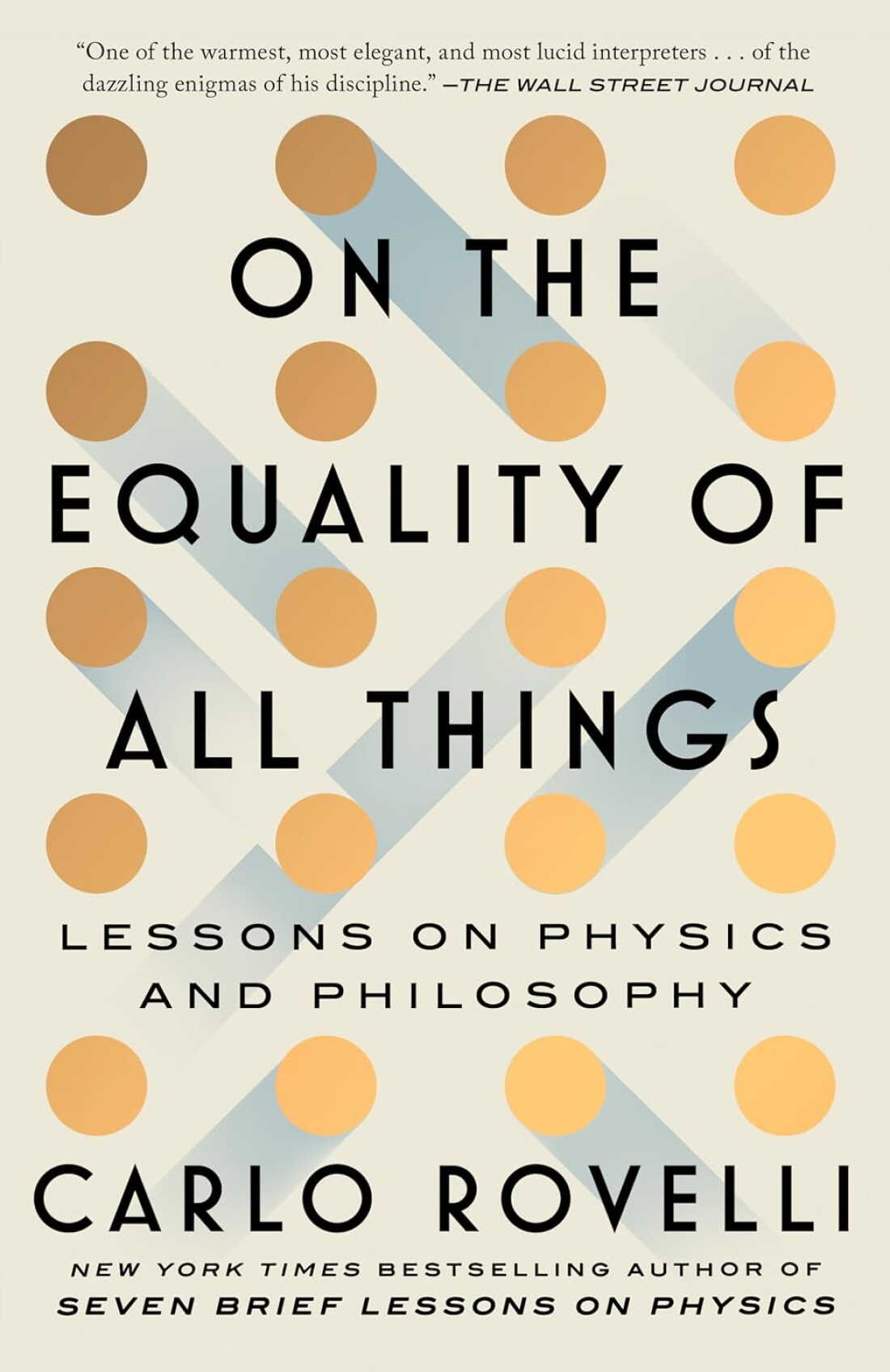
In a world where many physicists dream of achieving perfect, objective knowledge of the universe, Carlo Rovelli offers a different perspective. In his book, ‘On the Equality of All Things,’ Rovelli challenges the notion of a path to ultimate reality. As a leading physicist, his arguments hold weight and prompt reflection.
Rovelli begins with a fundamental point: human experience is limited. We perceive solid objects and fixed locations because we live on a solid planet’s surface. While these perceptions guide us, modern physics reveals them as illusions. Relativity, as established by Albert Einstein, demonstrates that measurements of time and space are relative. Quantum mechanics further reveals that object properties are inseparable from measurement methods.
Rovelli suggests that physics provides not an external ‘God’s-eye view,’ but rather a perspective from within. He delves into the relational interpretation of quantum mechanics. This viewpoint emerged when quantum mechanics surfaced in the early 20th century, challenging the Newtonian belief that physical laws existed independently of human experience. In quantum mechanics, object properties are undefined until measured, as illustrated by Schrodinger’s Cat.
Rovelli criticizes some interpretations that attempt to restore an Ultimate Reality through theories like parallel universes. Instead, he highlights relationality, where everything exists in relation to other entities. Without absolute perspectives, physics cannot fully explain the universe. Rovelli states, “Physics is often credited with a power it does not have: that of exhausting what can be known about the world. This is nonsense. Knowing the physical laws of the world does not amount to knowing the world.”
This assertion is radical, especially from a physicist of Rovelli’s stature. It counters claims of scientific triumphalism found in many popular science books and challenges several contemporary philosophers of science. Rovelli writes, “we never leave the circle of perspectives.” According to him, relativity and quantum mechanics underscore the impossibility of ultimate objectivity.
Rovelli’s arguments are significant for drawing on diverse philosophical traditions, including Indian and Asian philosophies. Figures like Nagarjuna and Zhuangzi feature prominently alongside Western philosophers like Plato and Aristotle, offering unique insights into complex questions about reality.
Rovelli defends the promise of physics and science in general. He argues for seeing science as an ongoing creative effort to seek knowledge, rather than as a means to absolute certainty. While science may not deliver ultimate reality, it produces knowledge that is both beautiful and useful. This perspective requires humility, acknowledging the universe’s vast complexity.
‘On the Equality of All Things’ invites dialogue. Some may disagree with Rovelli’s views, such as his downplaying the role of experience in understanding science. However, his work opens pathways for future discussions and creative interpretations.
For a concise book intended for a wide audience, Rovelli offers a compelling reconsideration of our understanding of reality and our place within the universe.
Adam Frank is a physics and astronomy professor at the University of Rochester, co-author of ‘The Blind Spot: Why Science Cannot Ignore Human Experience.’