
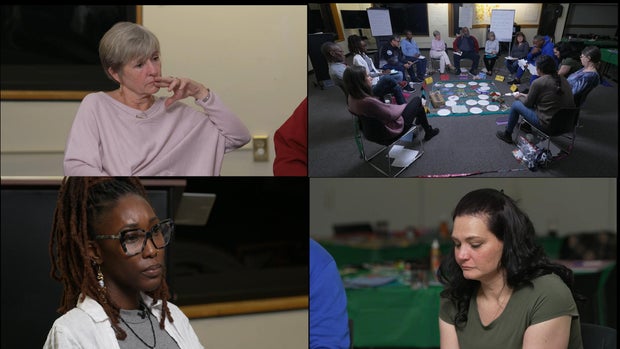
This week, 60 Minutes featured a report by Lesley Stahl on Healing Justice, a nonprofit organization focused on aiding survivors of crimes, wrongfully convicted individuals, and their families. These individuals, unrelated by case, gather for a three-day retreat designed to address the pain and wounds inflicted by failings within the justice system.
The retreat includes activities like writing exercises, group discussions, and art therapy. These activities enable participants to share their pain, comprehend their emotions, and empathize with others. “They arrive with emotions like bitterness, guilt, and sadness,” Stahl explained to 60 Minutes Overtime. “A weekend might not completely transform them, but it’s the start of a change.”
The sessions were captured by 60 Minutes cameras, with the cooperation of both participants and Healing Justice. This coverage aimed to show the emotional evolution experienced during the retreat.
Insight into the Founder
Jennifer Thompson, the founder of Healing Justice, is a rape survivor involved in a wrongful conviction case. Stahl and producer Shari Finkelstein previously reported on Thompson’s story in 2009, focusing on the inaccuracies of eyewitness identification.
“During the summer of 1984, while she was a college student, an attacker intruded into Thompson’s home. Despite her effort to memorize the attacker’s features, she mistakenly identified Ronald Cotton as her rapist during police lineups. Her testimony led to Cotton’s conviction and a sentence of life imprisonment plus 50 years. After 11 years, DNA evidence exonerated Cotton, identifying Bobby Poole as the actual perpetrator.”
Understanding Misidentifications
Research, as cited by producer Shari Finkelstein, shows that when lineups do not include the real perpetrator, witnesses often choose the person bearing the closest resemblance. This misidentification was magnified in Thompson’s case, a scenario Stahl herself experienced during a 2009 simulation.
Finkelstein explains that once this inaccurate identification occurs, the wrongful imagery solidifies. The repeated viewings of the wrongfully accused, in photographs, lineups, and courtrooms, embed their face in the victim’s memory, creating a false certainty.
The Healing Justice Experience
Finkelstein maintained contact with Thompson, leading to awareness of the Healing Justice retreats. Wanting to document the transformation, Finkelstein sought permission to film the process. Navigating such emotional landscapes required sensitivity and careful planning.
Stahl conducted pre- and post-retreat interviews with participants. Finkelstein ensured every aspect of the retreat was recorded, capturing minutes that highlighted participants’ emotional progression.
Filming and Observations
Photographers Don Lee and Tom Fahey operated four cameras, ensuring minimal disruption. The setup enabled a comprehensive view of group interactions.
In one notable instance, an emotional discussion between participants Loretta Zilinger White and Raymond Towler was documented. Zilinger White, raped at 15, struggled with memories of an exonerated man’s face, while Towler, wrongfully imprisoned for 29 years, feared lingering doubts about his innocence.
Finkelstein describes a pivotal moment captured with the participants’ consent as they shared their personal fears and emotional shifts. Observations indicated profound personal transformations, as seen in Zilinger White’s transition by the retreat’s conclusion.
While acknowledging that no brief retreat can serve as a complete remedy, Thompson and Finkelstein view it as a significant step forward in the healing journey.
Produced by Will Croxton and edited by Sarah Shafer Prediger, the original video aired on March 17, 2024.