
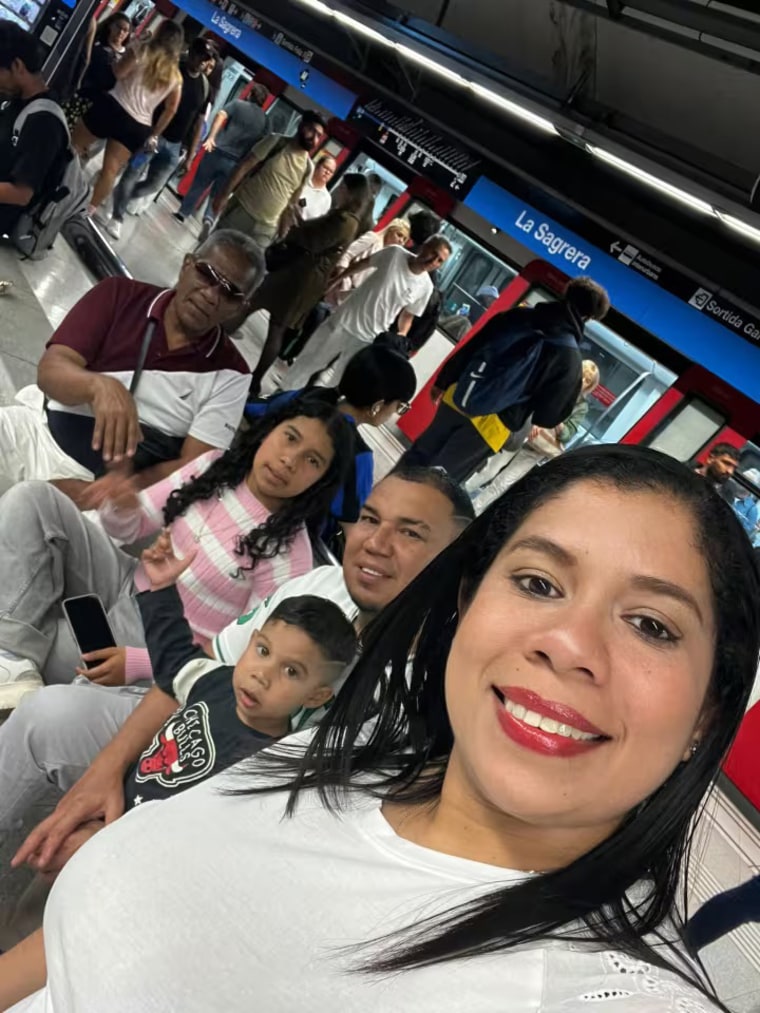
In Barcelona, Spain, Nariola Romo, 34, and her family relocated from Colombia, though their initial goal was to move to the United States. They could not secure the necessary loans for the journey, so they settled on Europe instead. As she approaches legal residency in Spain, Romo reflects on her journey. She believes circumstances worked in their favor, noting, Look at how things are in the United States with migrants. It seems like God didn’t want us to be there, because with everything that’s happened, we would have been deported already.
The Romo family, consisting of Nariola, her husband Ángel, their children Angelito and Claribel, and her father Will, are now a part of Spain’s comprehensive regularization program. This initiative, if approved, will legalize the status of over 500,000 undocumented individuals. Adults would acquire a one-year work and residence permit, requiring proof of employment for renewal, while minors receive a five-year status.
Contrast with United States Policies
Spain’s policies starkly contrast with U.S. strategies. In the U.S., former President Donald Trump’s rhetoric and actions involved significant immigration control efforts, including detention and deportation campaigns. Spain’s application deadline for the program is June 30, and decisions are expected within three months post-submission. The application surge demonstrated its demand, with over 43,000 submissions in the first three days and a total of 549,596 by the end of the month.
Spanish Prime Minister Pedro Sánchez described the initiative as an act of normalization, stating that these individuals already contribute to Spanish society. The program’s implementation offers hope to people like the Romo family, who faced a denial of asylum in 2025 but now see a possible resolution.
The Families Seeking Stability
Romo’s family originally fled Barranquilla, Colombia, in 2024 due to safety concerns, having faced threats from criminal gangs. In Spain, Romo, previously a teacher, found employment in a warehouse and as a private tutor. To emigrate, you have to be incredibly brave, leaving your home, your business, your job,
she notes, feeling fortunate for Spain’s welcoming environment.
Diadji Nguirane from Senegal seeks similar benefits. Living in Spain for two years, he aims for official work opportunities once he receives his documents. His partner, Maimouna Gueye, supports their family as a hospital cleaner. She coordinates their schedules, ensuring care for their three daughters.
Nguirane’s case highlights the tensions of legal status differences within families. While the regularization program aids his situation, Gueye and their children already possess legal residency. For Nguirane, attaining legal work is crucial for their financial stability.
The Regularization Process
Those seeking regularization must fulfill specific criteria and submit documentation. Proof of continuous residence before January 1, 2026, in Spain involves registration certificates or school enrollment evidence. A clean criminal record is also mandatory. Vulnerability certificates may be required for applicants facing challenging circumstances.
Spain’s current approach mirrors previous efforts, recalling a large-scale regularization under the Zapatero government two decades ago. Similar processes occur globally, according to Verónica Jaramillo from Bayt al-Thaqafa Foundation. The #RegularizacionYa movement estimates 500,000 undocumented individuals may benefit, though other analyses suggest the number could exceed 800,000.
Economically, regularization can support aging populations. Spain’s aging index highlights the demographic shift, where more retirees exist than young people entering the workforce. Adding immigrants to the Social Security system could address this disparity. Jaramillo emphasizes this strategy as practical, yet acknowledges the ongoing debate.
Despite opposition from right-wing parties, this measure aims to secure a future for immigrants and bolster the economy. Criticism includes accusations of political manipulation and resource strain, voiced by figures such as Isabel Díaz Ayuso from Madrid. However, legalized immigrants will not participate in voting, countering claims of electoral influence.
For families like Romo’s and Nguirane’s, Spain’s policy signifies more than paperwork. It represents a chance at security and roots in a new home. They look forward to contributing to Spanish society as recognized residents.