
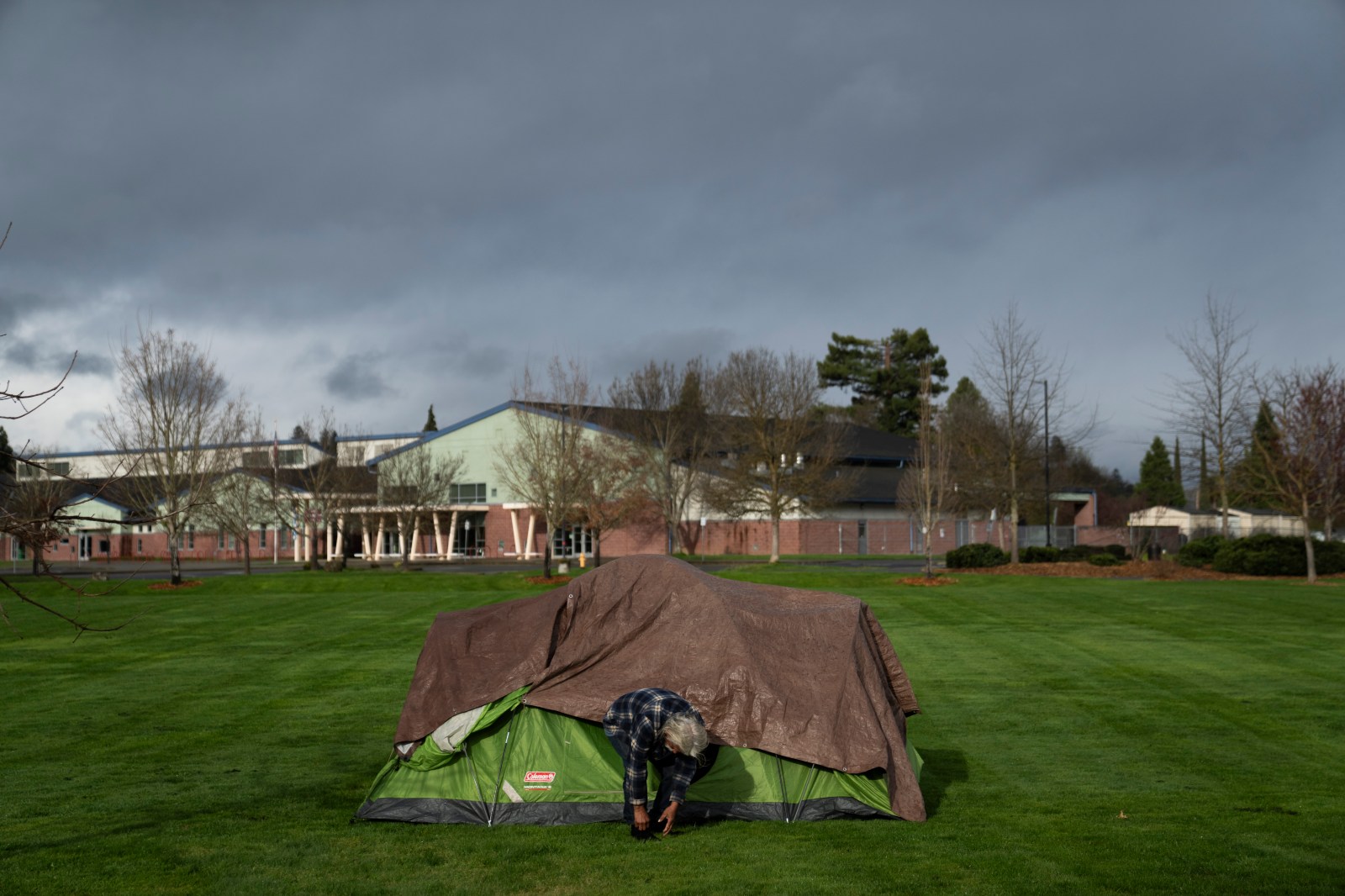
Uptick in Encampment Sweeps Post-Ruling
Recent research highlights the effects of a Supreme Court decision that expanded city powers to manage homelessness. The American Journal of Public Health published a study examining how this ruling influenced homelessness policies in Oakland, California. Findings indicate a significant rise in the number of encampment “sweeps” following the decision.
Before the ruling, the average monthly closure rate for homeless encampments in Oakland was 14.4 between 2021 and 2024. This figure included 6.6 new closures and 7.8 repeat closures. After the decision, the rate increased to 32.2 closures per month, with 17.5 new closures and 14.7 repeat closures.
Supreme Court Ruling in City of Grants Pass v. Johnson
In June 2024, the Supreme Court delivered a verdict on City of Grants Pass v. Johnson. The case focused on whether enforcing anti-camping ordinances against homeless individuals breached the Eighth Amendment’s prohibition on cruel and unusual punishment. The court, in a 6-3 ruling, sided with an Oregon city, arguing that these ordinances do not violate constitutional rights. This decision overturned a previous ruling by the Ninth U.S. Circuit Court of Appeals.
Data Analysis and Community Impact
Researchers used 785 closure reports from Oakland’s public database to analyze the trend of encampment sweeps. Numerous encampments were closed repeatedly, with one being closed 18 times over four years. The study also noted significant differences in the racial and ethnic composition of neighborhoods where sweeps occurred. Post-ruling, closures were more frequent in areas with higher percentages of Hispanic and Black residents.
The study authors propose two potential outcomes of the ruling: expanded enforcement in new areas and the emergence of dispersed encampments due to previous closures. Jamie Chang, a social welfare professor from the University of California Berkeley, questioned the effectiveness of these sweeps. Chang suggested that the cost and repetitive nature of sweeps warrant a reassessment of their role in managing homelessness.
C.J. Gabbe, another co-author, expressed concerns over the policy’s impact. Gabbe indicated that sweeps might disperse rather than support homeless individuals, pushing them into more vulnerable neighborhoods without offering stability.
Homelessness in the U.S.
Homelessness remains a persistent issue across U.S. cities due to limited shelter capacity and housing shortages. The U.S. Department of Housing and Urban Development’s 2024 report identified California as having the largest homeless population at approximately 187,000, followed by New York with around 158,000. Florida and Washington each reported over 31,000 homeless individuals. The report estimated over 770,000 people experienced homelessness on a single night in January 2024, marking an 18% increase from 2023.
President Donald Trump has committed to addressing homelessness. In March 2025, he signed an executive order to clear homeless encampments and graffiti from Federal lands in Washington D.C., aiming to enhance the city’s appearance.