
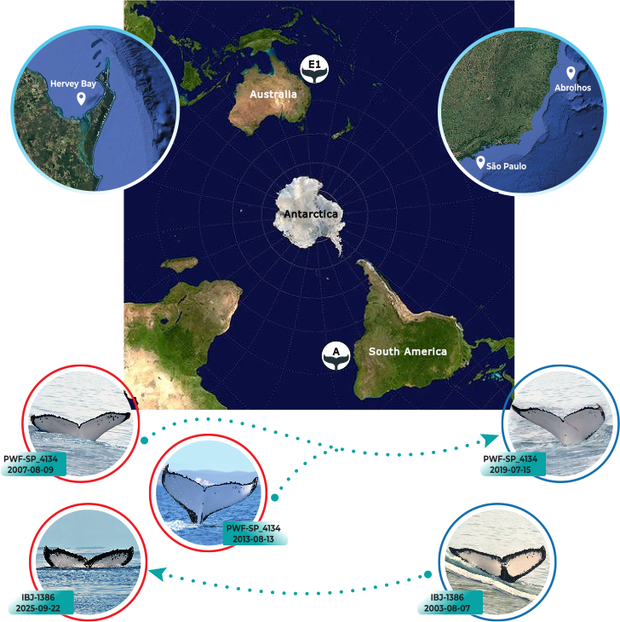
Researchers have uncovered groundbreaking journeys of two humpback whales traveling between the eastern shores of Australia and Brazil’s breeding grounds. Published in Royal Society Open Science, these distances mark the greatest ever recorded for such marine mammals.
Tracking Vast Distances
A team of international scientists used tens of thousands of images to identify the whales, captured on both sides of the world. One whale was seen in Queensland in 2007 and later near Sao Paulo, Brazil, in 2019 — a remarkable 8,823 miles apart. Another was photographed off Bahia, Brazil, before appearing 22 years later in Hervey Bay, Australia, a distance of about 9,383 miles.
The research presents the longest distance known between two photographs of the same humpback whale.
Significance of Rare Journeys
These significant journeys, rarely observed among humpback whales that can grow up to 55 feet long, have vital implications. Stephanie Stack, a Griffith University PhD researcher and co-author of the report, stated that these movements are crucial for genetic diversity within whale populations. The whales might also carry new songs from one region to another, as whale songs spread culturally across the ocean, akin to music trends in human societies.
Leveraging Citizen Science
The study relied on nearly 20,000 photographs since 1984, collected by both scientists and citizen scientists from eastern Australia and Latin America. Dr. Cristina Castro of the Pacific Whale Foundation highlighted the importance of these citizen contributions, which helped uncover one of the most extreme movements recorded among marine mammals.
New Records and Theories
These findings set new records, with journeys exceeding 14,000 kilometers between the continents. The study lent support to the “Southern Ocean Exchange” theory, suggesting that humpback whales may travel to Antarctic feeding grounds before taking different routes back, sometimes ending up in new breeding areas.
Griffith University noted that climate-driven changes, such as shifts in sea ice and Antarctic krill distribution, might increasingly motivate such crossings.
Conservation Status
Historically, commercial whaling led to the endangered status of humpback whales in the U.S. during the 1970s. The U.S. ceased commercial whaling completely in 1985. Today, according to NOAA, four out of the 14 distinct population segments remain protected as endangered, with one listed as threatened.
The research underscores the interaction between climate changes, whale behavior, and conservation efforts to ensure a sustainable future for these immense sea creatures.