
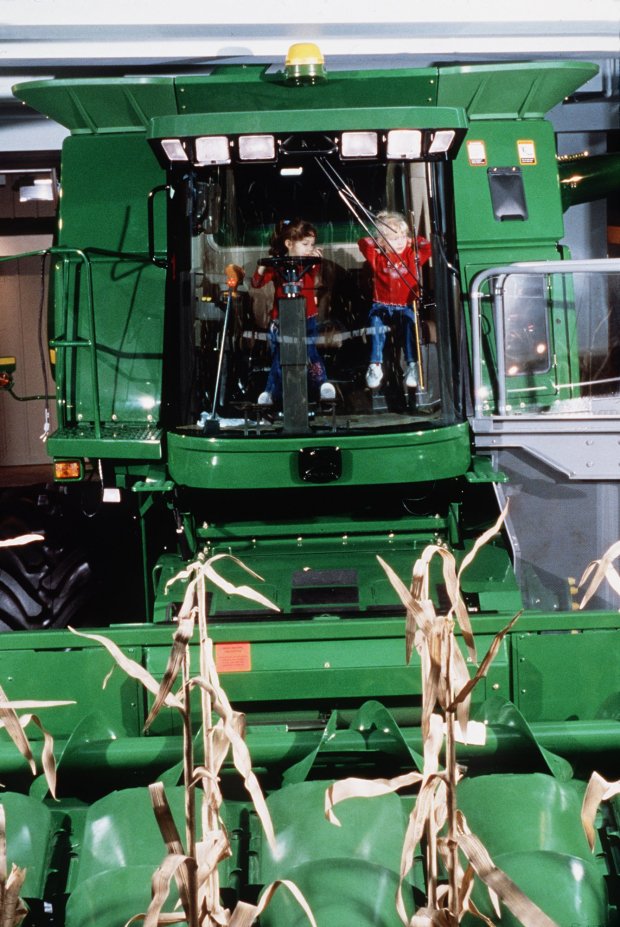
Many children with connections to the Chicago area have fond memories of visiting the city’s renowned attractions. A family favorite often included the Museum of Science and Industry. At this museum, children could see a 700-ton WWII submarine, chicks hatching, and explore a coal mine replica linked to their ancestors’ history in Spring Valley.
Years later, these early experiences had unforeseen significance. Fast-forward to today, where I found myself on a beautiful fall day, riding with our neighbor John on a combine in Muscatine County. This marked John’s 40th year of harvesting corn and soybeans near the Mississippi River. His brother Neil managed a second machine, while his son-in-law Bryar supported them with a grain cart. His son Tyler transported the harvested grain.
John remarked, “No matter how often you use the combine, watching kernels flow into the cart after nurturing the crops is special.” At the museum, children can climb on a giant combine at the “Farm Tech” exhibit, once called “The Farm.”
The workings of a combine are intricate yet fascinating. The header gathers multiple corn rows simultaneously, feeding them into the machine where threshing and winnowing systems efficiently separate kernels. The clean kernels fill the hopper, and the plant residue enriches the soil.
Technology makes today’s harvest vastly different from the past. Sitting in the combine cab, you see advances firsthand. A GPS steers the machine precisely, and a joystick controls speed and direction. Digital monitors provide real-time data on yield and moisture content, allowing the operator to tweak settings for optimal performance. The GPS also synchronizes with the grain cart for seamless unloading, aided by live camera feeds monitoring the grain level.
Operating a modern combine embodies skill and efficiency, crucial when hundreds of acres await harvest. The USDA projected a corn yield of 16 billion bushels this fall, with leading states Iowa, Illinois, and Nebraska contributing significantly. This monumental task demands an army of combines.
For a deeper understanding of where many corn-based products originate, visit the “Farm Tech” exhibit at the Griffin Museum of Science and Industry in Chicago. Climb aboard the simulated combine, part of a series manufactured at John Deere Harvester Works. It’s enlightening.
Susan Koch, former chancellor of the University of Illinois Springfield, resides in Iowa City with her husband, where they engage in farming. Share your thoughts by submitting a letter of up to 400 words to the editor.