
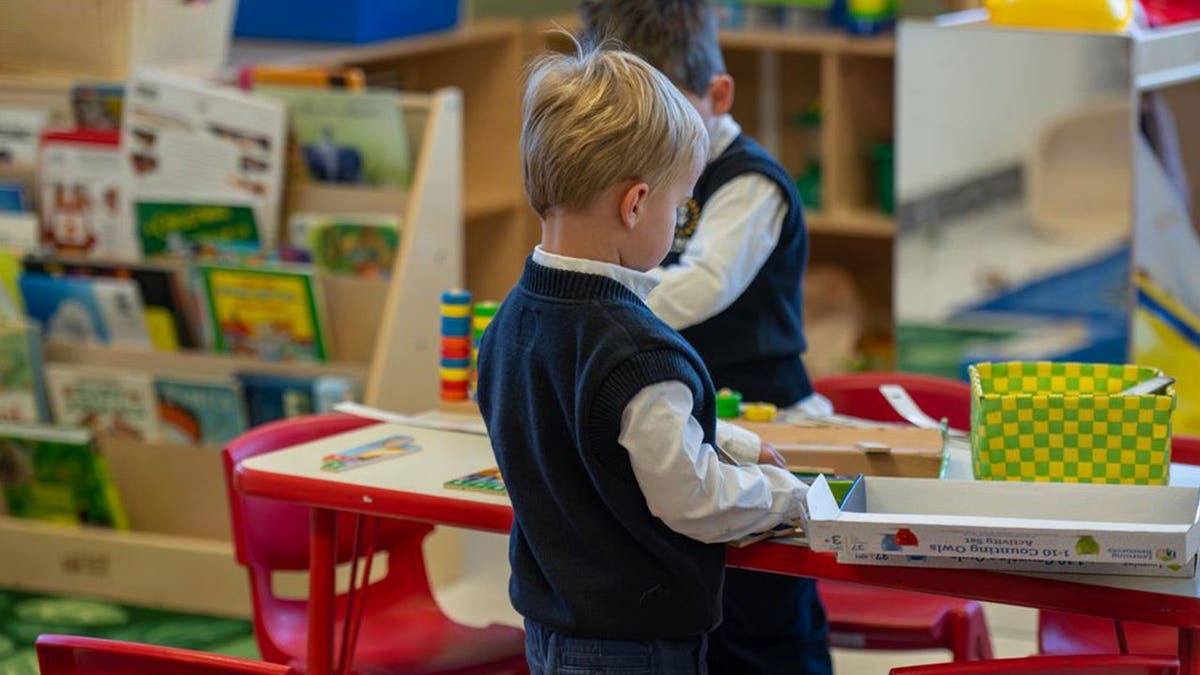
In Colorado, a father pays for Catholic preschool while his taxes fund public preschool, highlighting a broader issue in state education policy. His family’s decision to stay in Colorado is influenced by Medicaid’s comprehensive care for his child with spina bifida. An additional $6,000 annually would be a significant support.
A mother working at a lumber company and married to a seasonal house painter faces challenges paying for her children’s education. Initially assuming Catholic schools were only for the wealthy, she confronts financial obstacles while expecting her seventh child.
Another mother started a florist business to fund her children’s tuition, sending three of her kids to a Catholic school in Denver. Due to costs, her youngest attends a Lutheran preschool through a state program. She feels punished for choosing faith-based education.
A fourth parent accepted a lower-paying job at her children’s parish school to receive a tuition discount but has witnessed families leaving due to pre-K costs.
These Catholic families are represented in a Supreme Court case, St. Mary Catholic Parish v. Roy. Dan and Lisa Sheley, parents involved in the legal challenge, have seven children, with five attending St. Mary’s, incurring significant out-of-pocket expenses for church-based preschool education.
“I’m choosing faith, and here I’m being punished for that.”
Colorado’s ‘universal’ preschool program aims to aid families but fails due to a specific clause: schools must adhere to ‘equal opportunity’ standards related to sexual orientation and gender identity, conflicting with Catholic teachings on marriage, sexuality, and identity. This clause excludes Catholic institutions.
Historically, similar discriminatory measures existed under Blaine amendments. These were designed to block public funding for ‘sectarian’ schools, predominantly targeting Catholic immigrant communities. Although Blaine’s amendment narrowly missed Senate approval, many states incorporated its principles into their constitutions.
Colorado gives eligible four-year-olds $6,000 a year for education at schools their parents select, but the participation clause effectively bars Catholic schools.
The Supreme Court has gradually dismantled similar biases in recent rulings: Trinity Lutheran (2017), Espinoza (2020), and Carson (2022). These cases establish that states offering public benefits cannot exclude schools due to religious practices.
Colorado’s preschool program is flexible for other providers serving specific communities, but doesn’t accommodate Catholic schools. Roughly 1,500 children across 30 schools are excluded, with Catholic preschool enrollment dropping by 20% and two preschools closing.
The Supreme Court is asked to allow providers with specific missions, including Catholic ones. Colorado’s mandates have been criticized in Masterpiece Cakeshop (2018), 303 Creative (2023), and Chiles (2026) for intolerance, suggesting the state’s policies compromise constitutional guarantees.
Catholic schools should not be denied funding due to their faith. The Blaine amendments should not reemerge under new terminology.
Andrea Picciotti-Bayer directs the Conscience Project.