
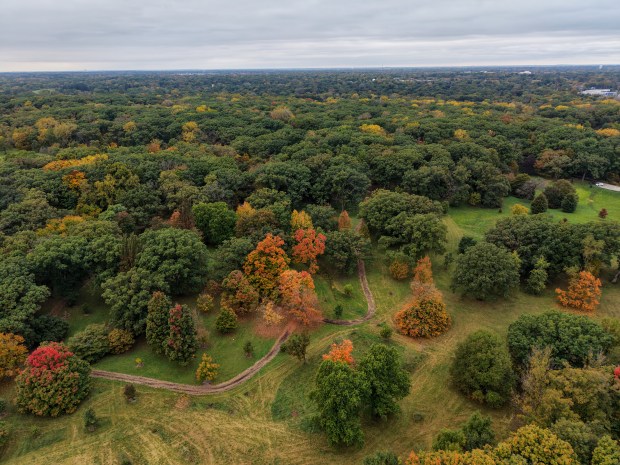
Janet Cole often finds herself at The Morton Arboretum, camera in hand. At 75, she relishes capturing the vibrant colors of the trees. Recently, an amur corktree with bright yellow leaves caught her eye again, despite having many photos already. Cole remarked on its beauty, demonstrating her ongoing appreciation for nature. Retired from her librarian job, Cole volunteers at the arboretum, participating in tasks ranging from weeding to assisting in events. Her duties extend to winter, where the cold normally restricts her cycling, but warmer temperatures might allow it this year.
The unusual warmth is causing delays in leaf coloring, affecting plant health across the Midwest and organisms in the Great Lakes. Above-average temperatures are expected to continue in Chicago and globally due to El Niño, according to the National Oceanic and Atmospheric Administration (NOAA). Illinois state climatologist Trent Ford stated that while El Niño doesn’t predict precipitation well, it indicates a 70% chance of warmer temperatures in the Great Lakes region during the winter.
Temperature impacts the timing and intensity of tree color changes, explained Michael Jesiolowski, plant clinic manager at The Morton Arboretum. Typically, temperature drops below freezing trigger color changes in leaves. However, recent October lows have stayed above 45 degrees, with only a slight decrease to the low 40s and high 30s later that week. A recent 88-degree day in October set a record high for the area. Normally, bright colors appear in mid-October for maples and late October for oaks in Chicago, according to the arboretum. Yet leaves were slow to change colors in mid-October, highlighting the impact of the warmer fall.
Various factors like temperature, sunlight, and precipitation influence fall foliage. Jesiolowski noted the absence of cool mornings and evenings as a reason for the delayed color change. He commented that although trees might exhibit new colors later in the season, these colors could persist longer.
“We haven’t had those freezing mornings,” Jesiolowski said. “That’s why we’re not seeing much fall color now.”
El Niño impacts global climate, with NOAA identifying it as a major climate influencer. The phenomenon features alternating warm (El Niño) and cool (La Niña) periods in the Pacific Ocean. Human-induced climate change is intensifying El Niño, making this winter potentially the strongest on record. While the effects vary globally, NOAA predicts normal to above-average temperatures across most of the U.S., including warmer conditions for Illinois and mixed precipitation outcomes.
The agricultural sector might experience both positive and negative outcomes from El Niño. Increased rainfall could alleviate droughts in parts of the U.S., but also exacerbate crop issues. For instance, David Zaya, a botanist, noted that El Niño often boosts corn and soybean yields due to extended growing seasons. However, colder springs can delay planting when fields remain frozen—less likely during El Niño years.
State climatologist Zack Leasor from Missouri highlighted that El Niño might be beneficial for farmers facing successive drought seasons. More precipitation during winter and spring could improve conditions; droughts have significantly impacted Missouri and parts of Southern Illinois.
“A wetter winter and spring are really what we need,” Leasor commented.
The focus also turns to pests and weeds in warmer conditions. According to entomologist Kelly Estes, pest survival rates may increase after mild winters, posing risks to crops. Marestail, a problematic weed in corn and soybean fields, could thrive sooner, due to its resistance to certain weedkillers. Zaya expressed concern over the influence of increased herbicide use on natural areas near agricultural lands, explaining that herbicides often drift and cause damage.
Some invasive species, like the Japanese chaff flower, might also spread faster with warmer winters, further affecting local ecosystems.
Aquatic ecosystems are vulnerable as well, with warm temperatures fostering harmful algal blooms in the Great Lakes. Planktonic growth accelerates in heat, as highlighted by Casey Godwin, a University of Michigan researcher. A 2022 study confirmed El Niño’s role in harmful algal bloom proliferation. Fish, particularly lake whitefish, rely on ice for egg protection; inadequate ice due to warmth could threaten their population.
Although risks of flooding and severe droughts are greater in other regions, local impacts remain significant. Ford advised gardeners to adjust practices, maintaining adequate moisture levels in plants. Jesiolowski recommended deep watering once a week rather than daily light watering to encourage deeper root growth. Mulching and leaving fallen leaves can help retain soil moisture, following a conservation practice known as “Leave the Leaves.”
As temperatures drop into the 40s, Morton Arboretum nears peak foliage. Cole, like many, finds solace in observing seasonal changes amid global challenges.
“It’s inspiring,” Cole stated. “A distraction from world events.”