
Imagine if Walmart offered a Democratic Resistance Starter Kit. It might include a kaffiyeh, a green abortion-rights bandanna, a pink blazer, and a black T-shirt reading ‘NO KINGS’ in a font suggesting impending democracy’s demise. Batteries not included; placard sold separately.
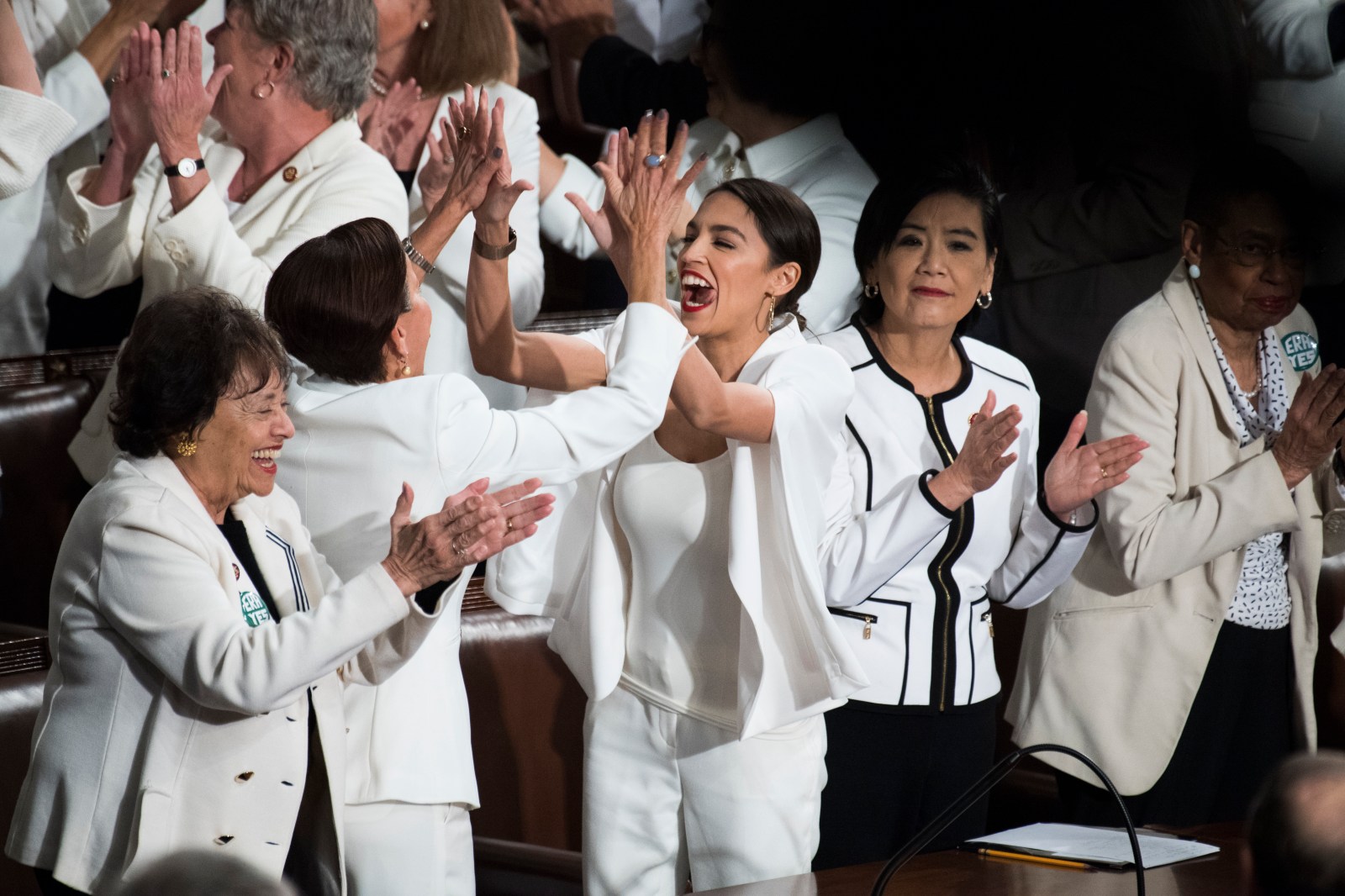
For traditional Democrats, there’s the Heritage Collection: an immaculate white pantsuit in tribute to suffragists, worn en masse. This concept is only partly humorous. Over the last decade, Democrats have curated a highly specific political wardrobe. Outfits symbolize reproductive rights, Palestinian solidarity, resistance against Donald Trump, suffragists’ legacy, and sometimes a mix of these ideas.
At the 2024 State of the Union, Representatives Summer Lee, Cori Bush, and Rashida Tlaib wore kaffiyehs supporting Palestinians, while Democratic women wore suffragist white, signaling reproductive rights advocacy. Such attire wasn’t new. During Trump’s first term, a coordinated sea of white showed up at his 2019 State of the Union.
In 2024, Democratic congresswomen wore white suits again for another Trump address in 2026, protesting the SAVE America Act. Interspersed were other clothing messages. In 2022, Democratic Congress members such as Alexandria Ocasio-Cortez, Ilhan Omar, Ayanna Pressley, and Tlaib wore green bandannas reading ‘Won’t Back Down’ to protest Roe v. Wade’s reversal.
For Trump’s 2025 speech, Democratic women chose pink. Representative Teresa Leger Fernández, chair of the Democratic Women’s Caucus, described pink as a color of ‘power and protest.’ Nancy Pelosi joined numerous Democratic women in the coordinated effort. Elsewhere, Representative Maxwell Frost wore a black shirt stating ‘NO KINGS LIVE HERE,’ and Representative Delia Ramirez displayed ‘NO KING. NO COUP.’
Yet, a memorable image some Democrats might prefer forgotten: June 2020, when Nancy Pelosi, Chuck Schumer, and other leaders knelt in the Capitol wearing kente cloth stoles after George Floyd’s murder. Symbolizing solidarity, the textile deeply roots in Ghanaian culture, linked to royalty, identity, and ceremony. However, the resulting photograph conveyed a more complicated message.
Uniformity isn’t exclusive to Washington. Walk around heavily liberal areas in America and political standpoints often become apparent through fashion. A kaffiyeh on an ordinary day, protest T-shirts under jackets, bandannas, totes, pins, and slogan sweatshirts signal beliefs even without a demonstration.
What’s striking is these clothes often reflect anger. They announce objections. They’re like portable picket signs, protesting without attending a protest. Liberals didn’t invent dressing according to political leanings. A simple red baseball cap can tell much about a stranger from across a parking lot.
The MAGA hat might be the most successful political clothing piece in modern history for its tribal function. It signals beliefs or perceived beliefs. Beyond the hat, Trumpism spawned an aesthetic: red trucker hats, cowboy boots, American flags everywhere. Often considered tacky, anger surfaces too.
However, there’s a key difference in what the clothing brands. The MAGA hat, despite being political merchandise, carries an affirmative message: Make America Great Again. Love or hate it, it suggests a proposition. Its expression: This is who we are, and this is what we want.
Contrarily, contemporary Democratic attire mainly signals opposition. Pink fights Trump, green counters abortion restrictions, white challenges threats to women’s rights, NO KINGS counters monarchy, kaffiyeh critiques Israel’s actions in Gaza. While standalone items make sense, collectively, they shape a party perpetually dressed for protest.
This might not affect the average American consciously, yet if attire indicates belonging, Democrats’ in-group increasingly resembles opposition uniforms—not in partisan terms, but as an identity, a contrarian group, peculiar for a governing party. Protest movements should appear exterior to power, applying pressure. Governing parties should visually portray power accompanied by clear goals unaffected by external opposition.
Instead, Democrats have honed the art of advocating, appearing as if they demand attention from those in charge. Their causes might be worthy. Many believe abortion rights face threats, Palestinians need solidarity, Trump endangers democracy, or women’s rights need defense. People naturally wear convictions.
Problems arise when clothing communicates grievances better than politics conveys alternatives. Aiming to lead the nation, parties must offer more than resistance collections. Perhaps Democrats require a winning outfit, less about opposition, more attuned to clear governance direction.