
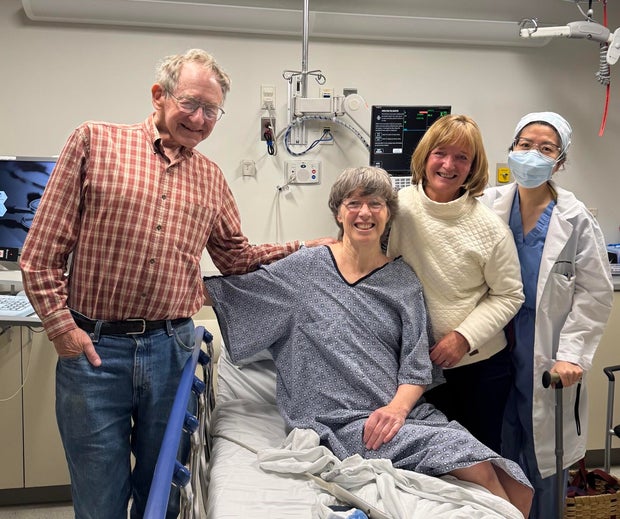
Vicky Titcomb, a Cape Cod bookstore owner, embarked on a routine heart scan at Mass General Brigham in March 2025. At 72, she felt healthy, the scan merely a task before visiting her son in New York City. Days into her trip, an alarming call from her internist reshaped her reality: the scan pointed to a pancreatic anomaly, likely cancer.
Recollecting moments from 2012, when she overcame breast cancer, Titcomb chose positivity. Upon confirming pancreatic cancer, she refrained from researching the often-grim prognosis. “I saw some terrible, terrible information and shut it out,” she remarked.
Developing an aggressive treatment plan
Pancreatic cancer’s late-stage diagnosis challenges survival rates, noted at 13% over five years according to the American Association for Cancer Research’s 2026 report. Despite treatment advancements, improvements for pancreatic cancer have been minimal. Alongside her pancreatic issue, Titcomb faced stage 1 breast cancer and a non-cancerous ovarian mass, quickly resolved through surgery.
Cancer specialists at Mass General Brigham devised a treatment strategy: chemotherapy and radiation aimed to shrink the tumors. “My goal was trying to make this cancer a raisin,” Titcomb shared, emphasizing her visual analogy.
The complex Whipple procedure awaited her if all went well. This surgery removes parts of the pancreas, small intestine, gallbladder, and bile duct, facilitating digestive function. Early diagnosis afforded Titcomb this crucial option, possible for only 20% of patients.
Coping with multiple treatments
In June, Titcomb began chemotherapy, receiving eight doses over four months. Radiation followed before additional chemotherapy rounds. Her surgical oncologist, Dr. Thomas Clancy, commended her resilience, noting the treatments’ success in tumor reduction, enabling a Whipple procedure.
November 4 marked her breast cancer surgery, followed by the Whipple two weeks later. Titcomb credited World Pancreatic Cancer Day with her optimistic outlook, though scheduling was coincidental. “I was sure Dr. Clancy chose me for that day feeling positive about the outcome,” she joked. Her swift recovery soon had her home after hospital care.
Upon follow-up, Dr. Clancy confirmed her progress but advised two more months of chemotherapy due to pancreatic cancer’s aggressive nature. “I coped with the day-to-day,” Titcomb reflected on the demanding regimen.
“The luck trumps all”
Several treatments later, March 2026 bore good news: no evidence of cancer. With ongoing scans every three months, Dr. Clancy encourages minimal focus on her condition: “You’re done with therapy; go about your days.”
Back at her bookstore, Titcomb regains normalcy, with family pitching in during her treatment. Framed by photos, videos, and calls from distant loved ones, her family remains integral.
Embracing advocacy, Titcomb furthers pancreatic cancer awareness, collaborating with the American Cancer Society and Pancreatic Cancer Action Network. “10 years ago, it would have been a different story,” she acknowledged, celebrating treatment strides. “I feel so lucky. The luck trumps all.”