
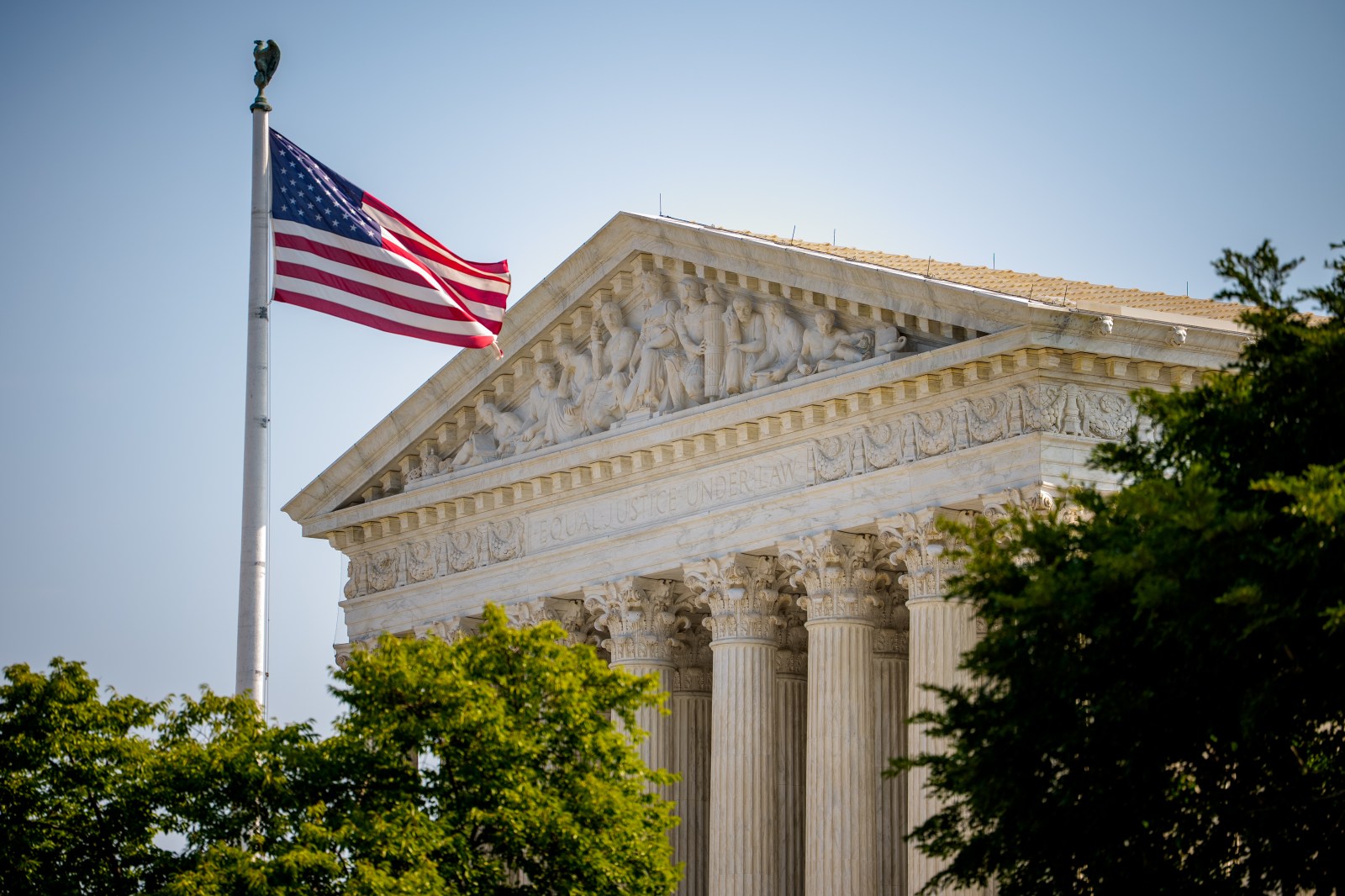
The United States Supreme Court recently rejected Missouri’s appeal to use a congressional district map from recent primaries for upcoming midterm elections. The map, pushed by President Donald Trump, was at the center of a significant election-law case that questioned the timing of court alterations to congressional maps.
Missouri State Attorney General Catherine L. Hanaway described the situation as a federal-election-administration disaster unfolding in Missouri, arguing that changes were too late for the midterms. Justice Brett Kavanaugh denied Missouri’s request, upholding the state Supreme Court’s decision to use a 2022 map instead.
Abha Khanna, a partner at Elias Law Group and counsel on the case, stated, “The Missouri Supreme Court made the right call, and Justice Kavanaugh rightly denied Missouri’s attempt to avoid its highest court’s ruling.” The Missouri constitution mandates that citizens should have the final say on gerrymandering requests, which was affirmed by the Supreme Court.
Beyond Missouri, this case highlights implications for election disputes nationwide, affecting states across political lines seeking to revise congressional maps.
A federal-election-administration disaster is unfolding in Missouri.
How Missouri Got Here
Missouri legislature approved House Bill 1 in September 2025, replacing the 2022 congressional map. The bill passed comfortably, signed by Republican Governor Michael Kehoe. The new map was utilized during the August 2026 primaries, with 1.2 million voters participating.
An activist group, People Not Politicians, led by Richard von Glahn, launched a referendum campaign for a statewide vote on the map. Legal battles arose, challenging Missouri’s use of referendum petitions against redistricting laws. Earlier courts maintained the map during ongoing litigation, leading election officials, candidates, and voters to rely on it.
On September 3, Missouri Supreme Court reversed a lower court ruling, issuing an injunction against implementing House Bill 1, instead using the 2022 map.
Why Missouri Asked the Supreme Court to Intervene
Missouri contended that conducting primaries with the new map was impractical, potentially altering district boundaries before general elections. They emphasized that changes would force voters to choose candidates they hadn’t nominated during primaries.
Kavanaugh’s refusal to grant relief left these arguments unresolved, indefinitely maintaining the Missouri Supreme Court’s order. This absence of immediate intervention does not equate to a ruling on Missouri’s legal concerns.
According to Richard von Glahn of People Not Politicians, “The victory belongs to the voters who rebuffed political power grabs. People, not politicians, will have the final say with Proposition A.”
The Broader Constitutional Dispute
The appeal posed constitutional questions aimed at attracting Supreme Court review. Republicans asserted Missouri’s redistricting should not be suspended by a small fraction of registered voters prior to a statewide vote.
They argued altering districts between elections violated Article I of the Constitution and equal protection principles. Opponents stressed state referendum laws mandated suspending the map until citizens voted on the legislation.
What It Could Mean Beyond Missouri
The broader significance arises from the ability of courts to modify congressional maps late in the election process. Missouri and national Republican groups warned similar disputes might emerge nationwide if courts intervene close to Election Day.
Citing the Purcell principle, courts are advised against making significant election-rule changes near elections to avoid voter confusion. Despite Kavanaugh declining immediate relief without explanation, the issues may resonate beyond Missouri, emphasizing state referendum systems’ tensions with legislative authority.
For now, Missouri election officials must operate under the state Supreme Court’s ruling, as stakeholders await developments in this pivotal election-law case of 2026.