
Skywatchers in the U.S. Prepare for a Remarkable Lunar Eclipse
Observers across the United States are anticipating a unique lunar event this week as Earth’s shadow covers over 96% of the moon in an uncommon deep partial lunar eclipse. NASA forecasts this eclipse to take place overnight on August 27 or 28, occurring when Earth positions itself between the sun and the full moon, casting a shadow on the moon’s surface.
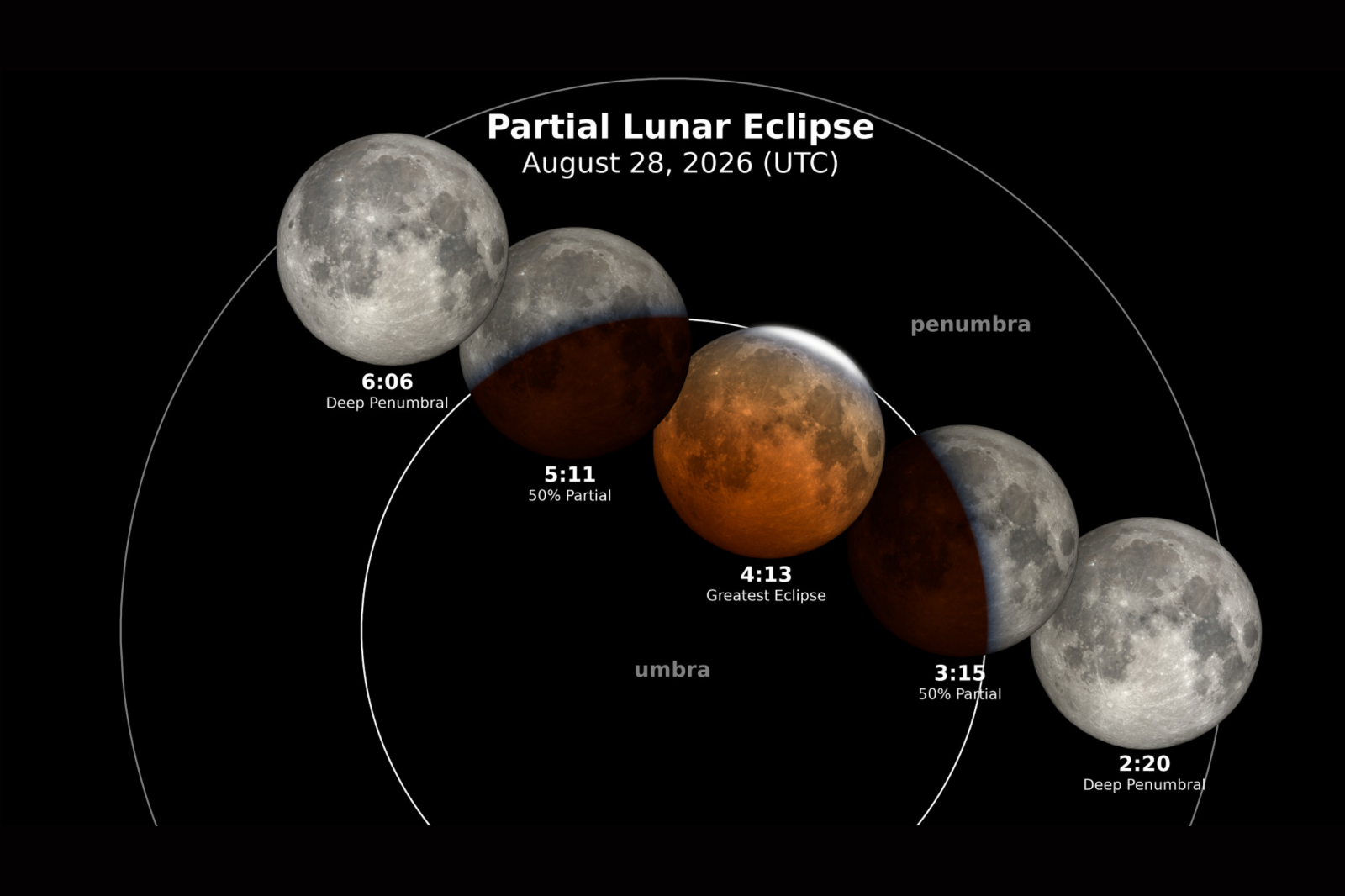
At the peak of the eclipse, 96.3% of the lunar disc will be immersed in Earth’s dark central shadow, referred to as the umbra. Although not a complete lunar eclipse, it bears a close resemblance, with only a thin slice of the moon remaining under direct sunlight at its maximum phase.
Understanding the Rarity of This Eclipse
Partial lunar eclipses happen frequently, yet deep partial eclipses of this extent are a rarity. This eclipse is a part of Saros 138, a longstanding series of lunar eclipses recurring approximately every 18 years, 11 days, and 8 hours as Earth, the moon, and the sun return to nearly identical alignments.
NASA noted the previous occurrence in this series on August 16, 2008, and the next one is expected on September 7, 2044. Astronomers have heightened interest in this event due to its dramatic nature, typically attributed to total lunar eclipses, creating reddish or copper hues on the lunar surface.
Expectations for Spectators
During the eclipse, viewers will witness a dark shadow gradually enveloping the moon. Initially, the moon will exhibit a slight dimming as it crosses Earth’s outer shadow, known as the penumbra. As the partial phase progresses, Earth’s deeper umbral shadow will seemingly carve an expanding slice out of the moon.
Nearing maximum eclipse, the sunlit part of the moon will reduce to a slender crescent. The shadowed area may appear in shades of red, orange, or copper, influenced by the way sunlight is filtered and bent through Earth’s atmosphere toward the lunar surface, similar to Earth’s red sunsets.
Timing of Visibility
The eclipse’s zenith occurs at 4:13 a.m. UTC on August 28, corresponding to various times across U.S. time zones:
- 12:13 a.m. EDT (East Coast)
- 11:13 p.m. CDT
- 10:13 p.m. MDT
- 9:13 p.m. PDT (West Coast)
Optimal Locations for Viewing
Throughout much of the United States, watchers will find favorable conditions for this event.
According to NASA and Time and Date, North America viewers will be treated to this spectacle, with evening visibility for West Coast residents and peak observation around midnight for East Coast spectators. Cities like Los Angeles, Portland, New York, and Jacksonville provide excellent viewing opportunities.
South America, parts of western Europe, and western Africa will also have visibility of this event.
Tips for Viewing the Eclipse
Unlike solar eclipses, lunar eclipses are safe to view with the naked eye. EarthSky advises that no special eyewear or protective gear is required. Choosing a locale with an unobstructed sky view and minimal light pollution will enhance the experience. While binoculars or a small telescope can offer more detailed views of Earth’s shadow traversing lunar craters and maria, clear weather will be vital for optimal observation.
For those unable to attend, Time and Date will host a live webcast of the eclipse, showcasing various observing locations globally.