
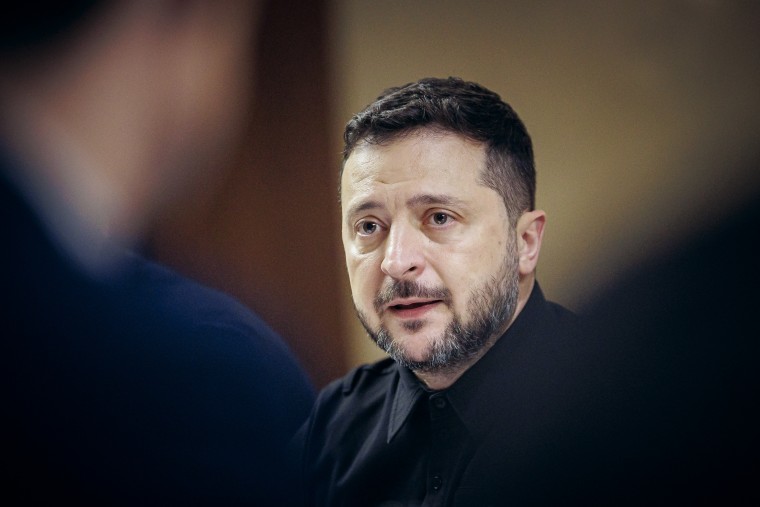
KYIV, Ukraine — President Volodymyr Zelenskyy expressed concerns about holding elections in Ukraine amidst ongoing conflict with Russia, fearing it would seriously divide the nation. His statements, shared with media on Sunday, marked his initial commentary on the issue following former Defense Minister Mykhailo Fedorov’s recent call for elections despite the war.
Fedorov’s sudden removal from office last month led to widespread demonstrations, with many initially supporting his reappointment but later resisting his electoral proposal. This marked the first instance a significant Ukrainian political figure advocated for elections since Russia’s comprehensive invasion in 2022.
“I believe moving towards elections during such a conflict would destroy the country,” Zelenskyy stated, emphasizing that wartime elections are prohibited under Ukrainian legislation. Experts argue security issues and the presence of millions of Ukrainians abroad or in occupied regions make such elections unfeasible.
Zelenskyy Maintains Political Stability Amidst War
Despite challenges, Zelenskyy’s approval ratings have held steady around 60%. A survey conducted by the Kyiv International Institute of Sociology on August 5 reported that 57% of Ukrainians prefer elections only after hostilities cease.
Reflecting previous comments, Zelenskyy deemed a wartime election feasible only if foreign allies assured security measures, which has not been proposed up to now. “Holding elections now would cause a state-level crisis that could split Ukraine,” he mentioned.
While discussing the political landscape, Zelenskyy noted that Fedorov, once a close ally and potential political contender, did not clarify his stance regarding future elections.
Misguided Decisions and Diplomatic Strains
In detailed remarks, Zelenskyy disclosed disagreements with Fedorov, noting some misguided decisions that led to tension. “I had, and still have, positive views toward Mykhailo, but believe he is veering or being guided into inappropriate actions,” Zelenskyy explained.
He reportedly offered Fedorov multiple roles within government, all of which were declined. Zelenskyy connected Fedorov indirectly to an awkward incident with SpaceX’s Starlink project involving Elon Musk. He recounted a scenario where the Defense Ministry initially claimed SpaceX approved using Starlink over Russian territories for specific military operations, pending political consent.
Relying on that information, Zelenskyy discussed the matter with former U.S. President Donald Trump, asserting Musk had affirmed the proposal. However, later interactions revealed Musk’s disapproval, accusing Zelenskyy of misleading the U.S. leadership, interpreting it as a risky escalation.
Zelenskyy clarified he did not openly accuse Fedorov of lying but cited this episode among reasons for their rift.
Zelenskyy addressed criticisms targeting former army chief Oleksandr Syrskyi and current Defense Minister Maj. Gen. Yevhen Khmara, denouncing protesters’ extreme rhetoric. “Disparaging slogans against military personnel are intolerable, especially when the military enables peaceful demonstrations in Kyiv,” he asserted.
Defense Budget Pressures and Optimism on Conflict Resolution
Zelenskyy acknowledged significant financial strains on Ukraine’s defense with a $27 billion budget shortage. The shortfall emerged from advanced fund allocations intended for later years.
Touching on corruption investigations leading to recent high-level dismissals, Zelenskyy reassured investigators found no presidential involvement in related to cases against a deputy head within his presidential office.
He remained optimistic regarding battlefield successes, noting substantial territorial control regained in the Dnipropetrovsk region, with only minimal areas left under Russian dominance. Zelenskyy revealed ongoing operations, promising more territorial gains by month-end.
Forecasting territorial parity by 2026, he explained Russia’s occupation covered approximately 990 square kilometers since the year began, whereas Ukrainian forces reclaimed about 820 square kilometers. Russia’s strategic focus persists on the Konstantynivka-Sloviansk-Kramatorsk axis while insisting Ukraine withdraw from the Donbas region for diplomatic settlement.
Addressing Missile Shortages and Strategic Communication
Zelenskyy highlighted the challenges in acquiring Patriot interceptor missiles amid increased Russian ballistic aggression. Ukraine received fewer missiles each year, with current efforts to secure additional supplies for winter months.
The U.S. and European partners face expansion hurdles in missile production, prompting Zelenskyy’s request for utilizing a small portion of U.S. reserves, emphasizing Ukraine’s preparedness to finance them.
In contrast, Russia aims to upscale ballistic missile production substantially, posing increased threats. Meanwhile, Ukraine explores alternatives to Starlink through collaboration on European communication initiatives, countering concurrent efforts by Russia and China on competing systems.