
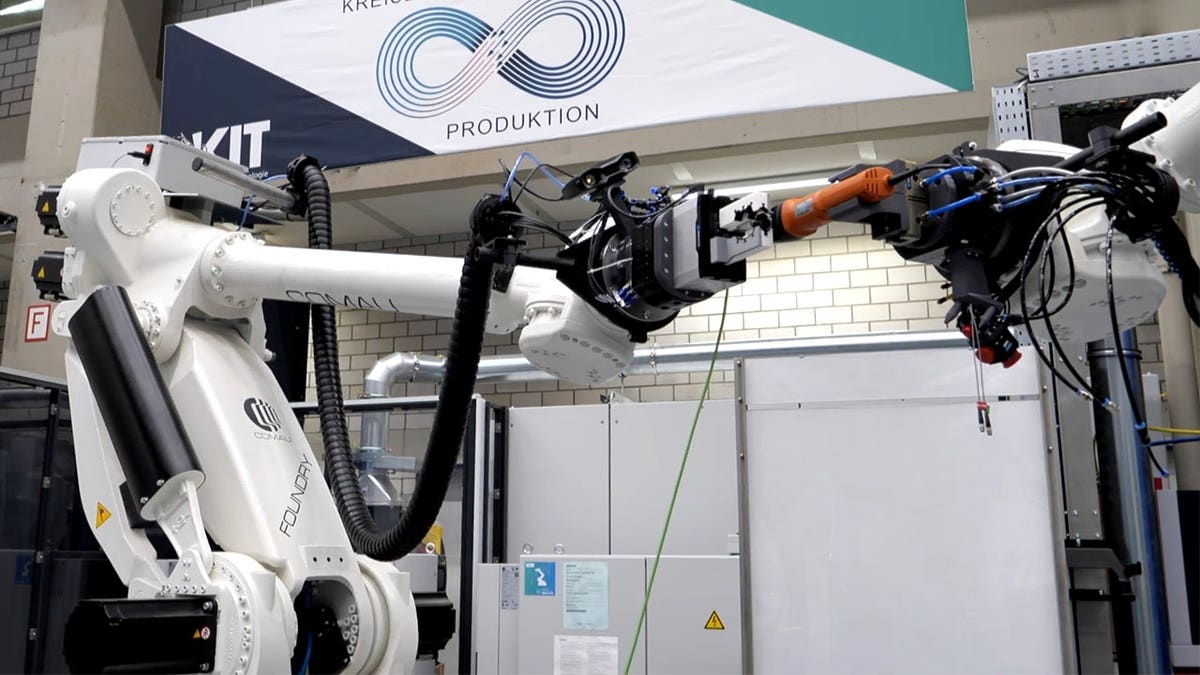
For decades, robots have played a vital role in manufacturing. Now, researchers are teaching them a crucial new skill: dismantling products when they malfunction. Currently, more than 4.6 million industrial robots are operational globally. As industries automate further, this prompts a crucial question. What becomes of machines and complex products when they break down?
Robotic Disassembly System Developed in Germany
Researchers at the Karlsruhe Institute of Technology in Germany have developed an innovative robotic system to address this issue. Unlike traditional systems, this one adapts to the unpredictable nature of older machines. A screw might be firmly lodged in place, or a part could be missing. The robotic system identifies these inconsistencies and modifies its approach accordingly.
This system uses probabilistic planning to adjust when machinery presents unexpected challenges. Such adaptive strategies are essential. Conventional robots follow a predetermined sequence in factories, but taking apart older machines is much more complicated. Years of use may distort how components align, demanding flexibility from the robots.
Understanding the Probabilistic Planning Approach
The system begins with a CAD model, assessing whether components behave as anticipated. If a part deviates from the model, the robot updates its understanding. For instance, if a screw behaves differently, the robot reevaluates its strategy. This use of the Partially Observable Markov Decision Process (POMDP) ensures the robot adjusts probabilities based on new information as it processes and interprets inspection data, CAD models, and its capabilities.
Practical Experiments and Implications
In laboratory experiments, researchers simulated scenarios like removing a stuck screw from an electric motor. The robot initially attempted to unscrew it before employing a milling tool when direct removal proved challenging. Another instance involved a missing screw in an angle grinder, which the system identified, saving time by not searching for it.
Traditional deterministic planning performs well when components act predictably. However, the probabilistic method shines when an alternative disassembly path is feasible. In experiments, it demonstrated faster disassembly times in scenarios with potential obstacles, suggesting that this approach could significantly enhance efficiency for repairing complex machinery.
Potential for Broader Applications
While this robotic system has not yet dismantled industrial robots, the concept could evolve to accommodate even more extensive systems. The technology might advance into facilities with robotic arms capable of various tasks, mimicking a reverse assembly line.
This innovation could encourage a more circular economy, where manufacturers recover valuable components from outdated products. If repairs become cheaper than creating new devices, this system could shift manufacturing toward preserving and repairing rather than outright replacement.
Implications for Manufacturers and Consumers
Currently, electronics often become e-waste due to the labor and cost involved in recovery. With these robotic advancements, manufacturers could recuperate more high-value parts. This approach could benefit industries where refurbishing equipment is economically viable, potentially reducing waste. It will be vital for manufacturers to consider future disassembly while designing products, ensuring ease of repair.
The Bigger Picture
This research showcases a potential future where robotic disassembly becomes a standard, influencing how manufacturers consider end-of-life for products. The system could ultimately facilitate a shift in how we perceive repair versus replacement. As robots improve in dismantling tasks, recovering expensive components becomes more feasible, impacting resource management adversely affected by traditional practices.
If these changes make repairing electronics more affordable than replacing them, would your habits concerning electronic device retention change? Share your thoughts by reaching out at Cyberguy.com.