
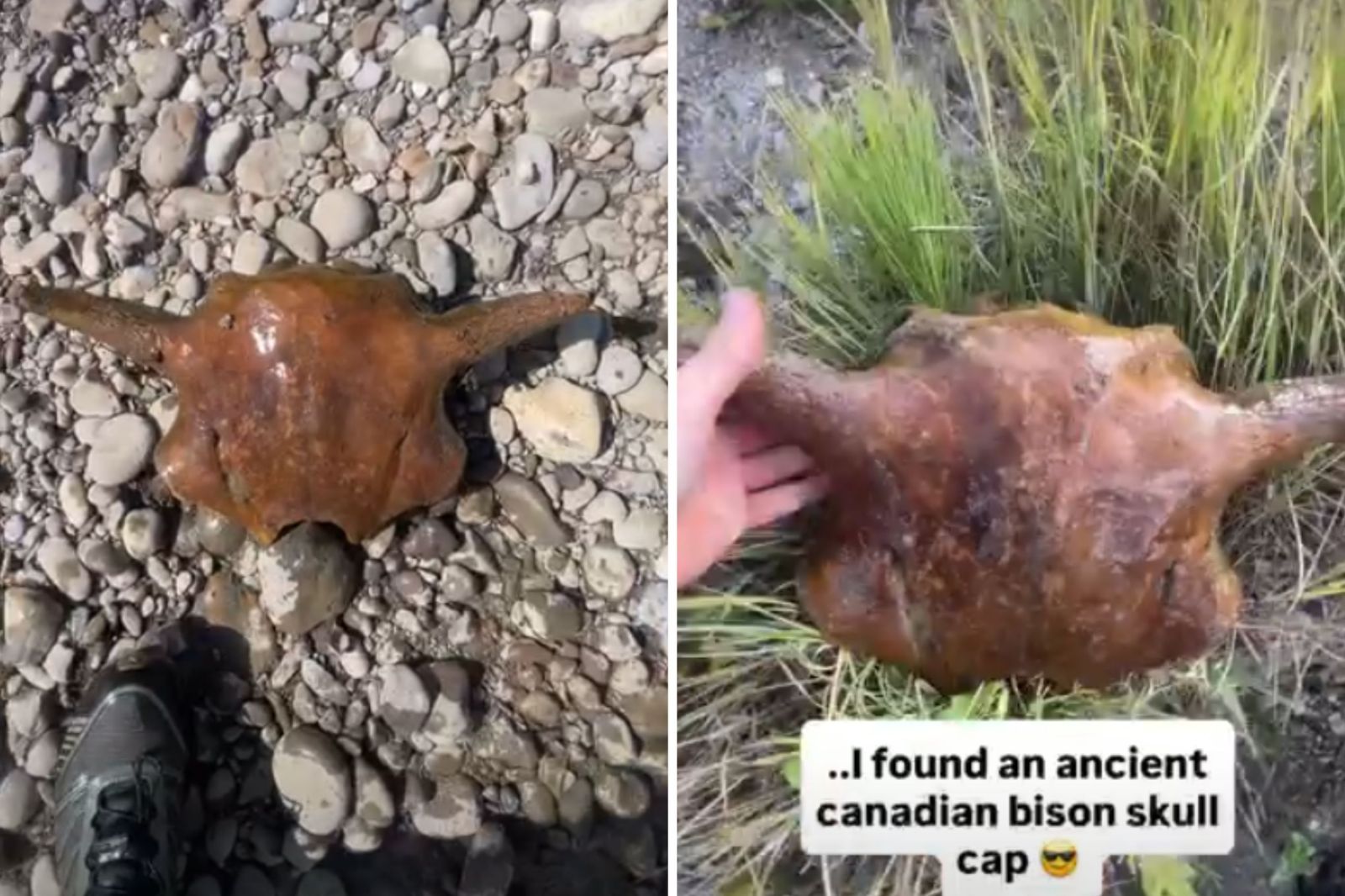
A fisherman in Alberta, Canada, came across a peculiar object protruding from the water while fishing. Dominic Boon, from near Banff, often seeks intriguing items on his outdoor adventures. This time, his find was exceptional.
Boon initially filmed the object as he approached it to document the moment of discovery. The footage was later posted on his Instagram, @dominicboon_. At first, his fishing companions thought it was a cow skull. However, Boon had a different suspicion.
“As soon as I saw horns, I believed it was a bison,” he stated.
Heavy Rain Unveils the Skull
The following day, experts confirmed it was indeed a bison skull. Curiosity turned to the timeline of how long it had rested in the creek.
This find followed an unusually wet summer. The Canadian Press reported that Alberta’s capital city set a record for rainfall. Boon speculated that heavy rain might have exposed the skull, potentially buried for ages.
Weighing several kilograms, this skull sparked thoughts of its ancient origins. Boon wondered if the bison remnants were much older than they seemed.
A 5,000-Year-Old Enigma
Seeking answers, Boon contacted Dr. Chris Jass from the Royal Alberta Museum. The expert confirmed, “It’s the cranium of a bison.” Though the skull’s exact age remains unknown, the curator estimated it could be up to 5,000 years old.
Boon noted the skull’s shape and eye sockets suggested an age much older than more recent remains. The youngest estimate for the skull is around 150 years old.
An article by the U.S. National Park Service explains that rapid burial can help preserve remains by shielding them from scavengers and weathering. Boon plans to visit the museum, situated about three hours away, for a deeper investigation.
“It’s just crazy,” Boon remarked.
A Glimpse into History
The bison species discovered faced near-extinction in Alberta. The Canadian Parks and Wilderness Society (CPAWS) reports plains bison once numbered over 30 million in North America. However, they nearly disappeared from Canada by the late 1880s due to overexploitation, habitat loss, and disease.
The wood bison also experienced a drastic population decline. Their numbers plummeted from 170,000 to just 200. Today, Alberta hosts an estimated 2,800 free-ranging wild wood bison, with plains bison occupying less than 1% of their historical Canadian range.
This background adds to the skull’s intrigue, despite its uncertain age. Whether it dates back 150 years or spans several millennia, Boon finds the discovery circumstances enthralling.