
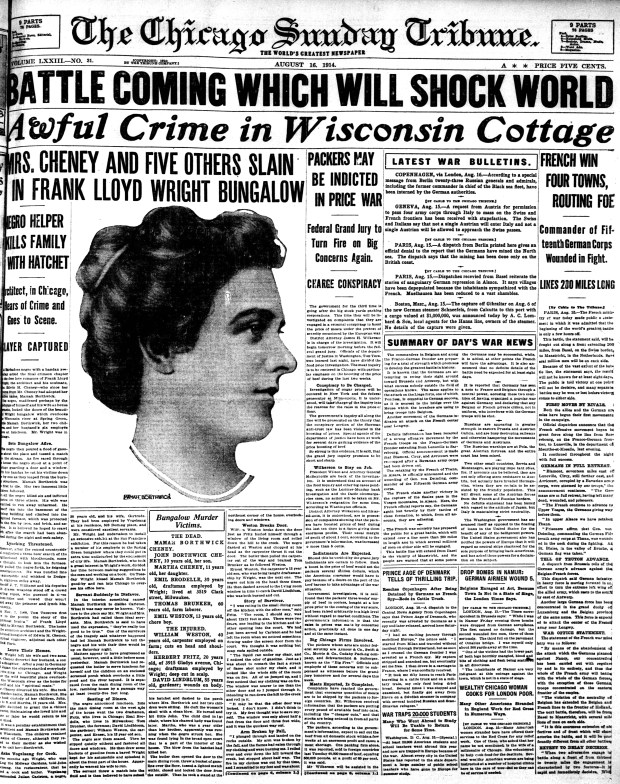
Tragedy at Frank Lloyd Wright’s Taliesin
On August 15, 1914, a horrific event shook Frank Lloyd Wright’s Taliesin in Spring Green, Wisconsin. A servant set the residence ablaze and attacked the fleeing inhabitants with a hatchet. The attack claimed the lives of seven people, including Martha “Mamah” Borthwick Cheney and her children, Martha and John. Julian Carlton, the handyman responsible for the attack, later ingested acid and died.
Frank Lloyd Wright’s sanctuary became marred by violence, highlighting the personal tragedies faced at renowned landmarks.
Weather Extremes in Chicago
Chicago witnessed various weather records on this date throughout history:
- High temperature: 98 degrees in 1944
- Low temperature: 48 degrees in 2004
- Precipitation: 1.87 inches in 1993
- Snowfall: None recorded
The Battle of Fort Dearborn
In 1812, a significant clash occurred involving 500 Potawatomi and their allies against 110 individuals evacuating Fort Dearborn. The conflict, once deemed a massacre, led to the death of 68 from the fort’s group. Native American losses remain unknown but were lower. The subsequent razing of Fort Dearborn the next day by the Potawatomi underscored the ongoing conflicts between Native Americans and European settlers.
Simon Pokagon observed the differing narratives: “When whites are killed, it is a massacre; when Indians are killed, it is a fight.”
Unveiling of Chicago’s Picasso Sculpture
On August 15, 1967, Chicago unveiled a monumental piece by Pablo Picasso. Despite Picasso never visiting the city, he gifted Chicago a striking sculpture for the Civic Center plaza. Reactions were mixed; some viewed it as a modern masterpiece while others found it perplexing. The debate over the sculpture’s meaning continues in the city’s cultural conversations.
The Tribune noted its potential long-term impact: “For decades, possibly for generations, Chicagoans will dispute about this huge semi-abstract head of a woman.”
Elvira Arellano’s Stand in Chicago
In 2006, Elvira Arellano, facing deportation, sought sanctuary in Adalberto United Methodist Church with her U.S.-born son. Caught using a fake Social Security number, her arrest and subsequent refuge in the church drew national attention. Arellano’s year-long stay in the church spotlighted the challenges faced by immigrants and stirred public debate on immigration policies.
Arellano’s case serves as a reminder of the human impact of immigration enforcement and policy discussions.