
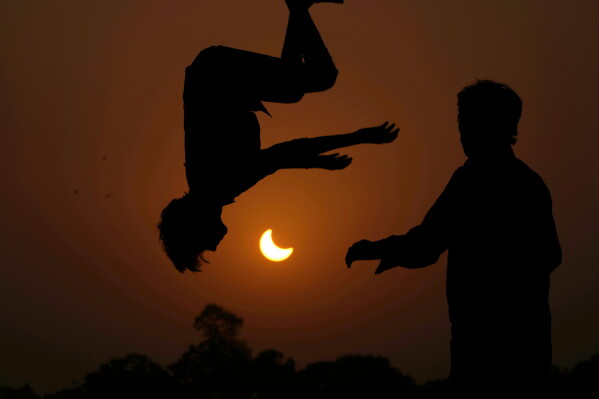
North America recently experienced back-to-back total solar eclipses. This time, the spotlight turns to Europe. On Wednesday, some Northern U.S. and Canadian regions could see a partial eclipse as the moon partially covers the sun.
Totality will start at the North Pole and move across Greenland, Iceland, Spain, and part of Portugal. The duration of daytime darkness will last only a few minutes. However, this marks continental Europe’s first totality since 1999. Spain will have another chance at totality next August, alongside North Africa and the Middle East.
In the U.S., the 2017 Great American Eclipse provided over two minutes of totality from Oregon to South Carolina. The 2024 eclipse will almost double that time, stretching from Mexico to Newfoundland. The next U.S. coast-to-coast total eclipse is set for 2045. Until then, residents should seize the opportunity to view a partial eclipse with proper eye protection using certified eclipse glasses.
Partial Eclipse Viewing Locations and Times
Several U.S. and Canadian cities can see a partial eclipse on Wednesday. Here are the details, listed alphabetically:
- Anchorage, Alaska: 28% coverage. Begins at 7:36 a.m., peaks at 8:21 a.m., ends at 9:09 a.m.
- Bangor, Maine: 24% coverage. Begins at 12:54 p.m., peaks at 1:53 p.m., ends at 2:49 p.m.
- Detroit: 3% coverage. Begins at 1:03 p.m., peaks at 1:36 p.m., ends at 2:08 p.m.
- Montreal, Quebec: 18% coverage. Begins at 12:50 p.m., peaks at 1:45 p.m., ends at 2:38 p.m.
- New York City: 9% coverage. Begins at 1:07 p.m., peaks at 1:54 p.m., ends at 2:38 p.m.
- Philadelphia: 7% coverage. Begins at 1:11 p.m., peaks at 1:53 p.m., ends at 2:35 p.m.
- St. Johns, Newfoundland and Labrador: 53% coverage. Begins at 2:28 p.m., peaks at 3:35 p.m., ends at 4:37 p.m.
- Toronto, Ontario: 8% coverage. Begins at 12:55 p.m., peaks at 1:40 p.m., ends at 2:23 p.m.
- Washington, D.C.: 4% coverage. Begins at 1:17 p.m., peaks at 1:53 p.m., ends at 2:27 p.m.
- Winnipeg, Manitoba: 5% coverage. Begins at 11:25 a.m., peaks at 12:02 p.m., ends at 12:40 p.m.
Ensure you wear certified eclipse glasses to protect your eyes while enjoying the spectacle.
“Witnessing a solar eclipse is an awe-inspiring celestial event, but never forget to prioritize safety.”