
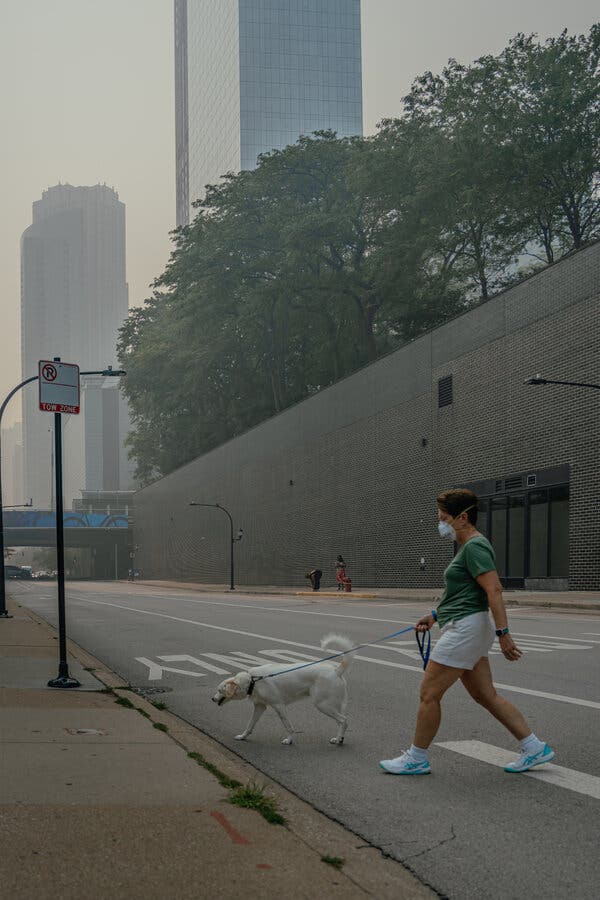
Smoke from wildfires in Ontario and Minnesota is affecting the Midwest and Northeast regions. On Sunday, forecasters predicted the worst air quality in the Great Lakes area.
Acrid smoke has been spreading from these Canadian wildfires into the Midwest and further into the Northeast and Mid-Atlantic areas. The smoke’s movement may change throughout the day, but the most severe conditions are likely in the Great Lakes region. Air quality alerts are active in areas including Minnesota, Wisconsin, Illinois, Indiana, Michigan, and parts of Ohio.
The Northeast saw some relief on Saturday when storms and rain helped disperse the smoke. However, this allowed more smoke to drift into the upper Midwest. On Sunday, new smoke clouds appeared over Wisconsin and Northern Illinois, and they are expected to reach the Ohio Valley. The East Coast might experience smoke later, though it is not expected to be as intense as earlier.
“We’re starting to tap into cleaner air from eastern Canada,” noted meteorologist Richard Bann from the Weather Prediction Center, indicating that this could improve air quality in the Northeast.
Air quality alerts remain in effect in parts of the Northeast and Mid-Atlantic, particularly in western and central New York and western Maryland. Little change is expected on Monday. According to meteorologist Frank Pereira, the thickest smoke concentrations will persist in the Great Lakes region, notably Michigan, Northern Illinois, and Indiana. Relief is anticipated later with the arrival of a strong weather system bringing widespread rain to the Great Lakes.
“A pretty strong system is going to be coming through into the area by late Monday, bringing widespread rain across the Great Lakes,” Pereira explained. “So that will help improve conditions and start to clear things out.”
However, conditions may not improve for long, as northwesterly winds from central Canada might introduce more smoke into the Great Lakes and Northeastern U.S. by midweek.
Key points to consider:
- More than 900 wildfires are active across Canada, with a significant number in Ontario. The smoke is drifting south into the U.S. via the Great Lakes.
- Wildfires in northern Minnesota also contribute to the air quality issues.
- Wildfire smoke is estimated to lead to tens of thousands of deaths annually, with climate change playing a growing role.
- Stay informed with the latest air quality maps and predictions.