
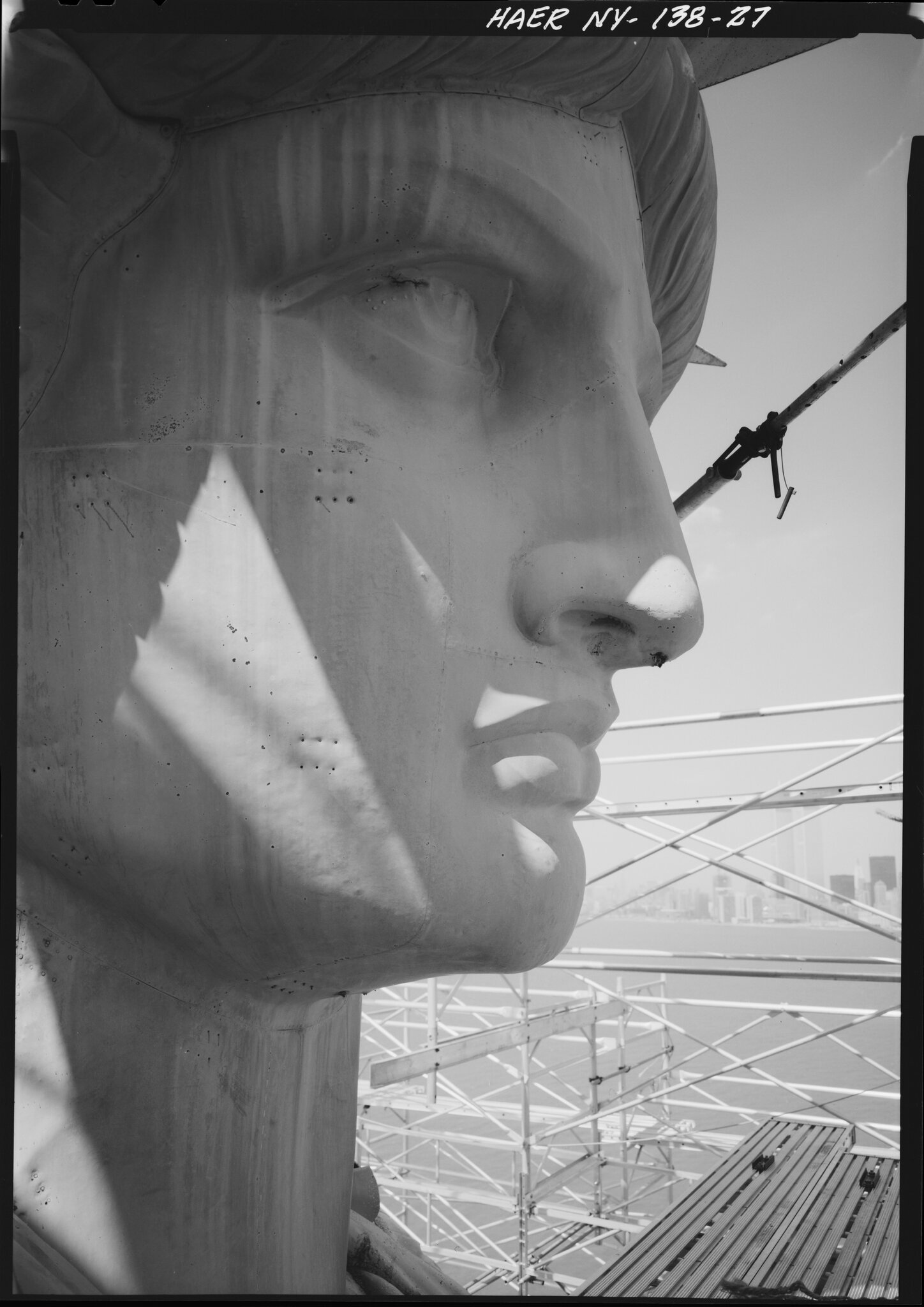
The Statue of Liberty is an iconic piece of American art, yet it originated as a French sculpture. Assembled first in Paris and then reassembled in New York Harbor, this colossal figure has embedded itself in American culture as a symbol of freedom and hope.
Funded by public contributions, the statue was supported by photography and public relations efforts. Despite its beginnings as an object of French origin, it has become a lasting emblem of its adopted homeland, embodying America’s identity. After its dedication in 1886, it was named America’s Mother of Exiles. However, it is just as much an object as an icon, reflecting both the grandeur and fragility of modern ideals.
The statue represents a melting pot of ideas and imagery. In French, the noun ‘liberty’ is feminine, prompting questions about what form liberty should take. Is she peaceful or revolutionary? A nurturing figure or a relentless force spreading her influence westward?
In the latter half of the 19th century, as imperialism and industrialization surged, French artists like Frédéric-Auguste Bartholdi were creating monumental works, addressing vast ideals. Bartholdi committed his life to sculpt a symbol of freedom as grand as a mountain. His inspiration drew from immense creations, like the Colossus of Rhodes and giant Egyptian statues sketched during his travels with French military expeditions.
Bartholdi’s grand vision was supported by funds and labor from France and Egypt during their shared public works, such as the Suez Canal. His initial proposal for a lighthouse ‘Egypt Bringing the Light to Asia’ was costly and impractical. As France faced political turmoil, Bartholdi looked overseas to the United States, envisioning a gift for America’s centennial while promoting liberal causes at home.
Supported by abolitionist Édouard de Laboulaye, Bartholdi’s journey to America fueled his understanding of the country’s scale. It was there he found inspiration for Liberty Enlightening the World, symbolizing universal freedom. The statue’s design borrowed elements from his discarded Egyptian project while incorporating new features, like a Roman peplum and a distinctive crown.
To build the massive statue, Bartholdi’s team employed repoussé, an ancient technique of hammering thin copper sheets, making the sculpture feasible for transport across the Atlantic. In Paris, Liberty became a temporary spectacle, a symbol of France’s republican rebirth.
The engineering marvel behind the statue involved Gustave Eiffel’s design, featuring an iron framework supporting Liberty’s copper skin. The statue’s modularity allowed for its assembly in Paris and reassembly in New York, embodying both structural ingenuity and artistic vision.
Upon its completion, workers riveted the 300,000 copper plates by hand. This method echoed the kit constructions of modern skyscrapers where the structure does not depend on the exterior for support. The Statue of Liberty, much like Eiffel’s later tower, represents a shift toward mobility and modular design.
The statue was unveiled in 1886, inaugurated by President Grover Cleveland amidst rain. Although initially a symbol of celebration, it soon became synonymous with immigration and the welcome of ‘huddled masses’ seeking refuge. As Liberty evolved, she transformed into a national allegory, embodied in currency and passports.
Visiting the statue reveals much about its construction. The interior structure and copper surface present a harmony of French precision and American ambition. The engineering creativity represents both real and ideal aspects of democracy — multiple parts coming together to form a meaningful whole.