
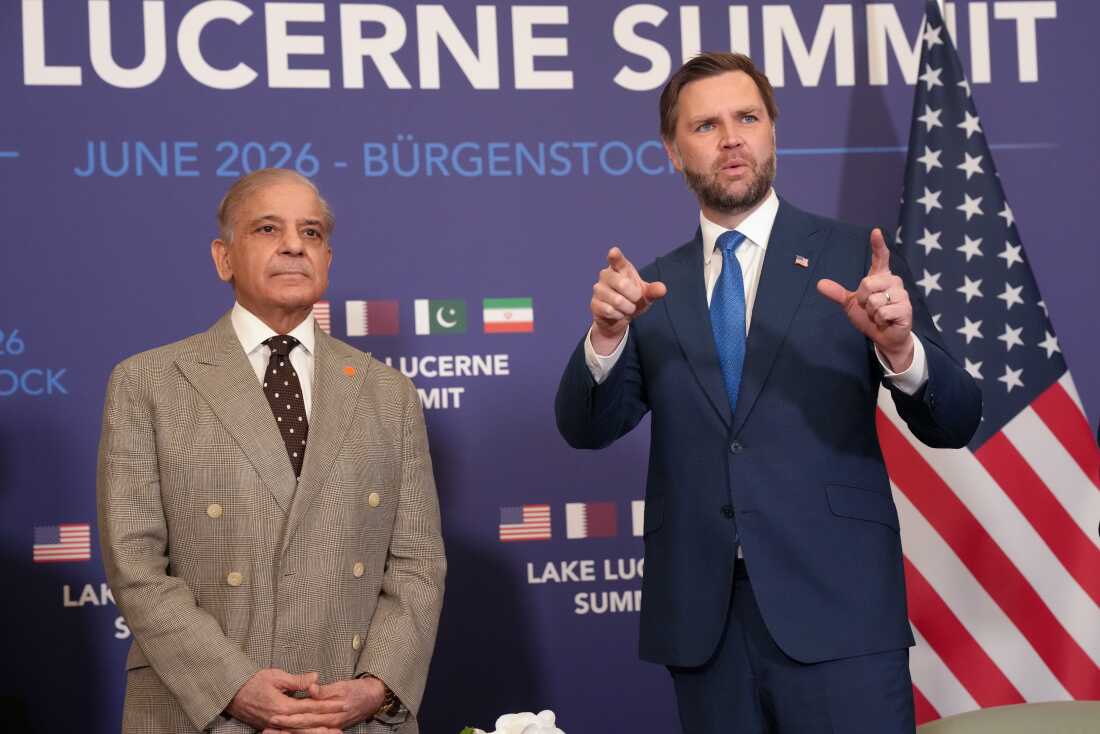
On June 21, 2026, Vice President JD Vance participated in high-level discussions aimed at advancing solutions to end the Middle East conflict. These talks took place at the Bürgenstock Resort in Obbuergen, near Lucerne, Switzerland.
During these discussions, Vance engaged with Pakistan’s Prime Minister Shehbaz Sharif. This meeting occurred amidst President Trump’s threats of further attacks on Iran if tensions in Lebanon involving Iranian-backed groups continued.
“Iran must immediately stop their highly paid PROXIES in Lebanon from causing trouble. If they don’t, we’ll hit Iran very hard again, only harder,” Trump stated on social media.
Amidst this backdrop, Iran decided to close the Strait of Hormuz due to ongoing Israeli strikes against Hezbollah in Lebanon. Iran accused the U.S. of not managing Israel’s actions, which violated a tentative agreement that aimed to cease hostilities in Lebanon.
Vice President Vance met with various representatives, including Pakistan’s Prime Minister Shehbaz Sharif and Field Marshal Asim Munir. Iranian delegates, Qatar mediators, and Rafael Grossi from the International Atomic Energy Agency were present. These discussions targeted a Memorandum of Understanding signed by the U.S. and Iran, which is facing challenges early on.
The state of the Strait of Hormuz, a critical maritime passage, was also a focal point. Despite Iran’s announcement, U.S. Central Command reported that shipping continued without disruption.
The negotiations included dialogues about Iran’s nuclear program. This issue remains controversial, with Iranian President Masoud Pezeshkian asserting Iran’s stance on uranium enrichment.
“What is certain is that we will never back down from the right to enrich uranium,” Pezeshkian stated, emphasizing Iran’s peaceful intentions for its nuclear program.
Despite declaring a ceasefire, heavy exchanges continued between Israeli forces and Hezbollah, complicating the negotiation efforts. Vice President Vance expressed optimism, saying significant progress was made.
Vance acknowledged the complexities with a note on continued efforts.
“These things are always a little bit messy, but I actually feel great about where we are in Lebanon,” Vance remarked.
He affirmed the U.S.’s role in mitigating the conflict more than any other government.
On Saturday, Israeli strikes resulted in casualties, with reports of at least 16 deaths, including civilians. Israel clarified that its actions responded to Hezbollah’s projectile attacks. Meanwhile, Hezbollah claimed its strikes were defensive.
On Sunday, the UN interim head announced a halt in attacks for the first time since the war began, despite the absence of formal agreements from Israel or Lebanon. Iran calls for U.S. commitment to enforce respect for Lebanese sovereignty as the Memorandum stipulates.
This agreement seeks an end to military activities in Lebanon, underscoring the negotiation’s importance.
Information contributed by NPR’s Jane Arraf.