
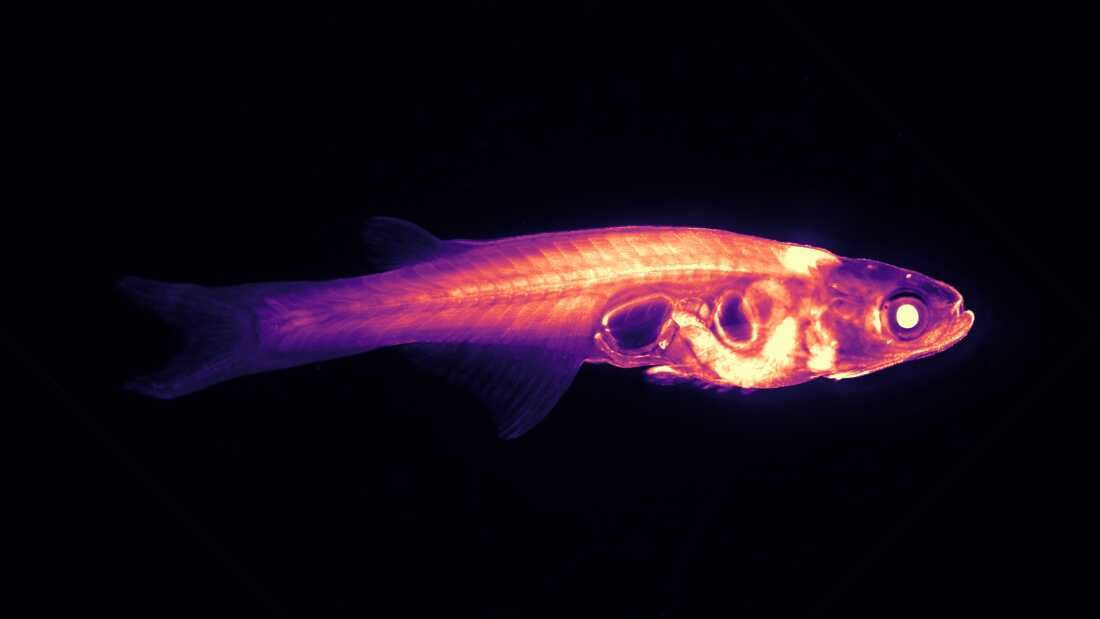
Fluorescent proteins in transparent Danionella fish allow scientists to track processes in the brain and body. Researchers at a major brain science center hope to uncover new information about the brain-behavior connection by studying these fish.
The Howard Hughes Medical Institute’s Janelia Research Campus, located near Washington, D.C., has launched an initiative to use artificial intelligence and Danionella fish to understand how the brain controls complex behaviors such as social interaction. Gerry Rubin, Janelia’s founding executive director and head of biology, describes the effort as a significant, high-risk endeavor that holds much promise.
To support this research, Janelia plans to expand its facilities to 6,000 square feet, accommodating thousands of tanks and increasing the number of scientists studying Danionella from about 10 to over 100. Scientists aim to observe entire fish brains in real time to gain insights into how the brain drives behavior in various species, including humans. “We all evolved from fish,” states Nelson Spruston, Janelia’s executive director, noting the similarities between human and fish brains.
The Brain as a Black Box
In understanding brains, Danionella offers advantages over other common lab animals like rodents. Typically, bones and skin hide the brain, but Danionella have transparent skin and lack the top part of their skull. While zebrafish, a more commonly used lab model, are larger and only transparent in larval stages, Danionella remains less understood. The species Danionella cerebrum, favored for research, was recognized officially as a separate species in 2021. As a result, Danionella is increasingly present in research labs.
“Having an animal with a clear head and body is extremely useful for neuroscience,” says Matt Lovett-Barron from the University of California, San Diego.
Transitioning from Flies to Fish
Janelia is renowned for its work on fruit flies, notably a 2024 project mapping 54.5 million connections in a fly brain. Now, HHMI President Erin O’Shea sees this new challenge with Danionella as a vital step towards unraveling the brain-behavior connection. Understanding how physical brain processes translate into memory and decision-making demands viewing the entire brain in action.
Rubin asserts that observing all neurons firing simultaneously is crucial for understanding how the brain functions holistically. However, analyzing the resulting mass of data from three times as many neurons compared to fruit flies will require artificial intelligence.
Progress in Brain Study Techniques
Janelia’s strategy includes developing tools to make Danionella research accessible globally. Creating a comprehensive map of fish brain connections akin to the fruit fly project is essential. Scientists aim to collaborate with artificial intelligence for faster discoveries. While current methods involve immobilizing the fish, Spruston envisions freely swimming experiments, though significant engineering challenges lie ahead.
Researchers like Lovett-Barron anticipate these innovations. He employs virtual environments to study how Danionella use visual cues for schooling. New tools would enhance understanding of how fish brains manage complex social behavior.
Even with advances, solving the brain-behavior enigma remains a long-term ambition. O’Shea would be thrilled to understand just one complex fish behavior within a decade. Janelia’s progress includes monitoring numerous neurons in larval zebrafish, paving the way for studies of adult Danionella with 650,000 neurons, compared to the 86 billion in human brains.