
School districts across the country face challenges from declining student enrollment, reduced funding, and the end of pandemic relief funds. As a result, discussions about school closures and rightsizing are becoming more common. District leaders must balance cost reduction with the need to accelerate academic recovery for students. However, not all communities are equally affected by school closures.
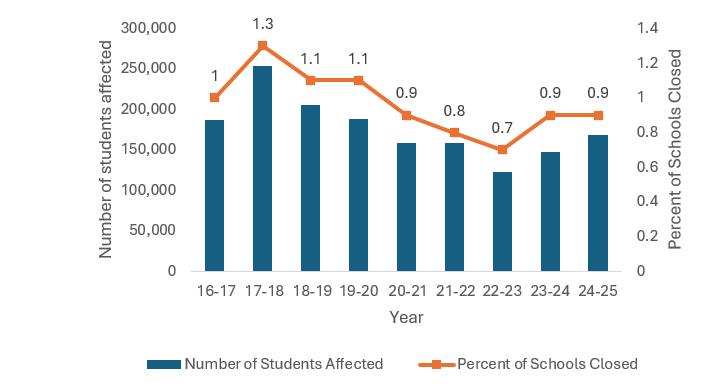
Research indicates that school closures disproportionately impact Black students and those from low-income communities. These groups, already facing significant educational challenges due to the pandemic, are further disadvantaged. Approximately 1% of public schools have closed annually over the past decade, translating to 671 to 1,174 closures each year, affecting between 100,000 and 250,000 students. This represents a significant disruption, comparable to displacing the student body of one large district annually.
The pandemic temporarily slowed the rate of permanent school closures due to paused accountability policies and federal relief funding. However, as these supports diminished, closure rates returned to pre-pandemic levels. The national closure rate peaked at 1.3% in 2017-2018, declined to 0.7% in 2022-2023, and rose to 0.9% over the last two years, indicating renewed pressures leading to closures.
Permanent School Closure Rates and Affected Students
School closures heavily impact Black and low-income communities. Historical data shows majority-Black and high-poverty schools are more often targeted for closure. In the 2024-2025 period, schools serving a majority of Black students accounted for about one-quarter of closures, although they comprise less than 10% of all schools. High-poverty schools experience similar overrepresentation.
This pattern persists even when enrollment declines are similar across schools. In schools with a 50% drop in enrollment, those serving all Black students face closure rates twice as high as those serving none. Pandemic-related achievement trends demonstrate that marginalized students encounter the largest academic setbacks and need consistent environments to maintain progress. Closing schools disrupts relationships and learning, threatening recent academic gains.
The effects of closures are particularly disruptive for students not transferred to stronger schools. Short-term declines in achievement are common, especially when students move to schools of equal or lower quality. For example, in Chicago, displaced students experienced setbacks in reading and math unless they transferred to higher-performing schools. Similar patterns were observed in Philadelphia.
System-Level Barriers and Financial Implications
System-level barriers like long commutes, poor transportation, and limited school seats hinder access to better schools, limiting potential academic benefits of closures. School closures do not always yield cost savings. National evidence shows fiscal benefits vary, and long-term studies from Texas link closures to negative outcomes like lower test scores and college attainment, with pronounced effects on students from low-performing and economically disadvantaged schools.
To avoid perpetuating inequities, districts must approach rightsizing without dismantling critical community anchors. Where closures are unavoidable, they should be executed fairly, transparently, and with community engagement. This approach includes ensuring displaced students do not attend lower-quality schools and supporting receiving schools with smaller class sizes, transportation, and counseling to prevent declines in attendance and achievement.
Policymakers need to tackle the structural causes making closures appear necessary, such as gentrification, decreasing state education funding, and housing or economic trends affecting enrollment. District leaders should not manage these issues alone. While some school closures may be unavoidable, asking the same communities to bear the brunt repeatedly is unjust. Leaders can opt for strategies that protect progression and do not disproportionately burden communities with the greatest educational debt.
Megan Kuhfeld, Ph.D., and Ayesha K. Hashim, Ph.D., contribute this perspective based on their work with the Northwest Evaluation Association.
Copyright 2026 Nexstar Media Inc. All rights reserved. This material cannot be published, broadcast, rewritten, or redistributed.