
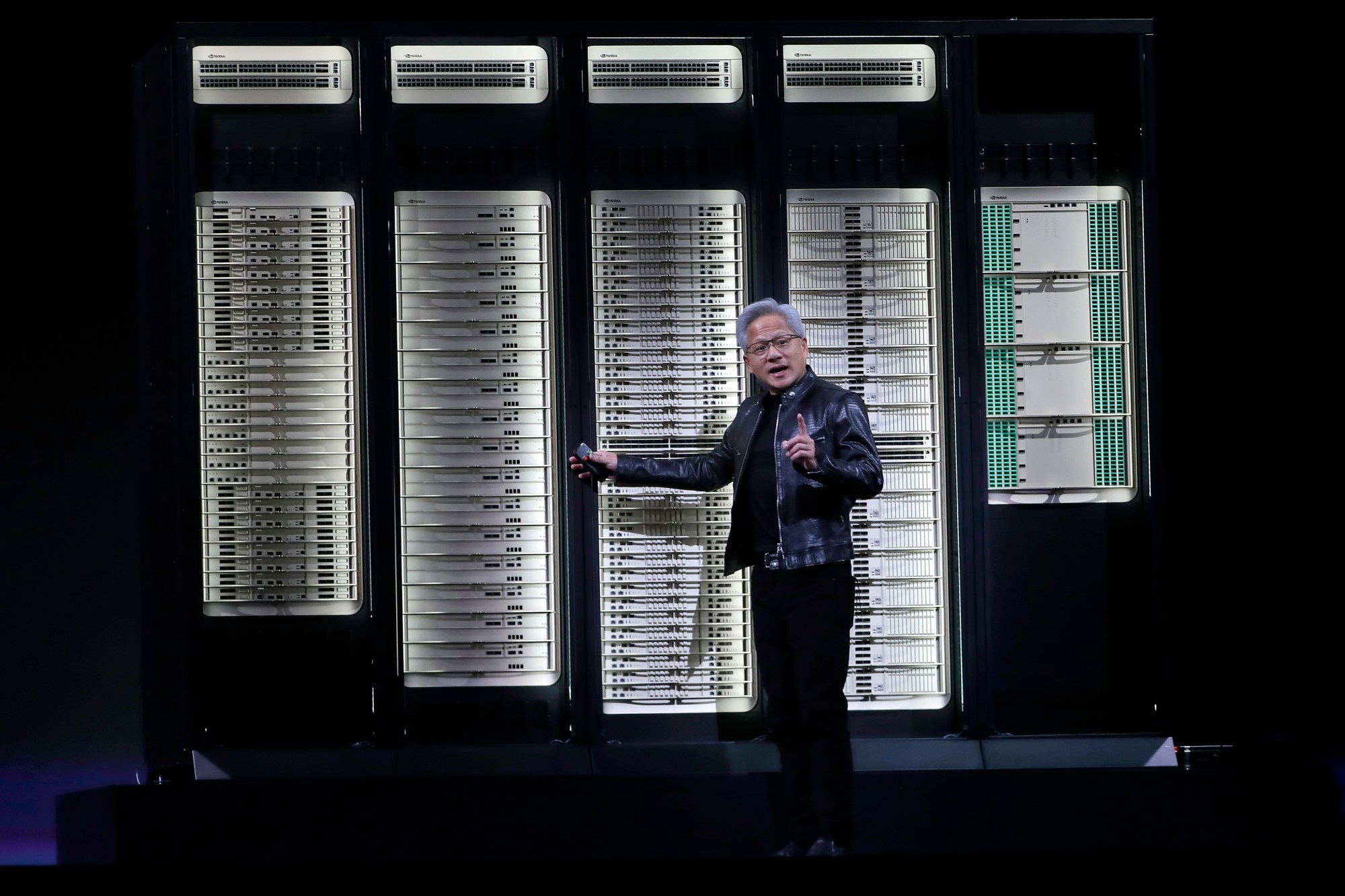
At the Computex 2026 exhibition in Taipei, Nvidia CEO Jensen Huang announced the release of new powerful chips designed to integrate advanced artificial intelligence functions into both laptops and desktop computers. These new models, developed by brands such as Microsoft and Dell, are anticipated to hit the market later this year.
Nvidia, headquartered in Santa Clara, California, has already achieved significant success by supplying high-end chips to data centers worldwide, benefiting from the ongoing demand for AI technology. However, the company now aims to extend its reach within AI systems and products.
During the annual Nvidia GTC event in Taipei, Huang, who founded Nvidia and maintains his role as CEO, shared news about the company’s collaboration with Microsoft. “We are going to reinvent the PC,” Huang stated during his keynote speech. He introduced the Nvidia RTX Spark superchip, a combination of CPU and GPU capabilities, which will power the upcoming Windows laptops and desktops known as “AI personal computers.” These are expected to be launched in the fall.
Nvidia, the world’s most valuable company, surpassing Apple, Alphabet, and Microsoft, plans to challenge the market dominance of chipmaking contenders Intel and AMD with its new superchips. Following the announcement, Nvidia’s U.S. trading shares rose by nearly 4%; in contrast, Intel and AMD experienced a decline of over 3%.
The new AI-enabled PCs will cater to both creation and gaming. Huang highlighted features such as an autonomous AI agent, emphasizing its ability to interact and assist users by reading files and conducting research. Microsoft’s statement reinforced this, announcing that the RTX Spark superchips would support “highly capable AI models” and handle complex workloads. These PCs can run AI agents locally, a notable advancement according to Nvidia. “This is the first across the lineup of PC reinvention for 40 years,” Huang emphasized.
Lian Jye Su, chief analyst at Omdia, noted growing consumer interest in personal AI agents, adding that this development brings more choice to consumers. Neil Shah, a co-founder of Counterpoint Research, remarked that these innovations will change PCs’ appearance over the next decade and boost agentic AI applications in households.
In addition to this major announcement, Huang introduced Nvidia’s new Vera CPUs for data centers, presenting them as a key growth driver fueled by the rise of AI agents. Early users include Anthropic, OpenAI, and SpaceXAI.
Nvidia also showcased a humanoid robot reference design, the “Isaac GR00T.” Standing nearly six feet tall, this design is based on Unitree’s H2 chassis and includes finely controlled dexterous hands developed by Sharpa in Singapore, aimed at enhancing research efforts in the higher education sector.