
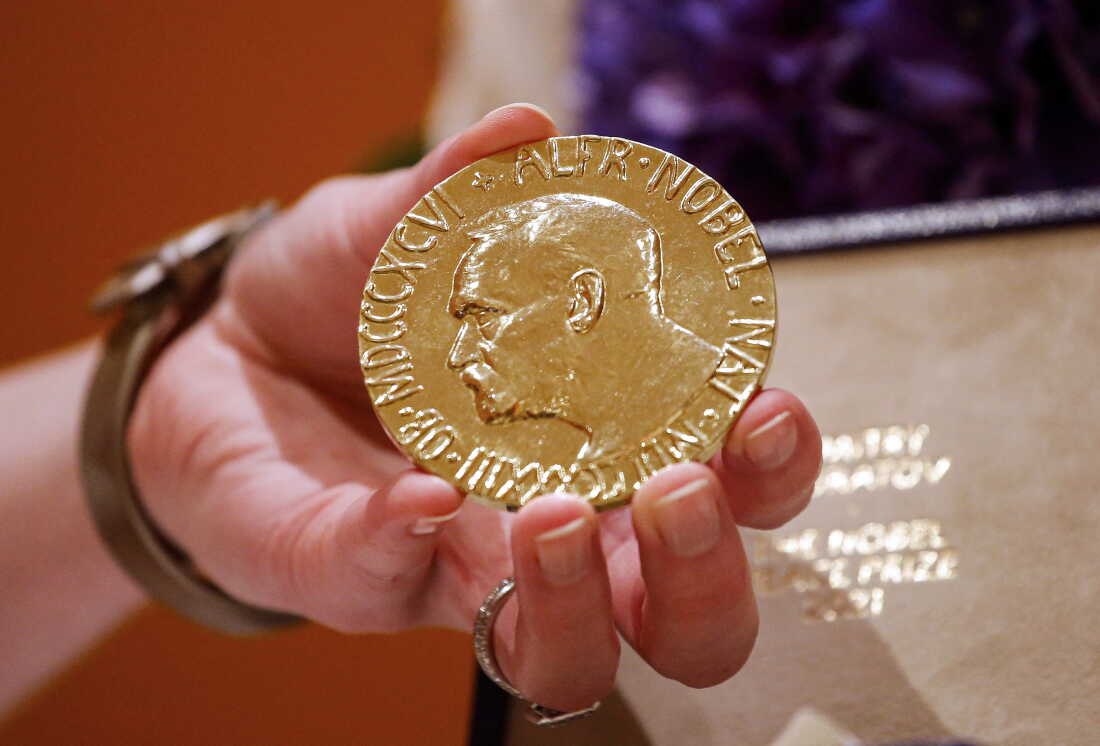
A woman displayed the 2021 Nobel Peace Prize medal awarded to Russian journalist Dmitry Muratov in New York in 2022. As Nobel Prize season unfolds, speculation arises about the 2026 Nobel Prize in economics. This upcoming Monday, the prestigious economics award will be announced, drawing interest from the economic community.
Understanding the Nobel Prize in Economics
Officially known as the Sveriges Riksbank Prize in Economic Sciences in Memory of Alfred Nobel, this award wasn’t established by Nobel himself. Sweden’s central bank initiated it in 1968. The selection process considers various factors, often favoring older candidates whose work has shown significant impact over time. Occasionally, the prize reflects contemporary trends, while other times, it recognizes technical advancements in the field.
Predicting the Winner
One common way economists attempt to predict Nobel laureates is by using prediction markets. These markets process dispersed information into a single value, showcasing public expectations. A prediction market for the 2026 economics prize exists but is small, with about $11,000 in trading volume compared to much larger markets like Kalshi’s primary market for the 2024 presidential election. This limited trading volume makes it less reliable as a predictor.
Current Front-Runners
As of October 6, economists Ariel Pakes and Susan Athey led the rankings, with Robert Barro closely following.
Ariel Pakes: Industrial Organization
Pakes, of Harvard University, has contributed significantly to the study of industrial organization, examining how market structures influence competition. His work, specifically the BLP model, assists in analyzing the potential impacts of mergers on consumers. This area remains highly relevant as antitrust discussions gain prominence.
Susan Athey: Economics and Technology
Athey, a professor at Stanford, focuses on the economics of digital technologies. Her pioneering use of machine learning has helped understand causal relationships in economic data. Athey’s contributions extend beyond academia, as she actively addresses gender-related challenges within the economics profession.
Robert Barro: Macroeconomic Expectations
Barro’s work reshaped macroeconomics by focusing on expectations. His research suggests that government actions like tax cuts may not always stimulate the economy as expected. This theory, known as Ricardian equivalence, remains debated, demonstrating its ongoing influence on economic thought.
Other Contenders
- Thomas Piketty and Emmanuel Saez: Renowned for research on economic inequality, their work highlights the concentration of wealth among “the one percent.”
- Raj Chetty: Known for utilizing large datasets to explore the American Dream, Chetty’s research addresses inequality and mobility.
- David Autor: Autor examines how technology and globalization have transformed labor markets and contributed to growing inequalities.
- Janet Currie: Currie’s research emphasizes the long-term economic effects of childhood disadvantage and the benefits of supportive government programs.
The predictions on platforms like Kalshi vary, and the market’s small size means results can be influenced by a few active participants. Stay updated through the Planet Money newsletter for insights into who will claim the economic honor and the impact of their work.