
Wendell E. Berry, a celebrated novelist and poet, dedicated his life to both farming and literature. He cultivated the same land in Henry County, Kentucky that his family worked for seven generations. Berry passed away at his home in Port Royal, Kentucky at the age of 92.
Berry began his writing career in academia. He studied at the University of Kentucky and Stanford University. By 28, he held a significant role as an English professor at New York University. Yet, city life did not appeal to him. In his 1968 essay A Native Hill, Berry explained his choice to leave the literary world of New York after only two years, returning to Kentucky. He wrote, “I had made a significant change in my relation to the place: before it had been mine by coincidence or accident; now it was mine by choice.” His commitment became firm and unwavering, and he lived out his days there, fulfilling his hope.
Berry’s farm in Henry County deeply inspired his writing and environmental advocacy. He criticized industrial farming and held a deep skepticism towards technology. He never used a computer, preferring to write by hand before typing on a typewriter bought in 1956, which sufficed throughout his life. His works encouraged a slower pace of life, capturing the essence of nature and community with vivid descriptions.
“Light and wind are running / Over the headed grass / As though the hill had / Melted and now flowed.”
While Berry’s poetry often depicted natural beauty, some works addressed political issues. His 1968 poem “Against the War in Vietnam” expressed stark opposition to war and technological consequences:
“In the name of ourselves we ride at the wheels of our engines, in the name of Plenty devouring all, the exhaust of our progress falling deadly on villages and fields we do not see. We are prepared for millions of little deaths.”
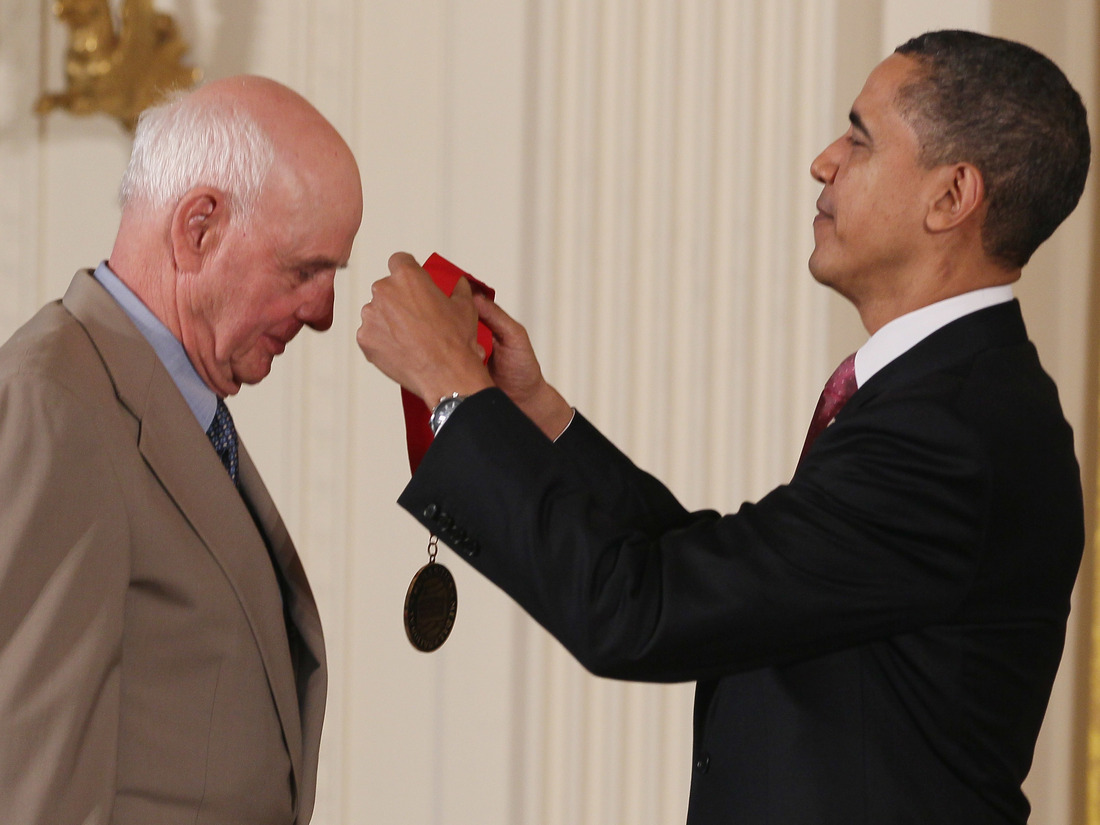
President Barack Obama honored Berry with the National Humanities Medal in 2010. In 2015, Berry became the first living author inducted into the Kentucky Writer’s Hall of Fame. In a 1998 interview on All Things Considered, Berry hesitated to give advice to young people. However, pressed by interviewer Noah Adams, Berry shared that, if possible, young individuals should “stop some place, and stay there. Learn the history of it, and the names of the plants and animals and the neighbors.”
Berry’s legacy stands as a testament to observing, connecting, and valuing the world around us.