
Tropical Moisture Threatens Southwestern United States
A weather system is channeling tropical moisture towards the southwestern United States, raising the risk of heavy rain, flash flooding, and mountain snow over the Halloween weekend. Several states may face flooding issues after recent storms.
AccuWeather meteorologists predict this developing pattern could lead to significant rainfall in Southern California. The full extent relies on how separate storm systems combine with Pacific moisture.
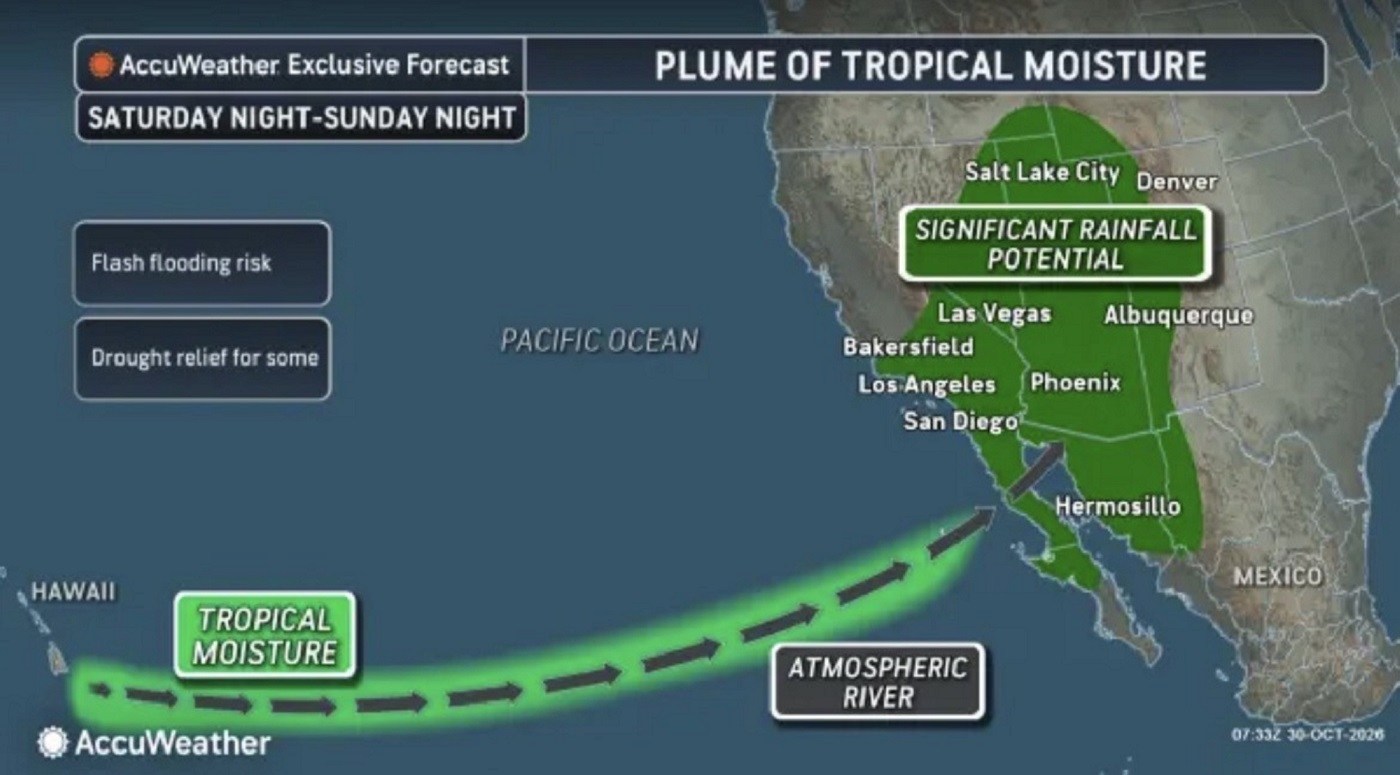
An atmospheric river, a long, narrow corridor of water vapor, might transport moisture from tropical areas toward the West Coast. If this corridor stretches from near Hawaii to the western U.S., it becomes known as a Pineapple Express.
Understanding the Pineapple Express
The Pineapple Express is a type of atmospheric river, carrying warm, moisture-laden air from the tropical Pacific, often near Hawaii, toward North America’s West Coast. Described as rivers in the sky by NOAA, these transport vast amounts of water vapor in narrow atmospheric bands.
When such moisture reaches land and meets weather systems or mountains, it can cause long periods of heavy rain and significant snowfall at higher elevations. Though valuable for drought areas, these systems can be perilous if they bring rapid, intense precipitation. This can overwhelm drainage systems, rapidly increase river levels, and trigger flash floods and mudslides, especially in wildfire-affected locations.
AccuWeather Map Forecasts Potential Rainfall
AccuWeather’s map outlines probable weather system development, highlighting regions at risk of significant precipitation over Halloween weekend into the following week. Two storms are drawing tropical moisture toward the western U.S. One approaches from Alaska, and another emerges near Washington state’s coast. Tropical Rainstorm Olana, close to Hawaii, may also contribute moisture.
Meteorologists suggest these storms will move separately along the Pacific coast. In this scenario, major Southern California cities like Los Angeles and San Diego would see limited rainfall, generally less than an inch. However, south- and west-facing mountain slopes might get up to 3 inches.
Another scenario, where storms and moisture combine earlier, could lead to a larger, slower-moving system near the coast. This would increase the possibility of heavier rain and widespread flash flooding in Southern California.
Increased Flooding Risk in the Southwest
Southwestern states such as Arizona, Utah, New Mexico, and Colorado risk significant rainfall leading to flash flooding, debris flows, and rising rivers from late this weekend into the next week. Rainfall could reach 1 to 2 inches across the area, with central Arizona, southwestern Colorado, and Utah seeing 2 to 4 inches. AccuWeather warns of a possible Local StormMax of 7 inches.
This additional rain is a concern, given recent high precipitation in some areas. Parts of the San Juan Mountains in northern New Mexico and southern Colorado collected 5 to 10 inches of rain last week, causing flooding and record streamflows.
Further downpours might cause renewed flooding, affecting cities like Phoenix and Flagstaff in Arizona, Durango in Colorado, and Farmington in New Mexico.
The broader weather system is expected to bring showers to the Pacific Northwest and snow to the Rocky Mountains’ higher elevations, including regions in Montana, Idaho, Wyoming, Colorado, and Utah.
Forecasters are closely monitoring this weather pattern as timing and potential rainfall amounts become more defined.