
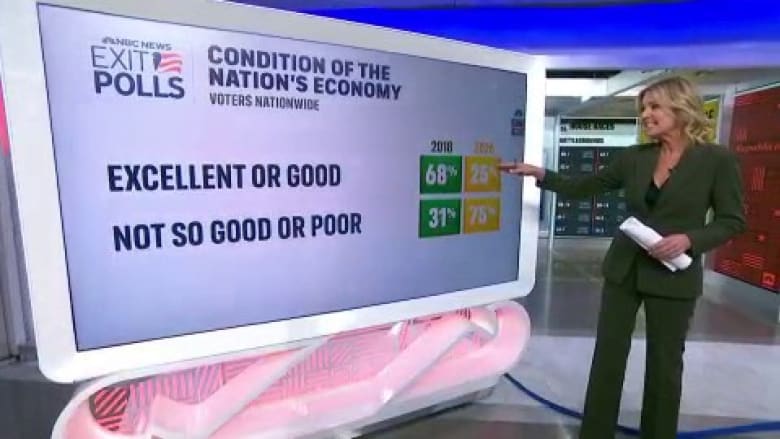
Americans are increasingly pessimistic about the economy compared to Trump’s first term. Back in 2018, during the midterms, 68% of voters said the economy was excellent or good in exit polls. Now, just 25% share that sentiment, with 75% rating it as not so good or poor according to NBC News’ Exit Polls.
Voters are also concerned about their financial situations. In 2018, 85% said their family’s finances were better or the same as two years prior. Now, 82% say their finances are worse or unchanged. Consumer prices have risen faster than paychecks, with 3.7% inflation over the last year compared to 3% wage growth. Families spent significantly more on necessities in 2025 than in 2024, straining budgets.
Blame is largely placed on Trump’s policies; over 60% of voters attribute high prices to Trump, and nearly two-thirds say tariffs have hurt the national and local economy. Voters are stressed about finances as they head to the polls.
“In 2018, 85% said their financial situation was better or the same. Now, 82% say it’s worse or unchanged.”
NBC News reporters spoke with Texan voters at Klein Multipurpose Center in Harris County. Cindy Bonilla Candanedo, a new citizen voting for the first time, expressed concern over immigration issues impacting Latino hospital visits and prioritized school funding and healthcare.
Voter Beth Burgess, who usually supports Republicans, voted for candidates from both parties this time, concerned primarily with better school funding.
Charlie Beal expressed dissatisfaction with high costs and Republican Gov. Greg Abbott’s handling of immigration policies.
Early election signs point favorably for Democrats in Indiana, with Democratic nominee J.D. Ford leading in Hamilton County’s early voting results by a wide margin, signaling possible Democratic gains.
Alaska shows record early voter turnout, breaking previous records with over 105,000 early votes cast. The Senate battle between Democrat Mary Peltola, Republican incumbent Sen. Dan S. Sullivan, and independent Daniel J. Sullivan Jr. is unfolding.
Negative views of the Republican Party have increased since 2022, while opinions on the Democratic Party have remained stable. Economic concerns persist, with voters expressing more support for capitalism than socialism.
In Georgia, voters cited economic concerns and personal values when supporting Abdul El-Sayed. “We’re a superpower, yet people can’t afford groceries,” one voter noted.
Control of the Senate remains tightly contested. Races in traditional battlegrounds and reliably red states are drawing attention. Early poll closings in Indiana and Kentucky may provide early insights.
Voters are concerned about AI, with many expressing fears it will hurt society. Opposition to new data centers is widespread, transcending political lines.
Trump’s approval ratings are low; exit polls show a disapproval rate of 62%, with many voters citing him as a major factor in their decision-making.
A polling site in Georgia extended hours due to a disruption, while in Iowa, DOJ election monitors have been present without interference.
Voter economic fears continue: 44% say they are worse off financially than two years ago, with many blaming Trump’s policies for high costs.
Polling issues are being resolved nationwide, and the administration is deploying a record number of election monitors to ensure voting rights and fair processes.