
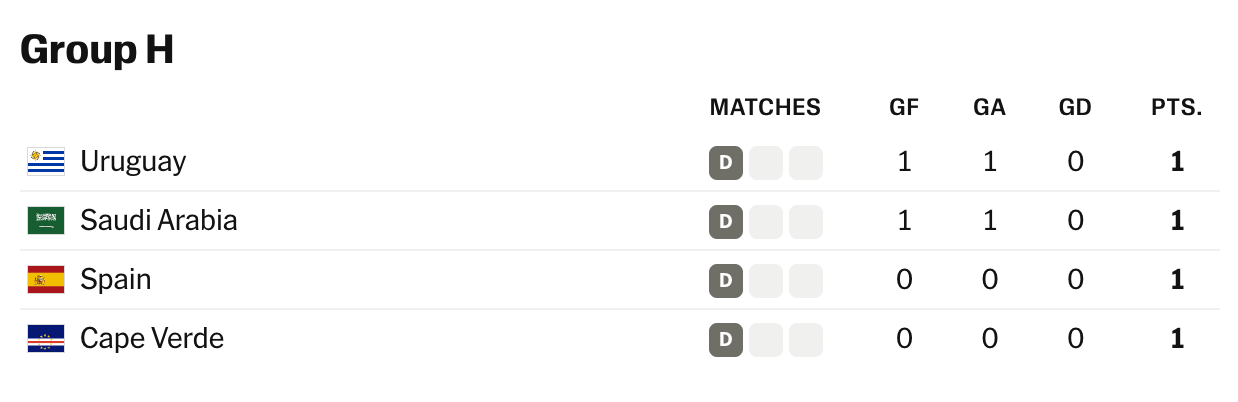
After Cape Verde’s surprising victory over Spain, Group H witnessed another potential upset as Uruguay faced Saudi Arabia in Miami. The match, part of the World Cup group stage, saw a thrilling battle at the Hard Rock Stadium.
In the first half, Saudi Arabia took the lead through a goal by Abdulelah Al Amri. The opportunity arose from Uruguay goalkeeper Fernando Muslera mishandling the ball, allowing Al Amri to score. This placed Saudi Arabia temporarily at the top of Group H.
With the match approaching full time, Uruguay found their breakthrough. Maximiliano Araujo capitalized on a mistake by Saudi goalkeeper Mohammed Al Owais, sending a shot into the far corner to equalize. Al Owais redeemed himself later with several crucial saves to ensure the match ended in a draw. During the game, Uruguay logged 21 attempts on goal.
Two draws in Group H leave all teams with one point each after the first round. Analysts Michael Cox and Jacob Whitehead reviewed key moments from the game in Miami.
Asian Teams Impress in the World Cup
Historically, the Asian Football Confederation (AFC) has had a limited impact at men’s FIFA World Cups. South Korea’s 2002 semi-final appearance stands out as the highest achievement. Critics expressed concerns that expanding the World Cup to 48 teams might dilute quality, particularly with rising participation from Asia.
However, AFC nations have surprised many by remaining unbeaten in their first five World Cup matches. Asian teams have earned two victories and three draws, signaling strong performances from countries like South Korea and Australia.
Saudi Arabia will host the World Cup in eight years. The success of their national team is crucial to their development plans. Recent results reflect the AFC’s growing strength as a competitive confederation.
Key Match Results
- June 11, Group A: South Korea 2-1 Czech Republic
- June 13, Group B: Qatar 1-1 Switzerland
- June 13, Group D: Australia 2-0 Turkey
- June 14, Group E: Japan 2-2 Netherlands
- June 15, Group H: Saudi Arabia 1-1 Uruguay
Muslera’s Mixed Fortunes
Fernando Muslera’s journey with the Uruguay national team has been tumultuous. Once the first-choice goalkeeper, he played pivotal roles in Uruguay’s 2010 World Cup semi-final run and subsequent appearances in Brazil and Russia. However, he was benched during the Qatar World Cup and later faced a FIFA ban for misconduct.
Despite these challenges, Muslera regained his position in goal for Uruguay’s opener against Saudi Arabia. At 39, he made history as the first Uruguayan to attend five World Cup tournaments, joining an elite group of 12 players globally.
Initially, Muslera showed his skill with a stunning save against an attack by Al Amri. Yet, moments later, he misjudged a straightforward catch, leading to Saudi Arabia’s opening goal from Al Amri.
Bielsa’s Tactical Changes
Group H hasn’t followed expectations. Uruguay’s performance against Saudi Arabia highlighted tactical challenges. Despite dominating possession, Uruguay struggled with creativity. A midfield trio of Manuel Ugarte, Rodrigo Bentancur, and Federico Valverde delivered robust play but lacked connections between the lines.
Manager Marcelo Bielsa made significant changes at halftime. He replaced Darwin Nunez with Agustin Canobbio, moving Federico Vinas to a central striking role. This shift energized Uruguay’s offense. Vinas soon had two strong headed attempts, one from a Cannobio cross.
This tactical adjustment put pressure on Saudi Arabia’s captain, Salem Al Dawsari, who couldn’t match defensively. Valverde exploited this opening, creating dangerous opportunities.
The equalizer arose from a left-wing play. Vinas’s header was saved before Araujo scored the rebound. The performance indicates Nunez might lose his starting spot, as Vinas proved more effective in leading the attack.