
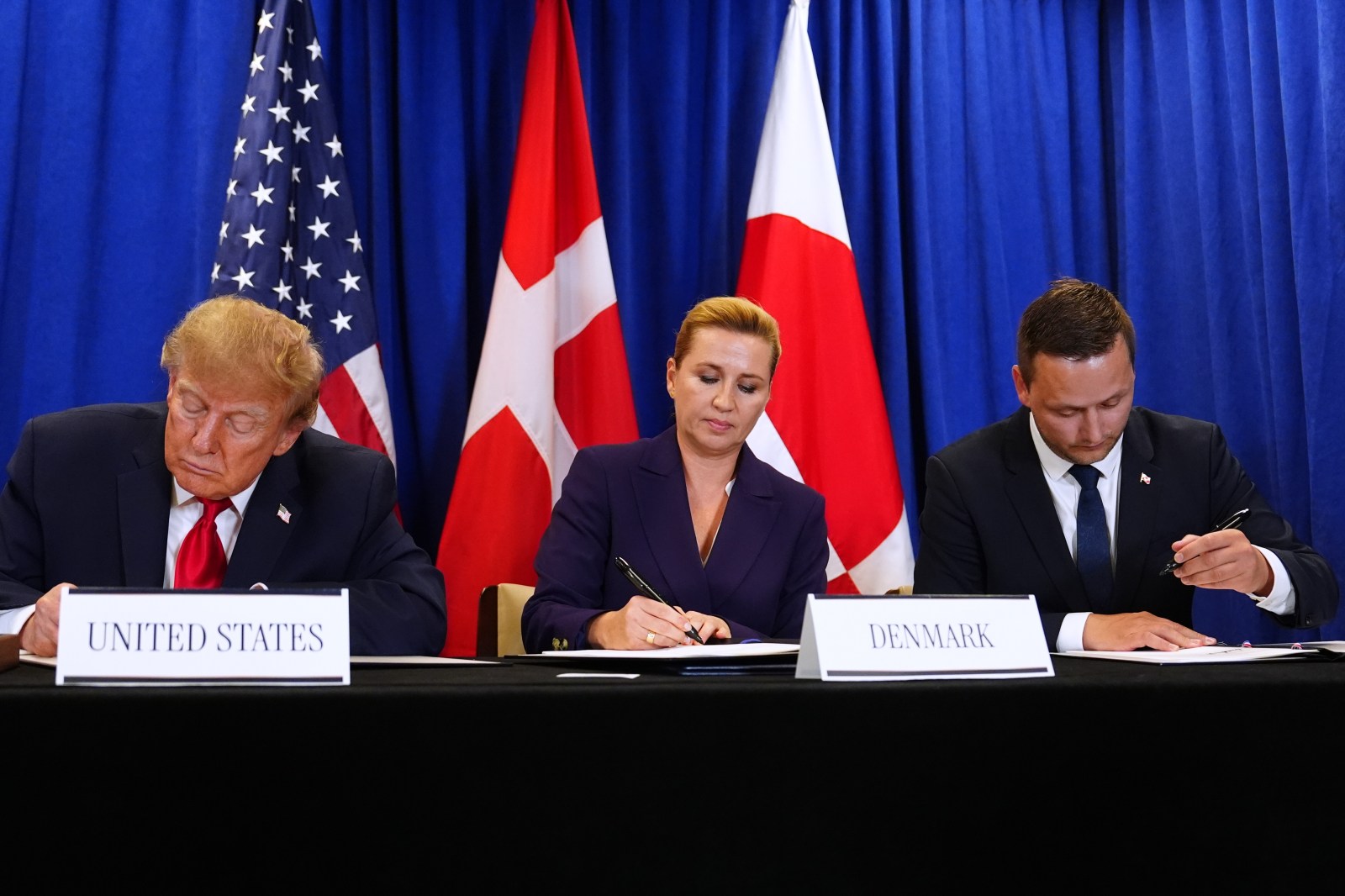
President Donald Trump signed a new security agreement with Denmark and Greenland, enhancing U.S. military presence on the Arctic island. This builds upon a defense treaty that has governed American military access there for 75 years.
Signed during the United Nations General Assembly in New York, the agreement introduces new defense sites and assigns Washington a long-term security role in Greenland. Unlike the 1951 U.S.-Danish Defense Agreement, this pact includes Greenland and grants U.S. veto power over sensitive foreign investments.
The security deal emerged after months of tension following Trump’s demand for acquiring the territory. In his U.N. speech, Trump emphasized the agreement’s importance for American control over Greenland’s security. He announced plans for constructing two significant military bases on the Arctic island, which remains under Danish sovereignty.
“No U.S. adversary will be permitted to establish a military presence in Greenland or make sensitive investments without our approval,” stated Trump.
Denmark acknowledged the arrangement as recognition of its sovereignty and Greenland’s right to self-determination while enhancing U.S. military involvement.
What Did the 1951 Treaty Specify?
The 1951 U.S.-Danish Defense Agreement, part of NATO’s security framework, allowed U.S. defense areas in Greenland. It provided extensive rights for American forces to build and operate facilities while preserving Danish sovereignty.
Numerous U.S. installations existed during the Cold War, with a significant presence centered on Pituffik Space Base in northwestern Greenland, home to approximately 150 American military personnel. The 1951 agreement was amended in 2004 to include Greenland’s Home Rule government.
Differentiating the New Security Agreement
The agreement prominently expands American military infrastructure. Plans include reopening Narsarsuaq, a former Cold War-era base, and establishing a presence at Mestersvig on the east coast.
Narsarsuaq previously housed Bluie West One, closed in the 1950s. Mestersvig is used by Denmark’s Sirius Dog Sled Patrol, a special forces unit. Trump affirmed plans to develop the larger military presence immediately, including two major bases.
Expansion at Pituffik is also allowed, alongside a potential Golden Dome missile-defense system. The U.S. has a long-term maintenance commitment at Pituffik Space Base, contracted to Greenlandic company Inuksuk A/S for up to $3.95 billion through 2034.
Non-NATO countries are blocked from establishing a military presence in Greenland, crucial due to Arctic competition involving the U.S., Russia, and China. The agreement seeks to limit rival powers from gaining strategic footholds.
Comparing 1951 and 2026 Agreements
Financial Implications for U.S. Taxpayers
“The agreement comes at NO COST to the United States,” claimed Trump.
Yet, costs for the U.S. military expansion typically involve construction, personnel, transportation, and operations, unless potentially shifted to Denmark, Greenland, or other NATO partners. No public dollar figures exist yet for new bases or broader expansion.
Denmark Views Agreement as Perpetual
Danish Prime Minister Mette Frederiksen characterized the agreement as a security measure, not altering Greenland’s sovereignty. Frederiksen noted the deal’s potential longevity and NATO’s vital Arctic role.
Frederiksen stressed Greenland’s self-determination throughout negotiations, reaffirming the island’s sovereignty. The deal’s parliamentary approval is required before enactment.
Greenland’s Perspective on the Agreement
Greenlandic Prime Minister Jens-Frederik Nielsen emphasized NATO over U.S. ownership, highlighting the alliance’s significance in the Arctic.
Nielsen described the agreement as a mutual benefit, enhancing Greenland’s role in international cooperation. The arrangement is structured to remain effective if Greenland becomes independent within NATO.
Nielsen cited the agreement as beneficial for Greenland, Denmark, and the U.S., emphasizing Greenland’s direct involvement in security matters.
Easing Tensions Over Greenland
The agreement resolves tensions among the U.S., Greenland, Denmark, and NATO members following Trump’s statements on acquiring the island.
Previously, Trump suggested economic or military pressure, but Greenland and Denmark firmly opposed U.S. territory acquisition.
NATO increasingly addressed Arctic security amid concerns regarding Russia and China, evolving frameworks to enhance regional defenses.
Ultimately, negotiations focused on strengthening Greenland’s defenses collaboratively between the U.S., Denmark, and Greenland, forming a united security framework.