
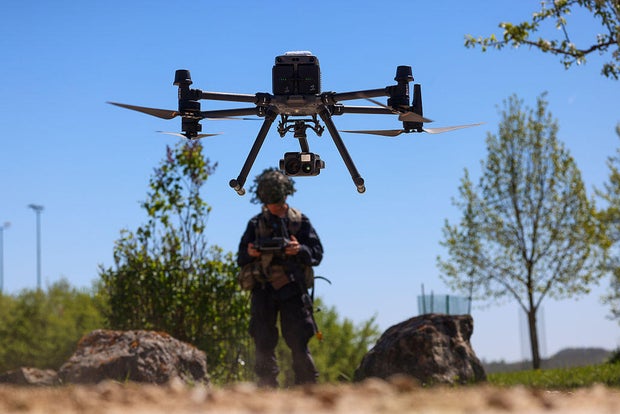
The U.S. Army has announced plans to phase out a drone battalion established to learn from drone warfare, particularly from the Ukraine conflict. The decision, confirmed by an Army official, comes amid tensions involving senior Army officers.
The battalion, known as the Unmanned Assault Battalion, was championed by former Army Chief of Staff Gen. Randy George and Gen. Christopher Donahue, former commander of U.S. Army Europe and Africa. Both faced early dismissals or retirement, paving the way for Gen. Christopher LaNeve to take on the role of acting chief of staff of the Army.
The Unmanned Assault Battalion was designed as a specialized unit deployable where drone support was needed. The ongoing war in Ukraine underscored the pivotal role of drones in modern warfare. This was further highlighted when Iran launched attack drones targeting U.S. military installations in the Middle East.
In an upcoming exercise, the battalion will share its insights on drone warfare to guide future Army strategies. Following the exercise, the unit will revert to its original role as an airborne infantry battalion within the 173rd Airborne Brigade. This means soldiers will resume training focused on parachuting and aerial deployments.
The Wall Street Journal initially reported the planned disbandment of the drone unit. Under the Army Transformation Initiative launched by George and Army Secretary Dan Driscoll, there was a significant emphasis on unmanned systems. Driscoll expressed the necessity of learning from the Ukraine war.
Despite the unfolding changes, a spokesperson for the Army secretary noted Driscoll had no comment about the decision to phase out the drone unit.
There has been long-standing tension between LaNeve and former senior officers advocating for the unit’s establishment. A specific contentious incident occurred when LaNeve’s command at the Army’s 82nd Airborne Division ended prematurely. This led to a strained relationship with Donahue.
LaNeve outlined his vision for the Army in a document titled “The Army Azimuth.” He emphasized focusing on fundamental soldiering skills while integrating new capabilities, including defenses against unmanned threats.
Retired Army General David Petraeus reiterated in April the crucial need for incorporating drones into military operations. He suggested replacing armored battalions with drone-focused units to innovate effectively.
U.S. Army Capt. Ronan Sefton, previously stationed in Germany, noted the importance of drones in warfare after observing Ukraine’s battlefield experiences. He stressed this message to senior U.S. commanders, highlighting drones as a key factor in evolving warfare strategies.
Sefton joined the Army’s Ukraine Lessons Learned Task Force, tasked with translating Ukraine’s military experiences for application in the U.S. military context. He emphasized that while traditional firepower remains essential, there’s an urgent need to adapt and counter drones developed by adversaries.