
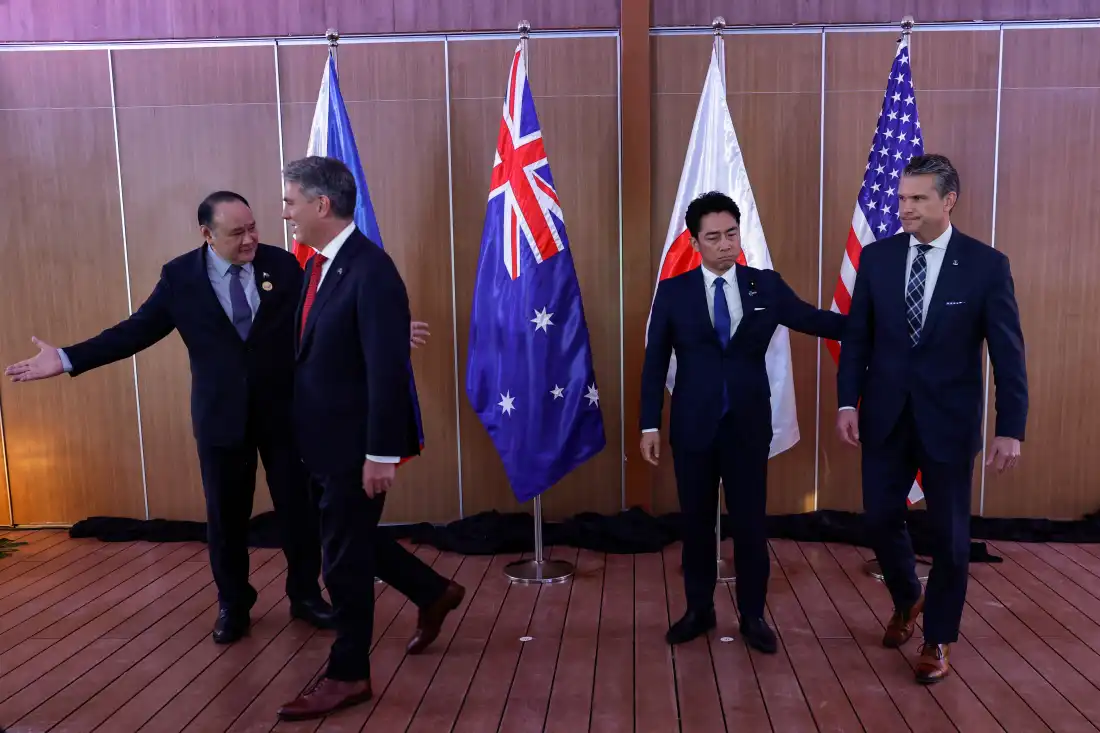
The United States and Japan have agreed to establish a Japanese facility for the joint production of advanced medium-range air-to-air missiles. This collaboration, announced by Japanese Defense Minister Shinjiro Koizumi, marks a strategic move in response to China’s growing assertiveness in Asia. The announcement came during a press conference in Cebu, Philippines, where defense leaders from ASEAN countries and their counterparts gathered for annual meetings.
Concerns Over China’s Naval Activity
Koizumi expressed concerns about China’s naval activities near Japan, pointing out a recent incident involving Chinese warships and a coast guard vessel crossing the Osumi Strait. This was the first time such a fleet configuration was observed by Japan’s defense ministry. Koizumi emphasized that this serves as an example of the challenging security environment in the region. Japan plans to continue monitoring Chinese movements closely and has accelerated its military buildup in southwestern Japan to deter potential threats.
Joint Missile Production Initiative
The missile production initiative, dubbed “Operation Supercharge,” is focused on essential armaments for F-35 fighter jets. Koizumi revealed that Japan will host a final assembly and inspection plant for the Advanced Medium-Range Air-to-Air Missile (AMRAAM) as part of this effort. The F-35s are among the most advanced aircraft globally and play a critical role in Japan’s military capabilities. The goal is to enhance the deterrence and response capabilities of the Japan-U.S. alliance swiftly.
During their meeting, both Koizumi and U.S. Defense Secretary Pete Hegseth reaffirmed the importance of maintaining a free and open international order based on the rule of law. They strongly opposed any attempts to alter the status quo through coercion or force.
U.S. Commitment to Regional Stability
Hegseth reiterated the U.S. administration’s dedication to deterring aggression in the region during a meeting with ASEAN defense ministers. Although not explicitly mentioning China, he emphasized a strategy described as “strong, quiet, and clear.” The United States aims to deter coercive actions without unnecessary escalation, signaling a firm commitment to defending its allies and interests.
He assured the Philippines, a long-standing treaty ally, of the U.S. commitment to building a robust deterrence against China’s actions, particularly in the contested South China Sea.
Australia’s Stand on Rule of Law
Australian Defense Minister Richard Marles highlighted Australia’s commitment to defending the rule of law in the Pacific, despite China’s actions. He referenced a previous incident involving a Chinese fighter aircraft and an Australian surveillance jet in the South China Sea. Despite the risks, Australia remains vigilant in asserting freedom of navigation on the high seas, a crucial principle for its national interests.
The ongoing tensions in the South China Sea involve claims by the Philippines, Vietnam, Malaysia, Brunei, and Taiwan. Washington has expressed its commitment to defend the Philippines if attacked, underscoring the complexity of the regional security landscape.
In a separate dispute, China and Japan have been at odds over small islands controlled by Japan in the East China Sea, with frequent exchanges of accusations regarding maritime territory infringements.