
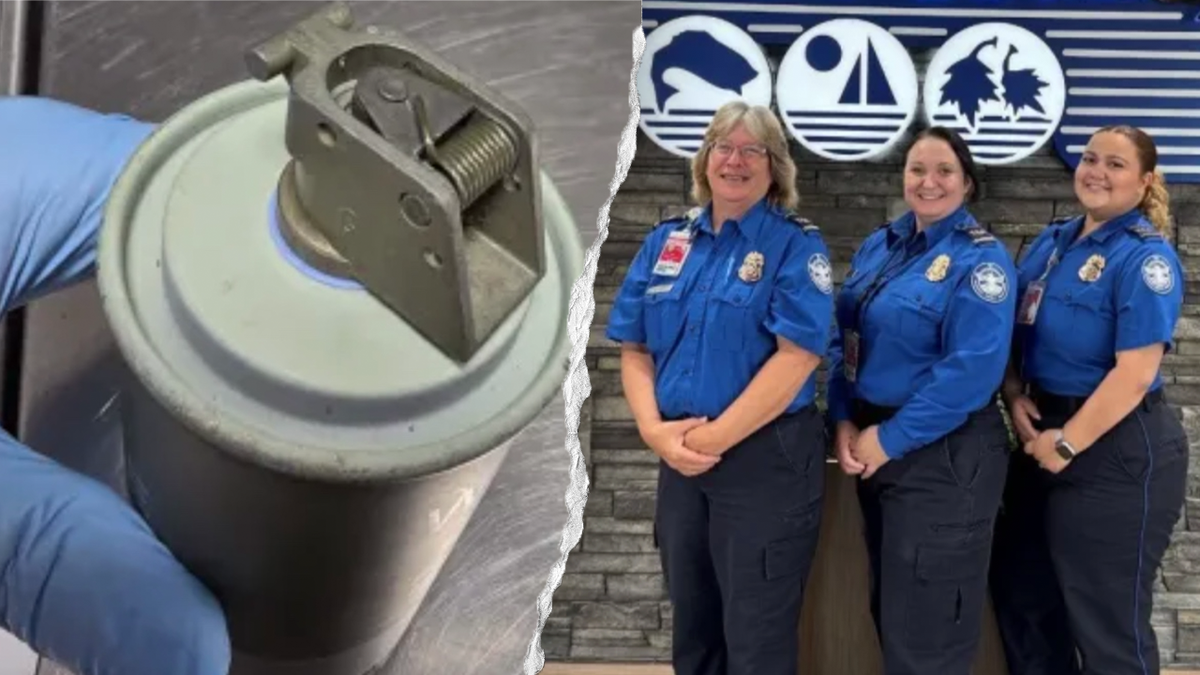
A routine security check at Watertown International Airport (ART) in upstate New York took an unexpected turn when TSA officers found a spent smoke grenade hidden in a passenger’s carry-on bag. The grenade was concealed inside an aerosol container, according to a statement released by the Transportation Security Administration (TSA) on September 24.
During the inspection, TSA Officer Yessenia Alvarez noticed something unusual about the aerosol container on the X-ray machine. “I didn’t like how the item appeared,” she stated, prompting her to call over Lead TSA Officer Melissa Graffam. Alvarez added, “I was very stunned when I saw the item on the screen,” as she had seen similar items during training.
Graffam explained that the item “looked funny” on the X-ray screen. “The top of the can didn’t look right but appeared to be empty,” she said. She discovered it was a spent M18 smoke grenade when she opened the side pocket of the bag. The finding was unusual for the airport, where prohibited items like knives and oversized liquids are more common.
Upon questioning, the passenger claimed to have forgotten about the smoke grenade in his bag. “I found [that] strange because his bag only had a few items in it,” remarked Graffam. Lead TSA Officer Debra Alcock coordinated with the Syracuse TSA Coordination Center and a TSA explosives expert confirmed the grenade was not live.
Alcock noted that the smoke grenade was one of the most remarkable finds she had experienced with the agency. She praised the teamwork involved in resolving the issue at the checkpoint. TSA officials warn travelers that spent, inert, or replica explosive items can cause delays, disrupt operations, and lead to a law enforcement response.
Brian Bushnell, TSA’s federal security director for the airports in upstate New York, emphasized the importance of travelers checking their bags before leaving home. He advised, “Spent, inert or replica explosive items are not allowed through the checkpoint and can cause delays, disrupt operations and prompt a law enforcement response.” He suggested that travelers should consult TSA’s resources, such as TSA.gov, before packing.
The Bureau of Alcohol, Tobacco, Firearms and Explosives (ATF) has issued warnings about vintage grenades, noting the risks they might still pose despite appearing harmless. Bushnell stressed avoiding testing the system by carrying such items.
A similar discovery occurred at Tampa International Airport, where TSA Officer Andrew Carter found a hidden knife inside a flashlight shaped like a baseball bat. Carter noticed something unusual on the X-ray and flagged the bag for further inspection.
Keith Jeffries, a Florida-based vice president for K2 Security Screening Group and former TSA federal security director at Los Angeles International Airport, commented on the knife incident, “Do not try to test the system. If you do, you will be caught.”