
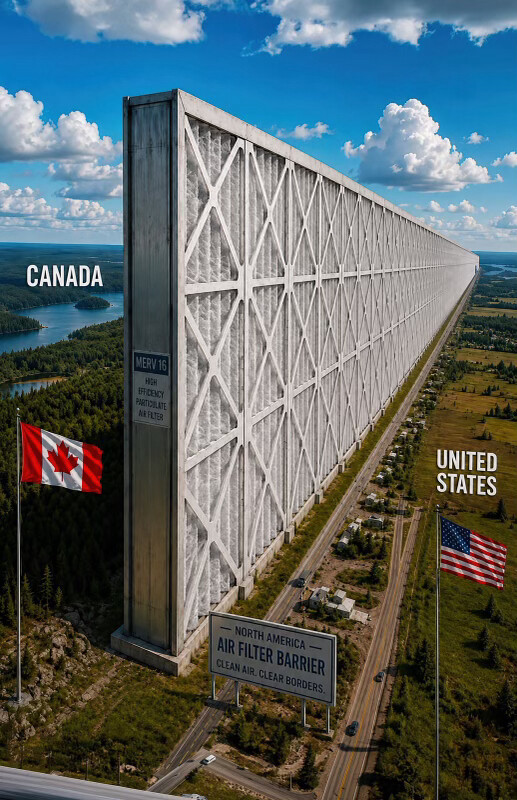
On Saturday, President Donald Trump shared an image, apparently AI-generated, showing a significant air filter along the U.S.-Canada border. This action underscores his ongoing criticism of Ottawa amid continued wildfire smoke drifting into the U.S.
Historically, both countries have cooperated during wildfire crises. However, Trump’s recent statement follows his accusation that Canada is affecting U.S. air quality. He suggested that the economic impact of the smoke should influence tariffs on Canadian goods. Canadian officials have highlighted their long history of cross-border firefighting efforts, regularly deploying personnel, aircraft, and resources when either nation faces intense fire seasons.
Image Details
Posted on Trump’s Truth Social account, the image displays a massive filtration barrier between Canada and the U.S. It carries the title, “North America Air Filter Barrier. Clean Air. Clean Borders.” Labeled as a “MERV 16 High Efficiency Particulate Air Filter,” it features the Canadian flag on the left and the American flag on the right.
Response from Canada’s Prime Minister
Trump has consistently claimed that Canada’s severe wildfire seasons result from inadequate forest management. As smoke reached states like Michigan and New York, he intensified his rhetoric, calling on the U.S. to add the pollution costs to current tariffs on Canadian products.
Prime Minister Mark Carney recently stated he had made clear to Trump that Canada is actively managing the wildfires. He explained the enormous scale of Canada’s forests, which cover an area eight times larger than Texas, and noted the ongoing drought conditions extending to regions as big as Texas and Minnesota.
Origins and Challenges of Canadian Wildfires
Wildfires are common in Canada’s vast boreal forests. Recently, these have intensified due to warmer temperatures and drier conditions, leading to longer fire seasons. Climate researchers note that rising temperatures exacerbate fire behavior.
These fires often start from lightning in remote boreal areas. Human activities, such as unattended campfires and power-line failures, also contribute. Presently, many fires are burning in inaccessible regions like Ontario, complicating suppression efforts.
Impacts of Wildfire Smoke on the U.S.
Last week, smoke blanketed the Great Lakes and Northeast, affecting cities like Chicago, Detroit, and New York City. The dense smoke triggered air quality alerts, with some areas experiencing orange skies and reduced visibility.
Though the smoke has lessened, it is expected to affect Americans again soon. According to Washington Post meteorologist Ben Noll, no major air quality issues are expected in the East, but haze will be noticeable.
Future Prospects
Canada’s wildfire season is most active from May to September, decreasing in the fall with cooler temperatures and increased rainfall. Without rain, air quality concerns may persist in parts of Canada and the northern U.S. for several weeks.
For comments on this story, contact Steve Mollman and Anthony Murray at Newsweek.