
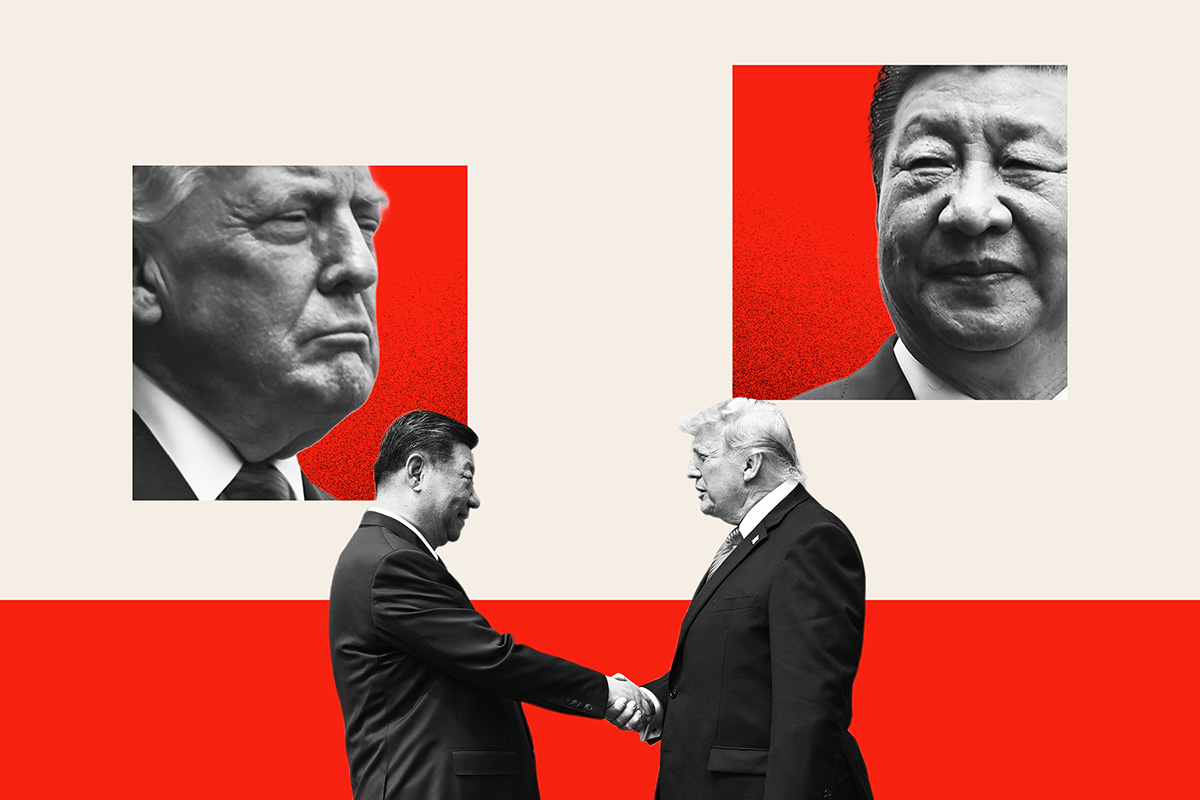
President Donald Trump prioritized a business-focused strategy in dealing with China, influencing a shift towards a softer U.S. approach. Despite this apparent change, influential figures with more critical views on China are still present within his administration.
The ceremonial spectacle accompanying Trump’s visit to Beijing marked a significant pivot in U.S.–China relations, beginning with the mutual tariff reduction last May. His previous administration clashed with China over trade and later, the COVID-19 pandemic origins, leading to strained relations. Trump’s recent remarks highlighted his friendship with China’s President Xi Jinping, reinforcing mutual trust as claimed by Xi.
Key figures in Trump’s Cabinet, known for their critical viewpoints on China, accompanied him during the visit. Marco Rubio, the Secretary of State, and Defense Chief Pete Hegseth, along with Stephen Miller, a White House adviser, supported Trump as he sought cooperation in exchange for increased business with China.
The visit aimed to assert that the United States remains a dominant global force, said Miles Yu, a former adviser to Secretary of State Mike Pompeo.
Trump’s administration eased some tensions last year by making concessions regarding U.S. policy towards Taiwan and Chinese access to advanced AI technology. Xi Jinping reciprocated, agreeing to a meeting in South Korea and making agricultural commitments to the U.S.
A state visit from Xi to the United States is planned for late September. Trump’s admiration may shape this trip as a diplomatic success, aligning with China’s broader strategy towards powerful nations.
Yu mentioned that despite diplomatic gestures, the relationship resembles a “new Cold War,” preferable to direct conflict. He expressed confidence in deterrence through strength.
Within the United States, the Justice Department charged Eileen Wang, a former California mayor, as an illegal agent of China, illustrating ongoing legal efforts to counter Chinese political influence. Similar legal actions, including the conviction of Harry Lu in New York for operating an unauthorized Chinese police station, highlight underlying tension.
States across America are implementing laws to limit Chinese influence in areas like science, technology, and business. Despite diplomatic optics, substantial changes in the relationship might be limited, Yu suggested.
Trump plans to invite Xi to visit the U.S. in September, hoping to deter any disruptive actions from China. The summit revealed differing perceptions; John Yasuda from Johns Hopkins University analyzed that Xi seemed to dominate the situation, portraying China as firm despite U.S. overtures.
Beijing may accept reduced tensions if the U.S. returns to transactional relations. Xi needs a non-confrontational America to address domestic challenges. Whether Washington fully understands this dynamic remains uncertain, according to Yasuda.