
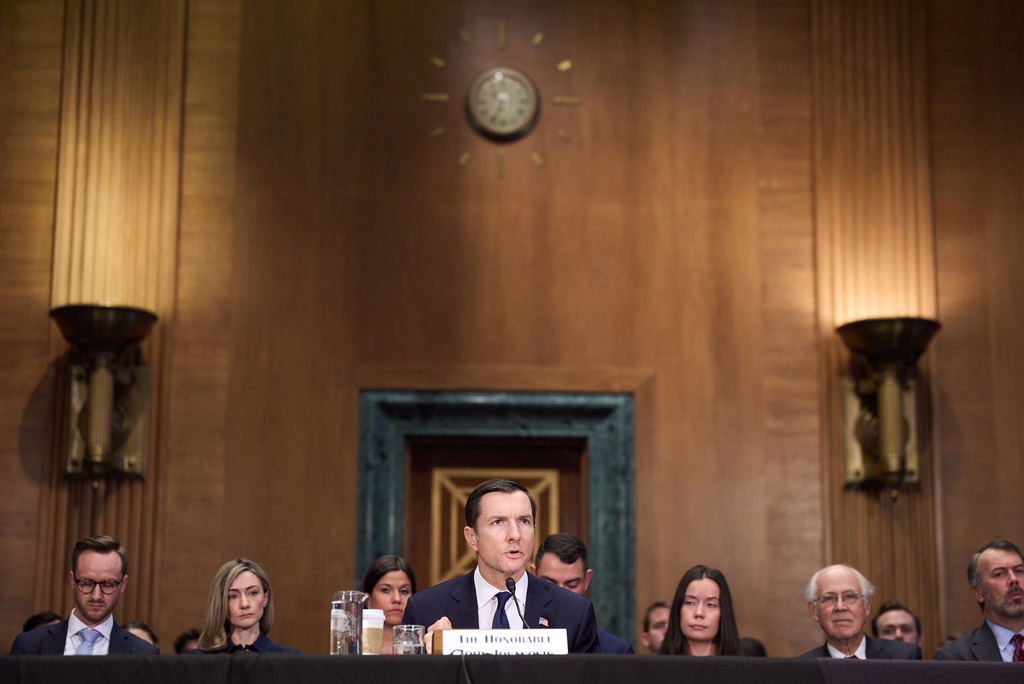
Export-Import Bank President and Chairman John Jovanovic addressed a Senate Banking Committee hearing on March 26, 2026, emphasizing the need for Congress to make a crucial decision. The choice is between boosting America’s global competitiveness or allowing China to dominate global markets. The charter of the Export-Import Bank of the United States (EXIM) runs out at the year’s end. Over $70 billion in pending projects, including essential energy and critical minerals projects supporting over 45,000 U.S. jobs, depend on this decision.
Congress must act by December 31 to maintain these projects and prevent U.S. workers from suffering consequences while competitors fill the void. Reauthorizing and updating EXIM will enhance U.S. economic competitiveness and energy leadership. This need aligns with a time of aggressive global energy development fueled by competitors. Since 2015, China has invested at least $446 billion in global energy infrastructure, almost ten times the U.S.’s contributions.
Chinese energy technologies gain ground due to significant subsidies and loans, not superior quality. The U.S. should employ a uniquely American strategy to counter this form of competition. EXIM operates without burdening taxpayers and supplements private capital by stepping in where private lenders hesitate, or where foreign governments provide advantageous support. By leveraging EXIM, U.S. innovators can expand and export American energy solutions worldwide.
A fully capitalized and modern EXIM can convert American strengths in technologies like nuclear, liquefied natural gas, and geothermal into active contracts. Presently, however, EXIM faces limitations due to bureaucratic inertia and a deep-seated culture of risk aversion, leaving a substantial portion of its lending authority untapped. Meanwhile, competitors invest aggressively in strategic industries.
EXIM’s recent Competitiveness Report indicates governments utilize export credit at unprecedented levels to secure essential global contracts. If EXIM faces an authorization lapse, American exporters remain at a disadvantage. During the 2015 to 2019 lapse, U.S. exporters lost business opportunities to foreign rivals.
Implementing a bipartisan, 10-year extension, the longest in its history, will affirm Washington’s dedication to supporting American enterprises globally. To equip EXIM with a competitive advantage, risk management and project selection need modernization. EXIM’s advisory committee has recommended bold new risk standards, including removing the current 2 percent default rate shutdown trigger. Such reforms would allow EXIM to support ventures that benefit American national and economic interests while upholding its financial health.
American companies are creating desirable energy technologies. The nation financing future energy and critical minerals infrastructure will dictate the global power balance. Congress must reauthorize the Export-Import Bank to empower American innovation and workforce. Failure to act means conceding the next decade of global energy dynamics to China.
Kevin Cramer is North Dakota’s junior U.S. senator and a member of the Senate Banking, Housing, and Urban Affairs Committee.