
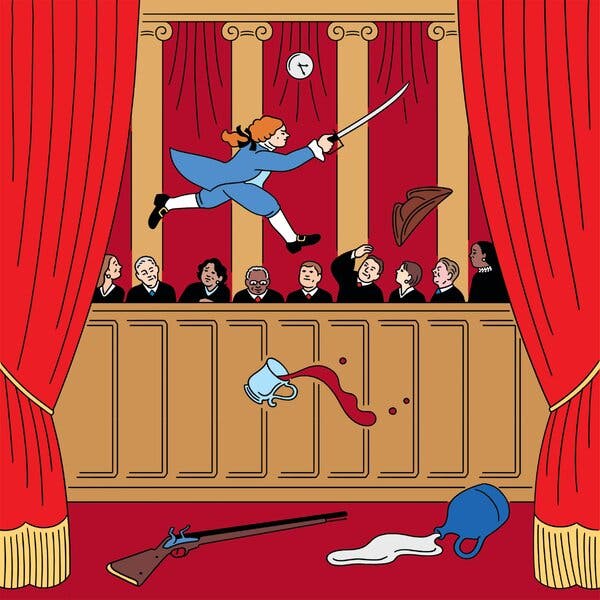
The latest term of the Supreme Court has seen significant developments that deserve closer scrutiny. One such aspect is the court’s approach to originalism, a method touted during the Reagan era. Originalism aims to guide judges by anchoring them firmly in history. Justice Brett Kavanaugh has emphasized that history offers a more objective basis than policy when interpreting constitutional rights.
Justice Kavanaugh illustrated this belief in a past gun rights case. He argued that restrictions on the Second Amendment should stem from historical context rather than present-day concerns. However, this reliance on history raises questions about its objectivity.
Examining History and Tradition
Consider a case involving a young Texan man who maintains a steady job and keeps a gun at home. He also uses marijuana occasionally. Under federal law, Section 922(g)(3), it is a crime for an ‘unlawful user’ of a controlled substance to own a gun. This law imposes a severe penalty of up to 15 years in prison.
The government, intent on prosecuting, must find a historical precedent to justify the young man’s prosecution under the Second Amendment. The 2022 Bruen decision requires that historical tradition, not contemporary circumstances, supports such regulations.
However, finding a fitting historical analogy proves challenging. Marijuana did not see significant use either in 1791 or 1868. Government lawyers, required to draw parallels, reference ‘habitual drunkard’ laws from the 18th and 19th centuries. These laws targeted inebriated individuals, restricting their rights, including access to firearms. Yet, is this the best historical analogy available to validate modern gun laws?