
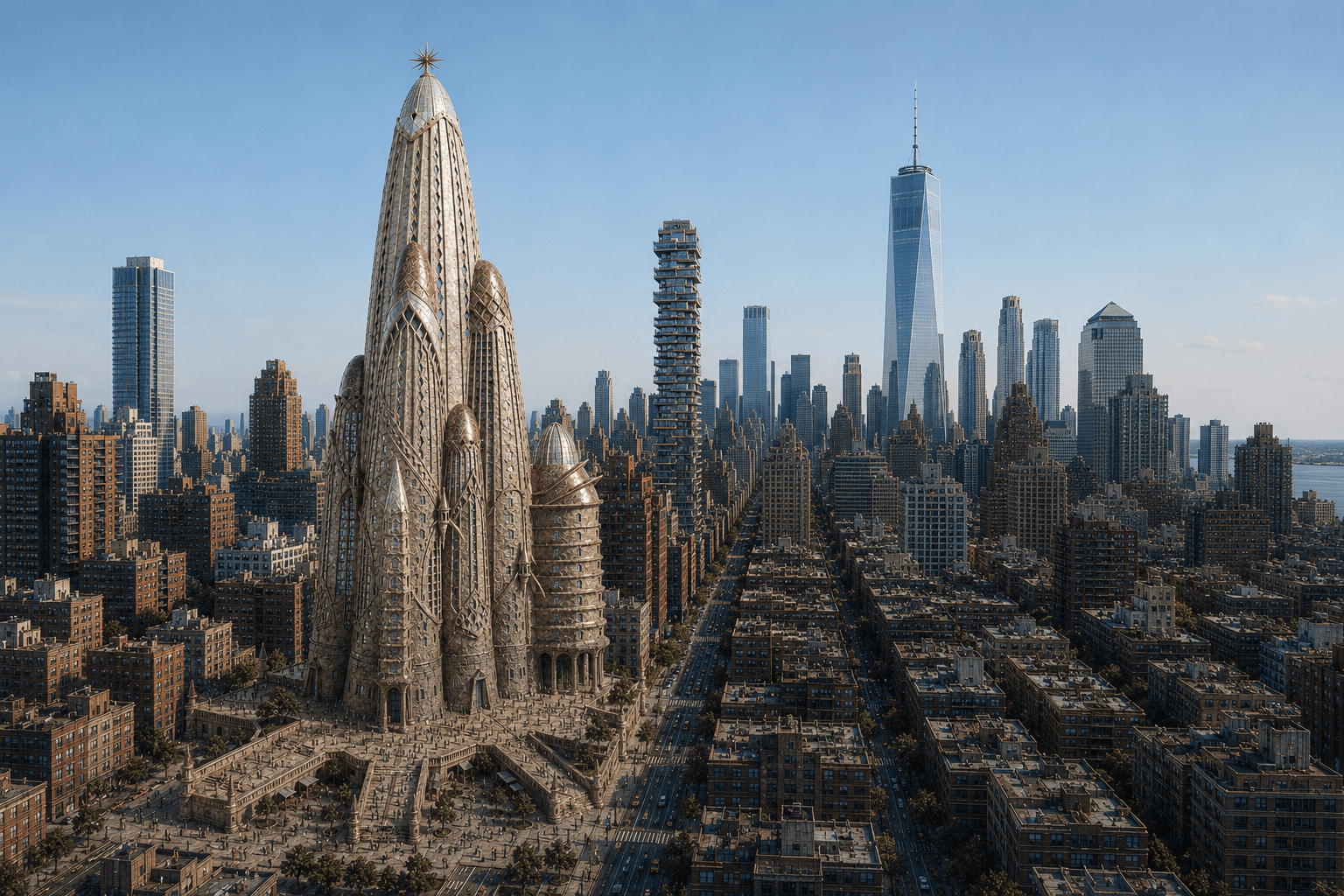
A New York City skyscraper, envisioned by Antoni Gaudí over a century ago, has been revived through a series of detailed visualizations, depicting both its exterior and surreal interiors. Journalist and architectural enthusiast Daniel Coughlin has brought new life to Hotel Attraction, a Manhattan tower reportedly commissioned in 1908 by two unidentified American businessmen for Gaudí to design. Coughlin showcases this unrealized project on his YouTube channel, The Curious Compendium of Architectural What-Ifs.
Coughlin’s latest work explores the vast ceremonial halls, themed cultural spaces, and monumental chambers planned inside the tower. The structure, had it been built, would have reached approximately 1,181 feet, dominating Lower Manhattan and standing as the world’s tallest building, until the Empire State Building surpassed it in the 1930s.
The renewed interest in Hotel Attraction aligns with the centenary year of Gaudí’s death. Gaudí passed away on June 10, 1926, while the construction continues on the Sagrada Família, his most renowned work in Barcelona, initiated in 1882. Recently, the church added a cross to the pinnacle of the Jesus Christ tower, reaching 565 feet, marking another step toward completing what will be the world’s tallest church.
A Vertical World of Themed Halls
Coughlin aimed to visualize Hotel Attraction in present-day Lower Manhattan, specifically on Church Street, near the Jenga Tower. He explained, “The interiors revealed it was intended to be more than a luxury hotel. It was a mix between a hotel, cultural complex, vertical city, and secular cathedral.” Visitors would enter through four monumental entrances into a 56-foot-high reception hall.
Above this hall, the design envisioned huge themed areas representing different world regions. “The America Room was on the first floor. The Europa Hall above served as a dining room, concert hall, and theater, featuring parabolic stained-glass windows and sculptures inspired by the myth of Europa,” Coughlin noted. Higher floors showcased regions like Asia, Australia, and Africa, and hosted museums, galleries, and concert halls.
The diverse functions intrigued Coughlin. Lower towers included residences, while the central structure housed museums, theaters, ceremonial halls, and observation areas. Underground floors were allocated for kitchens, garages, storage, and services. “It redefined the concept of a self-contained vertical world, moving from practical spaces toward ceremonial and celestial ones,” he said.
The Tower’s Most Astonishing Room
At the summit, the Tribute to America Room captured the essence of Hotel Attraction. According to Coughlin, this room was a vast 410-foot-tall hall, centered by a 33-foot Statue of Liberty replica and surrounded by sculptures of the Founding Fathers, an American eagle, and other symbols. “Its immense vertical chamber felt less like a hotel and more like a secular cathedral dedicated to America,” Coughlin stated.
The broader interior scheme fascinated Coughlin with its flowing, organic architecture. Columns, arches, and ceilings seamlessly blended, creating a sculptural and immersive environment, reflecting Gaudí’s architectural principles.
An intriguing discovery during Coughlin’s research was the planned exterior decoration. Contrary to modern depictions of a smooth tower, Hotel Attraction was designed with trencadís, Gaudí’s signature ceramic mosaic. Colors transitioned from earthy greens and browns at the base to silvers and golds near the summit. This gradient symbolized a journey from earth to the celestial realm.
Gaudí’s Legacy Lives On
Although never built, Coughlin believes Hotel Attraction could have significantly altered New York’s architectural identity. The tower represented a different skyscraper model, moving away from the rigid, box-like forms with its organic structure and decorative elements. While the building’s potential influence remains unknown, Coughlin suggests it might have encouraged a more expressive high-rise design. “Had it survived, Hotel Attraction would likely remain one of New York’s most recognizable landmarks, closely associated with Gaudí, second only to the Sagrada Família,” he concluded.