
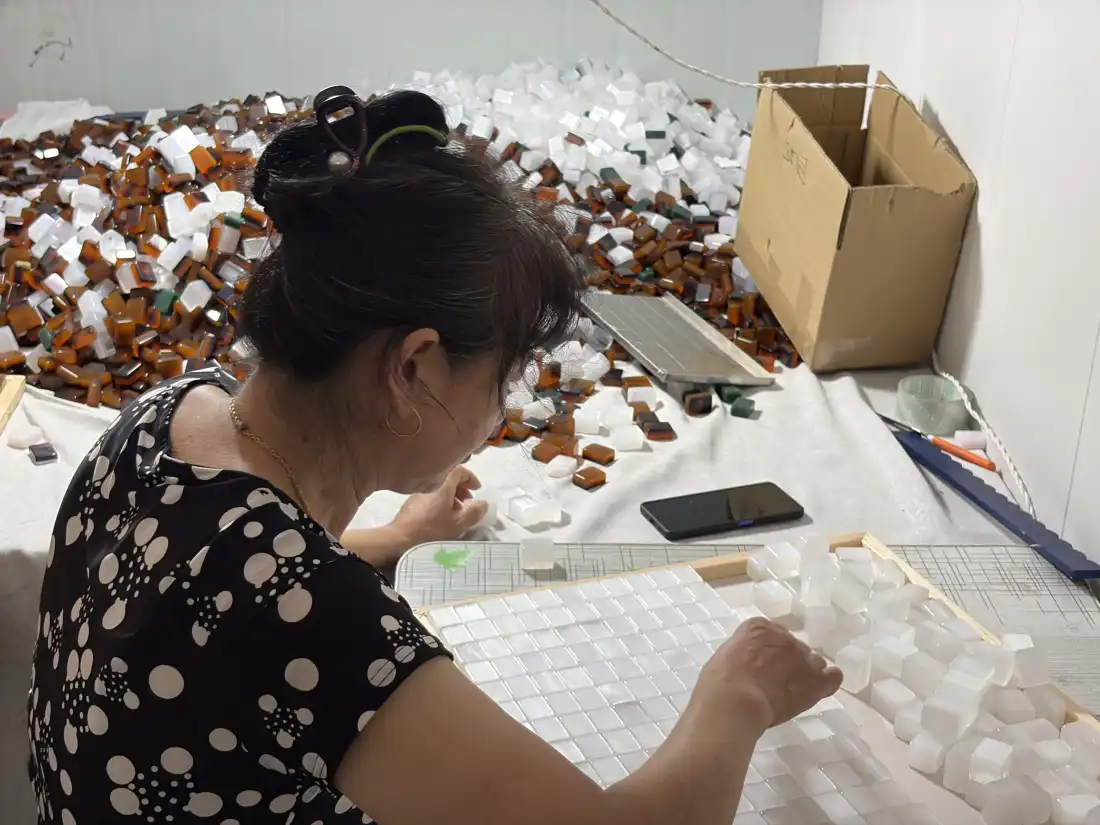
In Taixing, China, a workshop worker examines mahjong tiles closely to ensure they are free from defects before they are sent to the United States. These tiles are part of mahjong sets sold for hundreds of dollars each.
Inside a modest two-story home used as a mahjong workshop, workers handle tiles with care. These tiles are destined for U.S. customers. “Our clients sell these mahjong sets for $300 to $400, sometimes more,” says Wang Hao, co-owner of the workshop. “We produce them for about 200 yuan, around $30 a set.” Despite rising U.S. tariffs and shipping costs, clients are unbothered due to high profit margins.
Originating in China in the late 1800s, mahjong gained popularity in the U.S. in the 1920s. Its recent resurgence in the U.S. is fueled by social media trends. Wang Hao, previously at Alibaba.com, noted a 1,000% increase in mahjong searches and opted to focus on U.S. distribution. American mahjong sets, smaller and more colorful than traditional ones, are crafted from acrylic instead of melamine, requiring different production methods.
While geopolitical conflicts have strained China’s export sector, the U.S. mahjong trend has boosted Taixing’s tile-makers. Local producers are struggling to meet demand. Wang Hao expanded from distribution to manufacturing, citing supply shortages. “Supply was tight last year even when paying factories in advance,” he explains.
Craftsmanship Overhaul for U.S. Market
Adapting to the U.S. market requires significant changes in craftsmanship. Traditional tiles, often from melamine, offer a heavy feel and a particular sound when moved. American customers prefer acrylic tiles, prompting a shift in production techniques.
Zhu Xingyao, a second-generation mahjong maker, runs Taixing City Jiale Melamine Products. Historically focused on Chinese customers, his business now caters primarily to international buyers. Brightly colored tiles with decorative engravings like flowers and Christmas symbols are popular overseas. Domestic sales peaked between 2020 and 2022 but have since declined.
The Competitive “Involution”
As domestic demand decreased, mahjong producers increased, creating fierce competition. Known as “involution” in China, this intense rivalry affects many industries. Former colleagues of Zhu started their own factories, leveraging lower labor costs in regions like Henan and Anhui to offer competitive pricing.
For U.S. customers, quality and manufacturer reliability outweigh slight cost differences. According to Wang, premium packaging is essential. Each tile set requires precise wrapping for an optimal unboxing experience, appealing to social media-savvy buyers.
Potential client Ju Jiaojuan emphasizes the temporary nature of this market position. “The opportunity lies in the next two to three years,” she notes. “As competition grows, profits will shrink.” Currently, detailed attention to presentation helps differentiate products. On TikTok and Instagram, American buyers share videos of unboxing tightly wrapped tiles.
During the conversation, Wang receives another request for a rushed shipment to the U.S. for the holidays.