
In the winter of 2015, Dr. Tom Chiller received a call from public health officials in Britain. They were alarmed. A new fungus was causing severe infections at a major London hospital. The officials couldn’t eliminate it. They described the fungus as a yeast strain called Candida auris, which seemed to spread easily among patients. Parts of the hospital were going to be shut down to control its spread.
Dr. Chiller, then chief of the fungal diseases branch at the CDC, was initially confused. Candida usually affects areas like the mouth and the reproductive tract, but Candida auris was different. It was not only infecting but also sticking to surfaces like hospital floors that repel germs. Chiller realized something unprecedented was occurring.
First identified in 2009 in Japan, Candida auris behaves uniquely. It survives in high temperatures and salty environments, making it persist in human ear, armpit, and groin areas. It resists antifungal drugs and can cause severe illnesses. By 2015, it became clear that it could spread through physical contact and contaminated surfaces. However, much remained unknown. The urgency of the situation changed perspectives about Candida auris.
Almost everyone who works in mycology is here. They were red flags we should all be taking seriously.
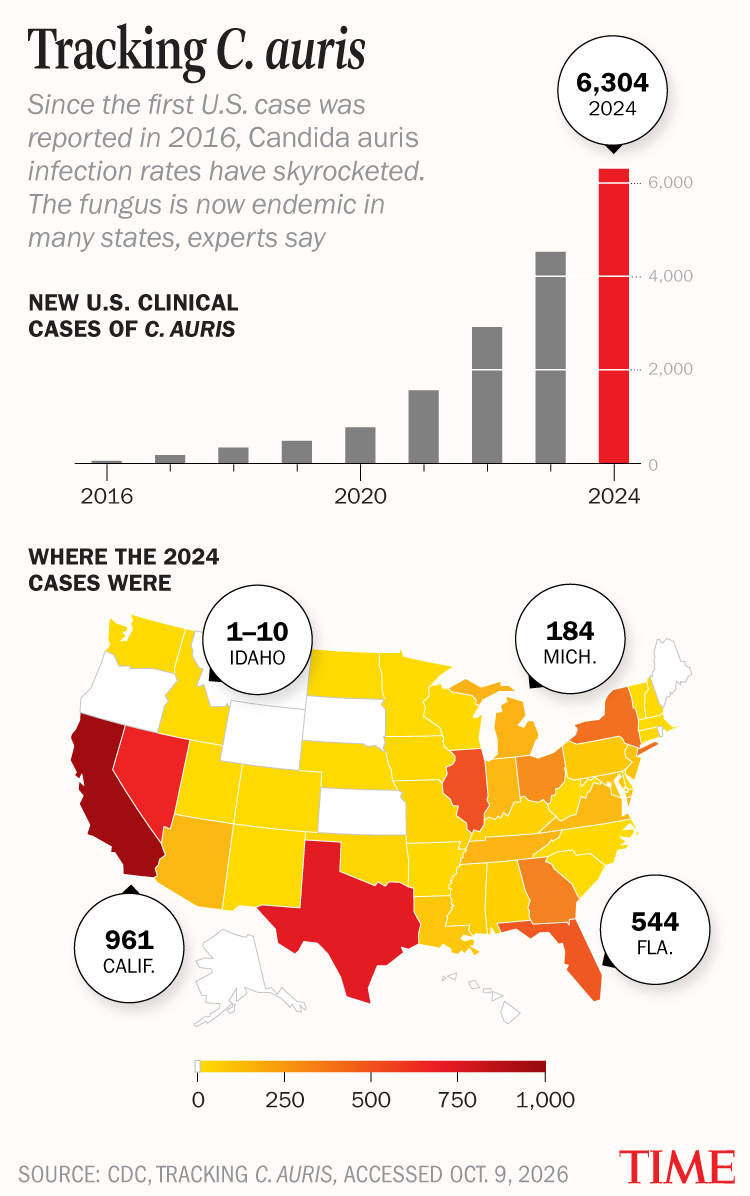
At a mycology conference in Denver in September, Candida auris was the primary focus. Cases have increased globally. Tens of thousands are affected in over 80 countries. The WHO deems it a top-priority threat. In the U.S. alone, thousands of cases occur annually, with high mortality rates. Rising temperatures and the overuse of antifungals have allowed fungal pathogens like Candida auris to evolve, adapt, and resist treatment.
Understanding Pathogen Evolution
Fungi, organisms extensively present around us, contain about 6 million species, though only 300 can cause diseases in humans. Human body temperature limits fungal growth, but warming global temperatures help fungi adapt. Candida auris evolved possibly from marine ecosystems and shows heat tolerance, surviving at 107°F. Rising global temperatures may accelerate the evolution of other fungal threats.
Fungal pathogens now affect mammals, plants, and marine life due to changing environments. Species like molds that stuck to plants have started infecting humans. A newly noted mold in South America disfigures cats and people. These environmental adaptations are cause for concern.
Climate Change and Fungal Adaptations
Climate change inadvertently nurtures these pathogens, pushing them to evolve. Researchers have observed fungi adapting to temperature changes through experiments in controlled environments.
In the U.S., for instance, rising temperatures have allowed fungi like Histoplasma to spread beyond their traditional regions. Rainfall shifts have expanded the reach of the Valley fever fungus beyond the American Southwest into cooler and wetter climates.
Impact on Human Health
The emergence of dangerous fungal strains is creating a healthcare challenge. Many people rely on immunosuppressive drugs for treatment of autoimmune diseases. These people, alongside those with medical devices, are more susceptible to severe infections. This results in a rising population vulnerable to fungal diseases.
For instance, Ryan Zwick, a 22-year-old nursing graduate, contracted COVID-19, which led to significant health deterioration. While hospitalized, he acquired a severe Candida auris infection, which became chronic.
As the fungi evolve, they affect not only the elderly or those with compromised immunity but also younger, healthier individuals. Dr. Luis Ostrosky-Zeichner from UTHealth Houston highlights that Candida auris has expanded beyond typical patient profiles.
The Drive for Solutions
To counteract rising threats, specialists like Dr. Andrej Spec and Dr. Arturo Casadevall study fungal evolution. They investigate how environmental changes amplify fungal pathogenicity, leading to previously unseen infections like those detailed by Dr. Spec in new mold infections.
In regions like Brazil, unknown fungal strains cause disease in cats and humans. Sporothrix brasiliensis, a species that emerged and started infecting cats, dogs, and humans, poses new health dilemmas.
Medical advancements made crucial strides in awareness, surveillance, and treatments. However, experts express concern about the need for expanded research and public health initiatives to stay ahead of these evolving pathogens.
Dr. Tom Chiller, instrumental in promoting fungal disease awareness, has consistently advocated for proactive measures and innovative tests to combat infections. His efforts have highlighted the urgent need to recognize fungi as a public health priority.