
A robotic arm meticulously drills a precise circle into a patient’s skull before fitting a quarter-sized device onto the brain. This device, dangling 64 minuscule wires thinner than human hair, picks up electrical signals from brain neurons. These signals are transmitted to a mobile device, allowing the patient to text, post on social media, and play video games using thought alone. This is the vision of Neuralink, a brain-computer interface (BCI) company founded by Elon Musk.
Neuralink has already brought this science fiction concept into reality for 26 test subjects, all living with severe disabilities. Musk launched the company in 2016, aiming for much broader usage. In 2017, he stated that humans might need these brain connections to keep pace with artificial intelligence, avoiding obsolescence. By 2025, Neuralink had grown to be valued at around $9.7 billion.
No brain implants have hit the U.S. market yet, but the first approval will be a significant milestone. It could ignite a long process of integrating our minds with machines. BCIs might eventually play critical roles in daily life, fostering new industries and requiring fresh norms for their application. Companies leading the charge look to tap into a massive market, harvesting both device sales and the immense data they collect. For society, the crucial question is the potential consequences of granting corporate entities access to our private thoughts.
Professor Nita Farahany of Duke University, author of a defense of thought freedom in the BCI age, cautions about the erosion of mental privacy. Scientists, doctors, governments, and companies might soon see into our minds at will, she warns. This unprecedented transparency could allow companies to anticipate desires before we do.
Competing for Market Entry
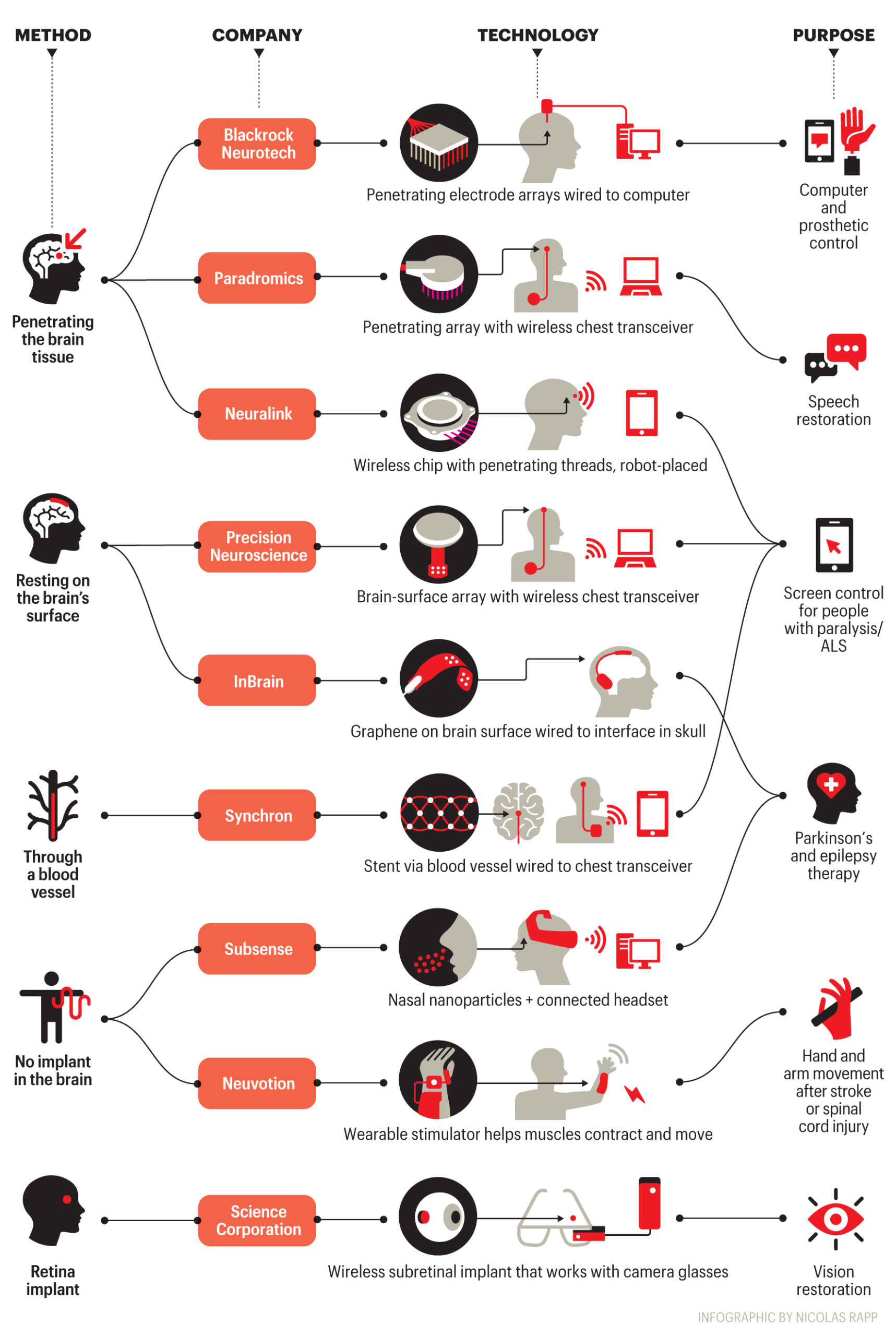
Neuralink is one among many U.S. companies striving to bring BCIs to market. Other contenders include Paradromics, focused on speech restoration, and Precision Neuroscience, targeting brain interfaces for paralyzed patients. According to Chad Bouton, CEO of BCI company Neuvotion, FDA clearance could arrive within a few years.
Neuralink, with $1.3 billion in funding, appears poised for success; however, it’s locked in competition with Synchron. Unlike Neuralink’s invasive approach, Synchron’s device, which avoids traditional skull drilling, could come to market first. Synchron CEO Thomas Oxley revealed his company has expanded its user base to 15 recipients of its Stentrode device, far surpassing previous numbers. This device is gaining traction as the company vies for domination.
Potential and Ethical Challenges
With the rise of AI, brain implants could become more potent, translating thoughts and intentions with unprecedented accuracy. Paradromics CEO Matt Angle envisions BCIs enabling control over robots or AI agents by thought alone, predicating desires before they arise.
For workplaces, BCIs might revolutionize productivity measurements. Connecting these interfaces to workstations could boost efficiency by monitoring concentration and offering subtle reminders to refocus. Nonetheless, the ethics of such surveillance raise concerns, such as potential invasion of workers’ private mental space.
Your thoughts and feelings are your last space of true privacy.
The existence of external cognitive aids, like smartphones and social media, already suggests a trend toward ‘cyborgization.’ This premise is supported by Sam Altman, who founded the BCI company Merge Labs. The firm aims to create a seamless relationship between humans and AI, facilitated by BCIs.
Road to Approval and Global Competition
The journey to FDA approval for BCI companies is complex, beginning with animal testing, human trials, and up to pivotal studies. These studies involve scaling patient numbers and perfecting manufacturing processes before final approvals.
Globally, China has been active, already approving its first commercial BCI. Such rapid advancements can present security risks similar to existing tech supply chain concerns with China, posing a question of data privacy for U.S. consumers.
Unesco’s recent recommendation emphasizes the ethical responsibility to develop BCIs primarily for medical uses, advocating for global standards. Conversations about neurotechnology ethics are advancing, with efforts like the neurotechnology trust index being developed to ensure ethical adherence.
Although today’s BCI capabilities may appear basic in the future, their potential impact remains significant. As research progresses, these technologies could fundamentally transform human interaction with technology and redefine privacy and autonomy.