
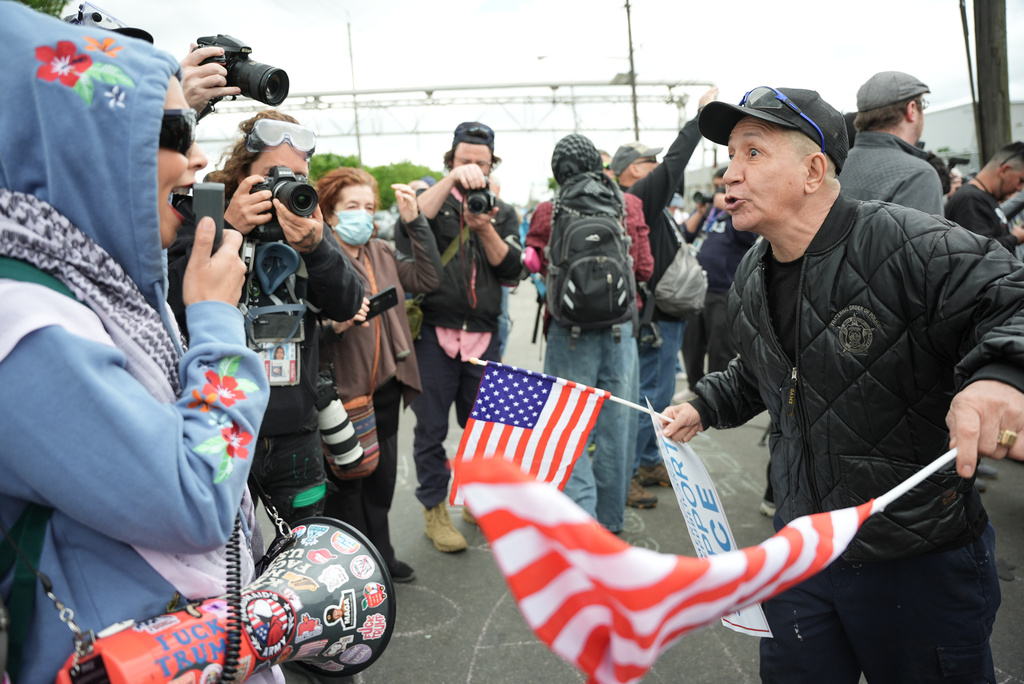
On May 30, 2026, Newark, New Jersey witnessed a clash between protesters supporting Immigration and Customs Enforcement and counter-protesters outside the Delaney Hall detention center. This incident highlights the increasing generational decline in trust across the United States, as identified by researchers at the Marquette Law School Poll.
Typically, Americans born before 1960 maintain a basic level of trust in their neighbors. They are considered the most trusting demographic. However, with each new generation, this trust diminishes. Individuals born in the 2000s exhibit the highest levels of distrust ever observed in this research. Many young adults today operate under the belief that others pose a threat.
Expanding on this, a survey conducted by Pew Research Center across 25 countries shows that Americans not only distrust one another, but increasingly view their fellow citizens as morally bankrupt. More than half of U.S. adults, 53%, believe that the average American lacks good morals and ethics.
“A society cannot thrive when most people no longer believe their fellow citizens are fundamentally decent.”
Trust in morality forms a vital part of the social contract. Without it, society risks turning hostile. Political and cultural divisions further complicate this, as opposing factions increasingly perceive each other as irredeemable. This eliminates opportunities for dialogue and compromise.
Over the past decade—tracing back to the pivotal moment of President Trump’s 2015 candidacy announcement—America’s dominant political emotion has shifted from anger to structural contempt. Relationship expert John Gottman has identified contempt, marked by hostility and ridicule, as a key predictor of marital failure. This understanding extends to society; America’s societal fabric displays similar signs of deterioration.
In essence, a nation functions as an interconnected network of relationships. Today, the American ‘marriage’ appears on the brink of collapse, with citizens divided by hostility and entrenched in separate ideological camps.
This escalation of division benefits several institutions. Media platforms, political fundraising, and cultural gatekeepers reap enormous financial returns from validating public contempt. Harmony does not generate profit in the current economic model. Instead, anger and division pay dividends by driving clicks, donations, and continuous enmity.
The political landscape thrives on convincing the public that the opposition aims to ruin civilization, fostering fear of communism or fascism. For the generation now entering adulthood, cooperation has never been a norm. They observe how political differences equate to existential threats, perpetuating a cycle of distrust and contempt.
The Marquette data should not be dismissed as an outlier, but rather seen as an early indicator of a potentially long-lasting trend. Entrenched distrust creates contempt, which decimates personal relationships and ensures future generations uphold the cycle of disdain. America is settling into a perpetual, lucrative state of mutual loathing.
Historically, the U.S. has often operated more as a collection of states than a united entity. Now a divided nation, it suffers not only from geographical borders, but from profound psychological divides as well.
John Mac Ghlionn, a writer and researcher, examines the impact of culture and technology on everyday life.