
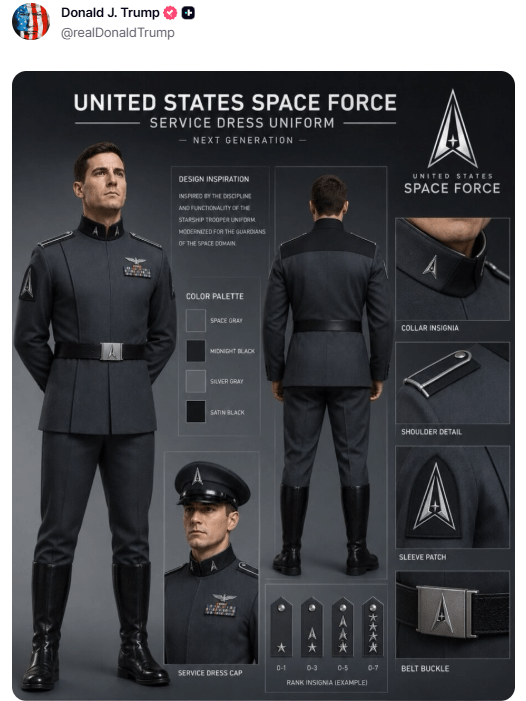
Donald Trump’s proposal for outfitting the United States Space Force sparked controversy after appearing briefly on Truth Social. The suggested design included charcoal overalls, knee-high leather boots, and belts aimed at creating a slim look. Critics compared this style to uniforms seen in movies and historical attire, triggering varied opinions on social media.
The post referred to the uniforms featured in the 1997 movie Starship Troopers, a film criticized by its director, Paul Verhoeven, for its depiction of fascism without awareness. Even if Trump had recommended a widely acclaimed fashion collaboration, reactions likely would have been skeptical. The central issue isn’t the clothing or the individual presenting it.
The real challenge lies in the cultural development of America’s youngest military branch. The Space Force faces the task of building traditions, something established branches have developed over many years.
Traditions Are Built Over Time
The U.S. Army and Navy have roots dating back to 1775, while the Air Force has an official history spanning almost 80 years. These branches have cultivated cultural identities over time, establishing recognizable icons.
The Navy’s dress uniforms, for example, evolved over the years. Earlier versions had practical elements, such as the neckerchief, and adjustments to rank markings and accessories happened gradually.
Space Force, which became an independent service in December 2019, lacks such an enduring background. It must develop names, mottos, insignia, emblems, and more to establish recognition and heritage.
Unique Challenges for Space Force
Space Force struggles to forge an identity in a digital era where opinions quickly form and spread. Its official uniforms faced criticism upon unveiling, and Trump’s personal vision was unlikely to fare better.
Creating a heritage akin to established branches is arduous. Brands using terms like ‘heritage’ avoid highlighting newly established origins, as it can seem insincere.
Aside from cultural hurdles, Space Force’s mission differs greatly from traditional military objects and vehicles. While armies wield weapons and tanks, and navies showcase warships and submarines, Space Force deals with satellites and technological devices crucial to daily life.
Promoting these less visible elements doesn’t capture public imagination like conventional military displays do. Its recruitment focuses on the technical operations protecting essential systems like GPS and communications.
According to its website: “From space to cyberspace, our reach is global and our duties protect our everyday way of life. You just don’t see them.”
The Long Road to Tradition
Uniforms and symbols unify military members, fostering a shared sense of purpose. However, tradition relies on time’s passage for legitimacy. What’s revered today might have seemed odd centuries ago.
No Space Force attire will immediately gain widespread acceptance. Donald Trump’s AI-driven design efforts and Space Force’s official uniform creation face the same barrier: absence of historical recognition.
As time progresses, these efforts may evolve into esteemed traditions. But for now, quick social media posts can easily lead to fleeting notoriety.
Contact Newsweek editors on this story: Gray R. Thomas