
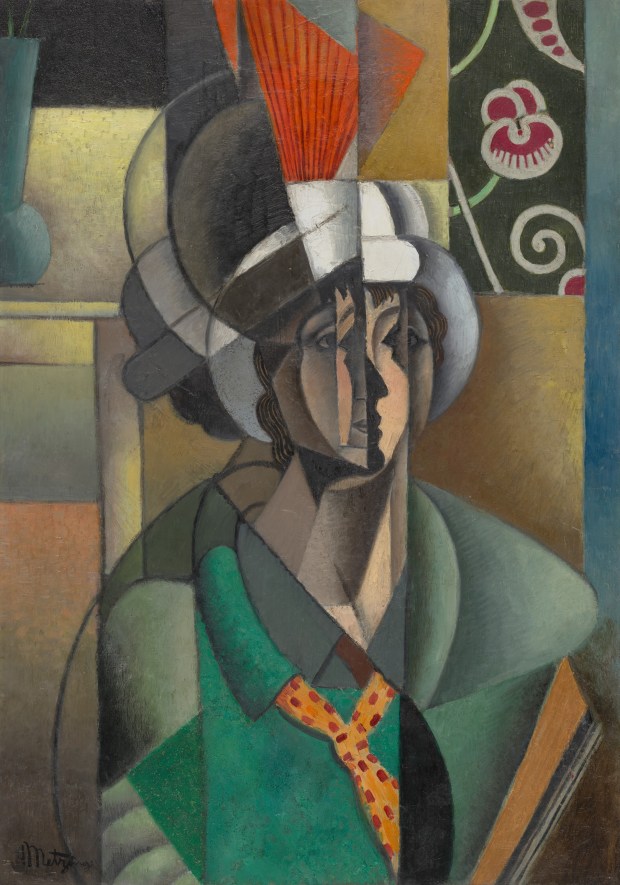
For three decades, descendants of Jewish art collectors have endeavored to recover art looted by Nazis during World War II. Recently, the Art Institute of Chicago announced the return of a 1913 painting, Woman with a Fan by Jean Metzinger, to the heirs of its original owner.
The painting belonged to the Lewenstein family, a Jewish family from Amsterdam. Jacques Schuhmacher, executive director of provenance research at the museum, stated the painting was sold in a forced sale in 1940 in Nazi-occupied Amsterdam. Research conducted in collaboration with Mondex Corp., experts in recovering looted artworks, confirmed its provenance.
Emanuel Lewenstein, a Jewish art collector, amassed a significant art collection with family wealth from a sewing machine company. His collection included works by contemporary Dutch artists and notable pieces by old masters such as Rembrandt. Upon his death in 1930, the collection passed to his children, Wilhelmine and Robert, who fled the Nazi invasion, leaving the art behind.
Provenance research involves tracing an artwork’s ownership history, which Schuhmacher notes can be challenging due to scattered records. The Art Institute’s collection includes approximately 300,000 objects, some with provenance gaps. However, these gaps do not always indicate looting.
Woman with a Fan entered the museum’s collection in 1959. The piece, by Metzinger, a noted Cubism theorist, depicted a series of basic shapes in distinct spatial planes. Changing attitudes about provenance in the 1990s spurred deeper inquiries into artworks affected by Nazi-era looting.
The museum listed the painting online, hoping to resolve its provenance gap. Mondex contacted the museum, revealing family history unknown to the Art Institute. The breakthrough came from faint pencil handwriting on the painting’s back. Infrared photography revealed the name Paul Citroen, Lewenstein’s cousin and influential figure in Emanuel’s collection.
This clue connected the painting to the Lewenstein family and an auction catalog from a forced sale in 1940. This contrasts with another disputed artwork, a 1916 drawing by Egon Schiele titled Russian War Prisoner. A New York appellate panel recently questioned the seizure of this drawing, previously owned by Fritz Grünbaum, killed in 1941. Schuhmacher noted a lack of evidence of forced sale for this drawing compared to the clear evidence for the Metzinger painting.
Currently, the Art Institute is arranging the painting’s return to the heirs. Schuhmacher, leading provenance research for two years, remarked on the rarity of dedicated departments for such specialized work in museums.