
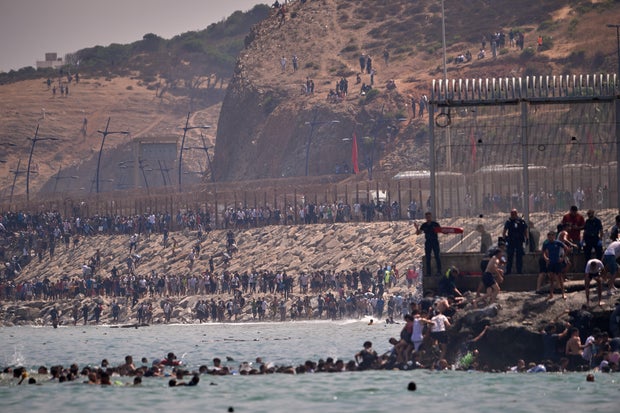
Spain has decided to send its military forces to Ceuta in response to a sudden influx of migrants crossing the border from Morocco. This move follows requests from Ceuta’s local authorities for reinforcements from the central government in Madrid. They needed help managing the escalating border crisis, which intensified with large groups breaching the border fence on Thursday.
The Spanish government announced on Thursday evening that the Armed Forces would assist the Civil Guard in maintaining security in Ceuta. Prime Minister Pedro Sánchez and Interior Minister Fernando Grande-Marlaska are set to visit Ceuta on Friday. Rachid Sbihi, who leads the association of Spain’s Civil Guard officers in Ceuta, said, “The situation is absolute chaos.” He indicated that thousands of migrants have crossed the border, causing it to “totally collapse.”
Achraf Maimouni, from the Moroccan Association for Human Rights in northern Morocco, referred to the situation as “exceptional.” Following the opening of the Tarajal border under unusual circumstances, many migrants moved into the area on Thursday, July 30, 2026. Antonio Sempere captured video footage of mainly Moroccan groups walking along Tarajal beach onto local roads. While most were young men, families with women and children were also among them.
Some expressed their emotions by shouting “Viva España!” to a freelance photographer working for the AP.
The reasons behind the migrant surge into Ceuta remain unclear. Before Thursday, migrants had been attempting to reach the exclave, primarily by swimming. Tragically, at least three migrants lost their lives on Wednesday. Although Moroccan authorities have not commented publicly on the crossings, Spain’s Interior Ministry mentioned that Morocco is collaborating closely with Spain. The Moroccan police have been preventing numerous attempted crossings.
The two countries have agreed to work on returning those who entered Ceuta illegally. Meanwhile, Spain’s government guaranteed citizen safety and national border integrity. However, the government did not declare a national emergency, a step Ceuta authorities had requested.
Ceuta’s migrant spike has been associated with a Spanish Supreme Court ruling. The decision states that migrants who arrive by sea should not be immediately forced back without due process. This stands in contrast to those who cross by land, by climbing the border fence, for instance. However, some Moroccan activists believe that most migrants may not know about such legal rulings.
Ceuta, part of northern Africa, often sees migrants attempting to enter Spanish territory, either by swimming from the Moroccan town of Fnideq or the closer town of Belyounech. These scenes are reminiscent of a 2021 border crisis when over 8,000 migrants entered Ceuta within two days. During that time, Morocco faced accusations of loosening border controls, allegedly in response to Spain allowing Polisario Front leader Brahim Ghali to receive medical care. This resulted in diplomatic tensions between Rabat and Madrid.
Juan Jesús Vivas, Ceuta’s regional government head, called for an emergency declaration over national security concerns. He requested more police and military deployment to secure the border and ensure community safety. Vivas highlighted that migrant reception centers were overcrowded, with many still sleeping outside following the entry of over 1,500 migrants during the past week. Thousands more continued to cross into Ceuta by Thursday.
Spain’s Interior Ministry, responsible for monitoring irregular migration, has not confirmed the exact number of migrants reaching Ceuta over recent days. They plan to release a migration report on August 3. As of July 15, the ministry reported that nearly 3,000 migrants had entered Ceuta this year by land or sea.
Spanish legislation does not categorize migration flows as a national security threat. However, governmental bodies are coordinating to address the situation in Ceuta efficiently and promptly. Historically, Ceuta has been under Spanish control since 1580, housing a diverse population of Christians and Muslims, Spanish and Moroccan residents, within its borders.