
National Emergency in Spain
Spain’s government has declared a national emergency due to severe wildfires that have forced the evacuation of approximately 10,000 people from the central Madrid region. This decision places the Interior Ministry in charge of the firefighting efforts across the country. Various regions are struggling to control multiple fires, exacerbated by an ongoing heatwave.
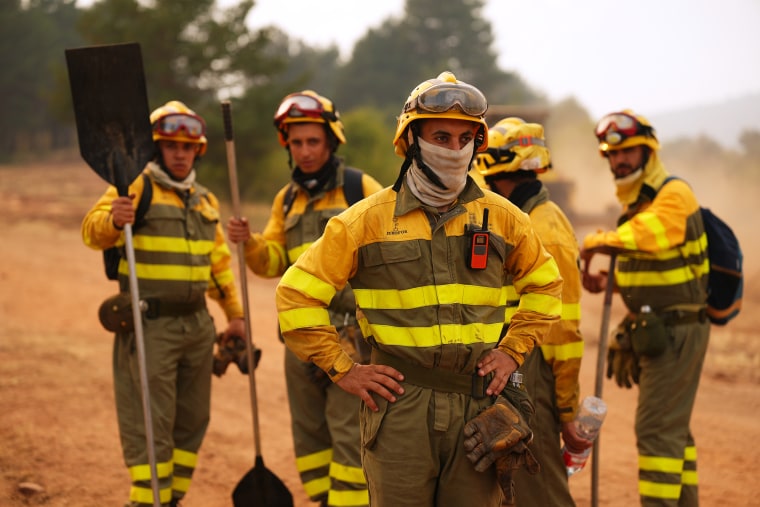
The Madrid regional government reported that 10,000 residents were evacuated as fires spread across several villages. This year, Spain has witnessed roughly 500 square miles of land incinerated, more than quadruple the area burned in the first half of 2025. Forest rangers are taking necessary breaks and then resuming their efforts to manage the fires, such as those near Condemios de Arriba.
A significant fire in Guadalajara, north of Madrid, has become Spain’s second-largest, destroying around 120 square miles in recent days. Earlier in the month, another tragic fire in southern Spain claimed thirteen lives, marking it as the deadliest incident in Spain’s recent history.
Call for Political Consensus on Climate Change
On Wednesday, Spanish Prime Minister Pedro Sánchez emphasized the need for a political agreement to address climate change. He highlighted the importance of adapting policies to address the increasing frequency of fires in the changing climate.
Temperatures in parts of southeastern Spain are predicted to surpass 39 degrees Celsius (102 Fahrenheit), with some areas experiencing highs of 44 C (111 F).
Mass Evacuations in France
Meanwhile, in southwestern France, authorities mandated further evacuations along the Atlantic coast due to extensive wildfires. Some 40,000 people have been displaced over the last two days in the area.
Since Wednesday, over 34 square miles have been scorched near the Cap Ferret peninsula, a popular tourist destination, with some residents evacuating by boat. France has sought assistance from the European Union’s Civil Protection Mechanism.
‘We will soon be able to rely on reinforcements including two Croatian Canadair firefighting aircraft, two Portuguese Air Tractor aircraft, and two heavy-lift Black Hawk helicopters from the Czech Republic and Slovakia,’ announced French President Emmanuel Macron.
Wider Context and Scientific Insights
This summer, southern Europe has experienced multiple large-scale fires. Europe, identified as the world’s fastest-warming continent based on the European Union’s Copernicus Climate Change Service, has shown temperatures rising at twice the global average since the 1980s.
Globally, the year 2025 was recorded as the third-hottest year, bringing severe heatwaves across Europe. Scientists emphasize that climate change is intensifying heat and dryness, particularly in southeastern Europe, heightening the risk of health impacts and wildfires.