
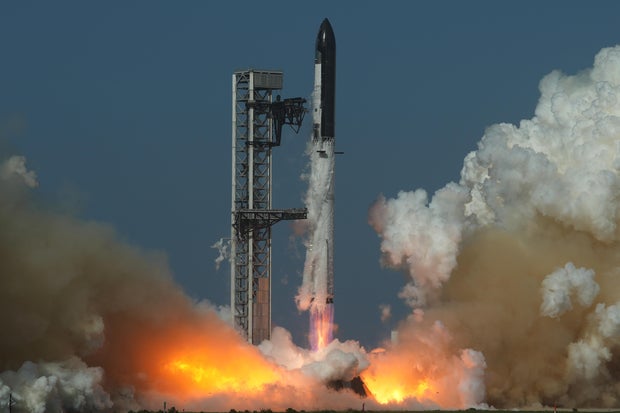
SpaceX launched its thirteenth Super Heavy-Starship rocket, achieving notable milestones despite a challenging journey. The launch took place at SpaceX’s Starbase, Texas, at 5:51 p.m. EDT. The rocket’s enormous booster reached a precise splashdown off the Texas Gulf Coast, albeit at a higher speed than anticipated.
The Super Heavy-Starship, standing at 397 feet, utilized 33 methane-fueled Raptor engines to produce 16 million pounds of thrust. This powerful launch drew attention from local residents and tourists, offering a stunning display.
Earlier attempts on July 16 were aborted due to technical issues. SpaceX addressed these, paving the way for a successful launch, albeit with a 24-hour delay due to clouds. However, clear conditions on the day of launch enabled all engines to function properly, allowing the rocket to ascend smoothly.
The July flight marked the second test of the third-generation Super Heavy-Starship. The booster performed well during ascent and aimed for a splashdown after separating from the upper stage. Despite fewer engines restarting than expected, the booster completed its descent into the Gulf as a safety measure.
Meanwhile, the Starship upper stage powered successfully to space. It deployed 20 third-generation Starlink satellites, with some equipped with cameras for heat shield inspection. The successful re-ignition of a Raptor engine demonstrated its capability for future moon missions before the Starship splashed down near Australia.
NASA views these tests as promising developments. They rely on SpaceX for landers in the Artemis program, requiring reliable vehicle certification for human spaceflight. For lunar missions, plans include launching multiple tankers to refuel the lander in space before it embarks on moon exploration. The crewed lunar landing target is set for 2028.
Challenges persist, including the refinement of Raptor engines and timely completion of crucial mission elements. The Government Accountability Office (GAO) highlighted risks like cryogenic fuel management. SpaceX’s schedule has slipped over a year behind, delaying key developments.
Nasa seeks alternative options, considering Blue Origin as a potential candidate for lunar lander missions. Blue Origin’s New Glenn rocket faced setbacks during engine tests, impacting their launch timeline. NASA plans for an interim Artemis mission in low-Earth orbit, involving both spacecraft for testing purposes.