
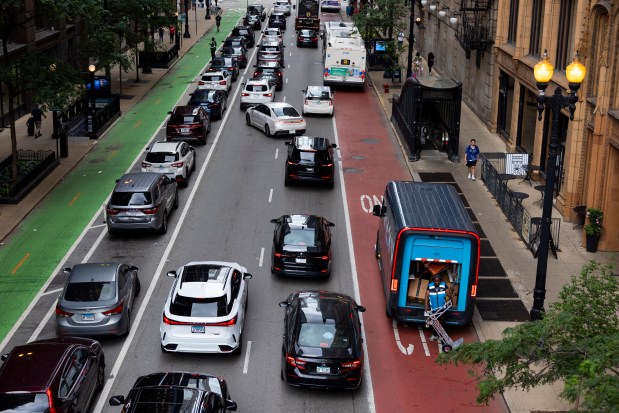
A program aimed at enhancing the safety of downtown Chicago streets for cyclists and pedestrians has revealed that package delivery companies are frequent violators. The ‘Smart Streets’ initiative issues warnings and fines to those obstructing bike and bus lanes. City vehicles and Chicago Transit Authority buses, equipped with cameras, capture these violations with tickets issued by the Department of Finance.
Since its inception a year and a half ago, the program has recorded tens of thousands of warnings and citations and levied nearly $2.6 million in fines. Amazon Logistics, FedEx, and UPS have been charged a combined amount of $460,000 for lane violations during this period.
Independent contractors using personal vehicles, as well as firms hired for final deliveries, also contribute to the congestion. For instance, companies like Trans One Inc. and Northwest Express Inc. received fines totaling $78,000.
The program strives to reduce collisions, fatalities, and improve bus efficiency by preventing lane blockages from parked vehicles.
Smart Streets launched in late 2024 and is scheduled for expansion, with bike lane citations increasing to $250 following a tragic incident involving a blocked lane leading to a cyclist’s death. The project also covers occasional parking violations outside of lane obstructions.
Amazon linked its fines to third-party contractors who lease its vehicles. Amazon operations involve over 10 local companies, employing more than a thousand drivers in the Chicago area.
FedEx maintains a priority on safety while UPS acknowledges parking difficulties yet emphasizes training for lawful parking. Enterprise Mobility addresses its citations by either passing them to the driver or recovering costs from them.
Fines and fees aim to deter unsafe parking behavior and enhance public safety by reducing the accident rate in bike lanes.
Before Smart Streets, recidivism for lane violations stood at 15.6%. Recent data shows this rate dropped to 7.6%. The city issued roughly 60,000 zero-fine warnings, including expired meter notices, street sweeping, and loading zone violations alongside the main infractions.
Moreover, an escalating fine system and potential court appearances exist for significant unpaid balances. Businesses must clear fines to secure necessary permits.
Cameras currently cover several bus routes and lanes across Chicago. The program will expand further with additional cameras funded by transit revenue.
Feedback from CTA highlights improved bus speeds and safety as vital outcomes of the initiative. Blockages particularly impact ramp deployment for passengers with disabilities, underlining essential safety considerations.
Christina Whitehouse of Bike Lane Uprising noted the hazards posed to cyclists when lanes are blocked, sometimes near memorials for killed cyclists.