
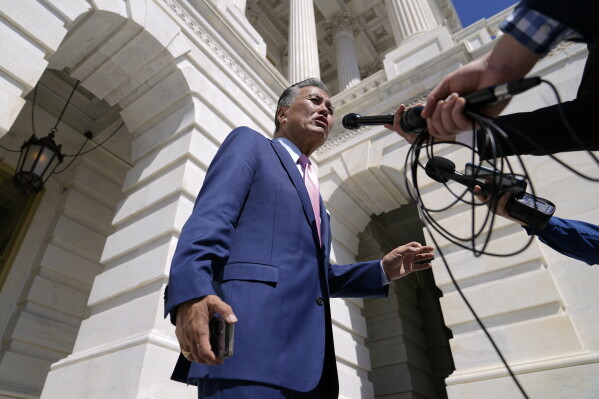
WASHINGTON (AP) — On a recent Fourth of July visit to Southern California, Congressman Mark Takano encountered disturbing stories of immigration patrols sweeping through communities. One resident disclosed a decision to carry a passport as proof of legal residence in the United States. Takano, whose parents experienced forced relocation during the internment of Japanese Americans in World War II, finds unsettling similarities between past actions and current events.
Takano commented on the parallels, recalling his own family’s history. His father and mother were labeled as enemy aliens and deemed threats to national security, leading to their internment. The congressman sees echoes of those arguments in the current administration’s stance on immigration, where immigrants are portrayed as grave dangers necessitating strict measures.
During an interview with The Associated Press, Takano asserted, “I do feel like there’s a similarity of circumstance.” He highlighted the historical context of his father’s internment as a two-year-old and his mother’s experience at just one year old.
President Donald Trump’s initiative for the largest mass deportation in U.S. history is unfolding, affecting thousands. Public protests have occurred, notably after the deaths of Renee Good and Alex Pretti, U.S. citizens outraged by the immigration actions in Minneapolis.
In response to criticism, the White House revised its approach, appointing Markwayne Mullin as the new Secretary of the Department of Homeland Security. He vowed to reduce the department’s media visibility. Nevertheless, Trump faces pressure from conservative factions to pursue the deportation of 1 million people annually. Congressional Republicans have supported these efforts with billions in funding.
Takano, who serves as the ranking Democrat on the House Veterans’ Affairs Committee, draws from his family’s experience and the country’s eventual apology to Japanese Americans to challenge Trump’s policies. Reflecting on the era of internment, he stated, “We look back on that era … as a shameful one.” He emphasizes political leaders’ failure to uphold the Constitution and protect American citizens.
Family History: A Personal Narrative
Before his congressional career, Takano worked as a high school history teacher in Southern California. His family stories shape his views on immigration enforcement.
His grandfather, Isao Takano, emigrated from Hiroshima and married Kazue Takahashi, a U.S.-born citizen. They settled in Bellevue, Washington, establishing a business cultivating produce for Seattle markets. Following the attack on Pearl Harbor and subsequent U.S. entry into World War II, their family was among 120,000 individuals of Japanese ancestry forcibly relocated.
Takano’s father, William, was two years old when they were sent to the Tule Lake incarceration camp in California. His mother, Nancy, was a year old upon relocation to Heart Mountain in Wyoming.
Takano shared a photo depicting his grandparents, aunt, uncle, and father, underscoring the generational impact of internment.
“Will Americans generations from now visit detention facilities and ponder how the government could conduct such operations?” Takano asked during a House speech, referencing Trump-era detainment sites in Florida. He urged Congress to reflect on actions taken to intervene.
Redress and Historical Precedent
Recalling his father’s visits to their former land and stories of great uncles serving in the Army’s 442nd Regimental Combat Team, Takano recounts contributions to a national redress campaign. In 1988, Congress enacted the Civil Liberties Act, apologizing and offering $20,000 to each detained individual. President Ronald Reagan endorsed the legislation.
Takano’s parents received both a federal apology and compensation, acknowledging their suffering.
Current congressional discussions explore potential reparations for those affected by Trump’s immigration policies. Reflecting on these efforts, Takano remarked, “Remarkably the country did come to realize the mistake … we can come out of this moment stronger.”