
A recent comprehensive study has reexamined the widespread notion that ‘All roads lead to Rome,’ offering fresh insights into the Roman Empire’s road network. Published in the journal Nature Communications, the research analyzed 190,000 miles of Roman roads across Europe, the Middle East, and North Africa.
The saying ‘All roads lead to Rome’ may not accurately depict the historical reality.
Tom Brughmans, a classical archaeologist from Aarhus University, Denmark, spearheaded the research. His team discovered that provincial capitals, rather than Rome alone, were significant hubs in the empire’s road network. Constantinople, now Istanbul, Turkey, gained prominence as a central hub after Emperor Constantine designated it the imperial capital in the fourth century A.D.
Constantinople’s strategic position between Europe and Asia enhanced its centrality for travel across the empire. The traditional phrase, coined after the fall of the Roman Empire, might not fully capture the complexities of the road network.
Brughmans conveyed to Fox News Digital that the proverb should not be interpreted literally. Many roads outside Roman Britain did not lead to Rome directly. ‘Rome is the center of the empire. This is where power lies,’ Brughmans remarked, highlighting the study’s nuanced take on the ancient maxim.
Taco Terpstra, a professor at Northwestern University, noted the findings affirm but do not undermine Rome’s significance as the empire’s center. Before Constantinople’s rise, it was merely Byzantium, a modest town. Once elevated to imperial capital status, Constantinople became key to overland connectivity.
Despite new transportation hubs like Constantinople, Rome continued to be a political and military powerhouse. Alexandria, another major city, had roughly half of Rome’s population, underscoring Rome’s predominant role.
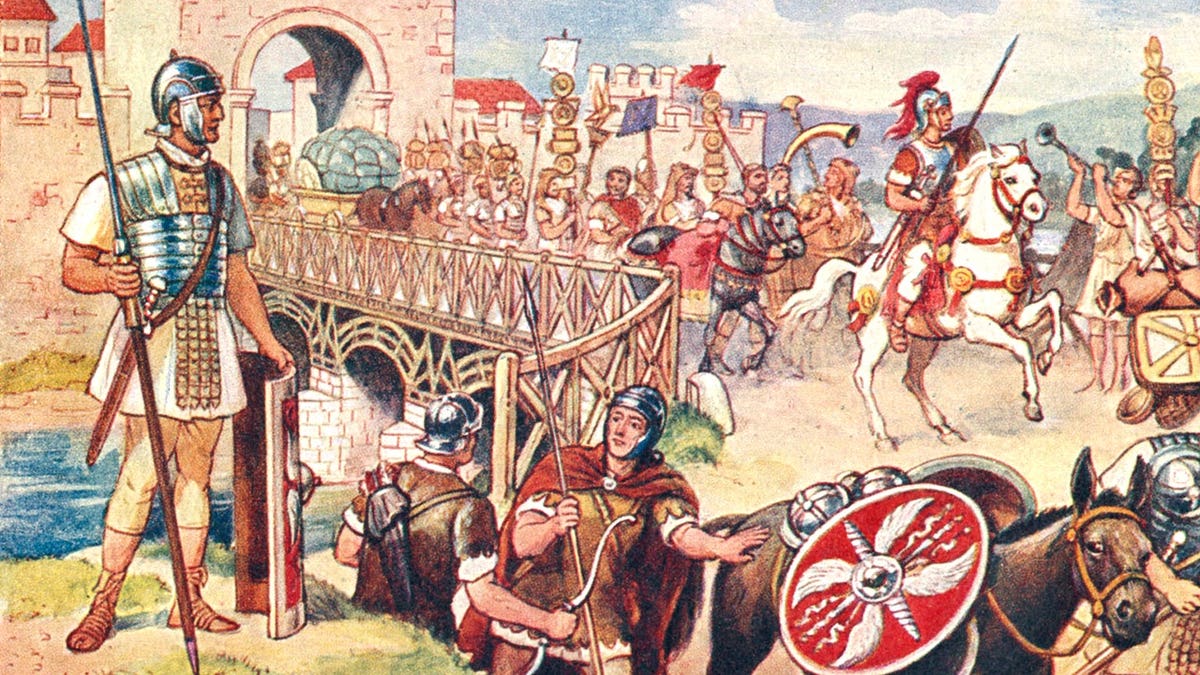
The research also explored the engineering prowess behind Roman roads. Though the roads were notably straight, challenging terrains occasionally necessitated deviation. Initially constructed for military purposes, these roads enabled rapid troop movement post-conquest and eventually served economic functions as well.
Additionally, Terpstra highlighted maritime transportation as the Roman Empire’s primary network, facilitating cheaper goods movement compared to terrestrial routes.